
• About Us
  • Submit Project
  • Advertise
  • NewsLetter
PA
Subscribe
  • Articles
    • Archipreneurs
    • Technology
    • Bim / Aec
    • 3D Printing
    • Architects
    • Artificial Intelligence
    • Robotics
    • Sustainability
    • Tools
    • Case Study
    • City Guide
    • Opinions
    • Interviews
    • Architecture & Design
      • Urbanism
      • Metaverse
      • Space Architecture
      • Geography
  • Projects
    • Architecture
    • Interior
    • Design
      • Fashion
      • Pavilion
      • Installation
      • Digital Art
      • Landscape Design
    • Products
  • News
  • Workshops
  • PA Talks
  • Videos
  • Books
  • More
    • PA+ Membership
    • Courses
    • Competitions
    • Events
    • Jobs
    • About Us
    • Contact Us
Font ResizerAa
PAPA
Search
  • Articles
    • Archipreneurs
    • Technology
    • Bim / Aec
    • 3D Printing
    • Architects
    • Artificial Intelligence
    • Robotics
    • Sustainability
    • Tools
    • Case Study
    • City Guide
    • Opinions
    • Interviews
    • Architecture & Design
  • Projects
    • Architecture
    • Interior
    • Design
    • Products
  • News
  • Workshops
  • PA Talks
  • Videos
  • Books
  • More
    • PA+ Membership
    • Courses
    • Competitions
    • Events
    • Jobs
    • About Us
    • Contact Us
Follow US
PA > Blog > Articles > Contemporary Malaysian Architecture is a Fusion of Hybrid Urbanism, Megastructures, and Climate-Responsive Design
Articles

Contemporary Malaysian Architecture is a Fusion of Hybrid Urbanism, Megastructures, and Climate-Responsive Design

Last updated: April 17, 2026 12:12 pm
Pooja Khanna Tyagi
Pooja Khanna Tyagi
ByPooja Khanna Tyagi
Pooja Khanna Tyagi is an India-based architect and design writer. Her work engages with architecture, interiors, materials, and evolving lifestyle narratives, with a focus on translating...
Share
Malaysian Architecture is a Fusion of Hybrid Urbanism, Megastructures, and Climate-Responsive Design
 Jesselton Docklands © Snøhetta
Malaysia tower
Malaysian Architecture is a Fusion of Hybrid Urbanism, Megastructures, and Climate-Responsive Design
List of Images 1/11
Malaysian Architecture is a Fusion of Hybrid Urbanism, Megastructures, and Climate-Responsive Design
Malaysia tower
Malaysian Architecture is a Fusion of Hybrid Urbanism, Megastructures, and Climate-Responsive Design
SHARE

Malaysia’s evolving architectural landscape explores coastal regeneration, vertical cities, and material innovation, where Malaysian architecture blends ecology, identity, and technology. Malaysia’s contemporary architecture is shaped by the overlap of city and coastline, tradition and technology, monument and infrastructure, all existing in a continuous state of negotiation.

Contents
  • Malaysian Architecture is Reclaiming the Waterfront as Civic Infrastructure
  • Megastructure as Identity and Urban System
  • Climate-Driven Sacred Architecture

Therefore, what emerges is not a fixed style but a design culture built on hybridity, where meaning is generated through connection. Across different building types and scales, a clear architectural tendency emerges: Malaysia is using design to reconnect fragmented urban, cultural, and environmental systems into unified spatial narratives.

Malaysian Architecture is Reclaiming the Waterfront as Civic Infrastructure

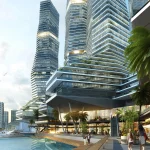
Snøhetta’s Jesselton Docklands masterplan repositions Kota Kinabalu’s waterfront as a living urban edge. Instead of treating the sea as a boundary, the project transforms it into an active civic surface where mobility, leisure, commerce, and ecology intersect.

The masterplan by Snøhetta is driven by the idea of porous connectivity, where public spaces flow toward the water, transport systems are integrated with pedestrian networks, and cultural programs are embedded within the shoreline experience. The port is not limited to trade but becomes a threshold of arrival and interaction.

 Jesselton Docklands © Snøhetta

This reflects a wider Malaysian tendency in coastal cities: the waterfront is being reactivated as public infrastructure, not just redeveloped as real estate. Architecture here becomes a mediator between land and maritime systems, dissolving the traditional separation between city life and natural edge conditions.

Megastructure as Identity and Urban System

In Kuala Lumpur, Merdeka 118 rises as an architectural object and national statement, as the skyscraper is a layered urban system that integrates transit, commercial space, and the public realm into a single vertical framework.

Malaysia tower

Merdeka 118 © Ahmad Ali Karim 

Its faceted form is often read as symbolic, evoking cultural patterns and gestures of independence—but its deeper significance lies in its integration of infrastructure and narrative. The tower is embedded within a larger precinct strategy, where movement, occupation, and visibility are carefully orchestrated across multiple levels.

This signals an important shift in Malaysian high-rise development: the skyscraper is no longer an isolated icon, becoming a vertical extension of the city itself, organizing urban life while simultaneously projecting identity. Architecture here operates at two speeds, and that is global ambition in form and local specificity in meaning.

Climate-Driven Sacred Architecture

The Masjid Tuanku Mizan Zainal Abidin, often referred to as the “Iron Mosque,” represents a different but equally important direction in Malaysian architecture, where spirituality and environmental performance converge.

Malaysian Architecture is a Fusion of Hybrid Urbanism, Megastructures, and Climate-Responsive Design
Masjid Tuanku Mizan Zainal Abidin © Mosqpedia

Wrapped in a stainless steel mesh skin, the mosque functions as a climatic filter that moderates sunlight, supports natural ventilation, and creates a soft, diffused interior atmosphere. It does not rely on heavy ornamentation; instead, the building achieves spatial depth through light, air, and material transparency.

What makes this project significant is its shift in sacred architecture from symbolic enclosure to environmental responsiveness. The mosque becomes a performative envelope, where material and climate work together to shape the spiritual experience.

Malaysian Architecture is a Fusion of Hybrid Urbanism, Megastructures, and Climate-Responsive Design
© Mosqpedia

This reflects a broader design intelligence emerging in Malaysian architecture, where even religious buildings are increasingly shaped by sustainability, passive systems, and sensory refinement instead of purely formal expression.

Malaysian Architecture is a Fusion of Hybrid Urbanism, Megastructures, and Climate-Responsive Design
© Mosqpedia

Across these Malaysian contexts, a clear architectural direction emerges, and that is integration over isolation. The underlying trend is not stylistic unity but systemic thinking. In this condition, buildings become nodes in a larger cultural and environmental network, shaping a future where architecture is defined by relationships and not just boundaries. This evolving approach signals a shift toward more adaptive, resilient, and experience-driven environments where design responds to ecological pressures and cultural continuity, redefining how cities grow and connect.

TAGGED:contemporary architectureMalaysia architectureMosqueSkyscraper
Share This Article
Email Copy Link Print
ByPooja Khanna Tyagi
Pooja Khanna Tyagi is an India-based architect and design writer. Her work engages with architecture, interiors, materials, and evolving lifestyle narratives, with a focus on translating complex ideas into clear, accessible content. With a minimalist sensibility, she uses writing to simplify design ideas. A graduate of Dr. B.N. College of Architecture, Pune (2000), India, she has been active in the writing domain since 2016. She has contributed to leading publications in India and internationally, bringing together professional insight and a measured, articulate voice.
Previous Article Nashville Unveils a New Global-Standard Tennessee Performing Arts Center Nashville Unveils a New Global-Standard Tennessee Performing Arts Center
Next Article Yibin High-Speed Railway Station Gateway Development Yibin Transforms Its Rail Hub into a 9-Million-Square-Foot Urban Destination

More Stories

Construction Projects

Beyond the Architect: Rethinking Power and Hierarchy in Contemporary Construction Projects

By
Mahshid Motamed
How AI Is Transforming Outdoor Living Spaces Beyond The House

How AI Is Transforming Outdoor Living Spaces Beyond The House

By
PA Editorial Team
2026 FIFA World Cup Stadiums

5 Infrastructure Lessons from FIFA World Cup 2026: What Future Host Cities Must Learn

By
Pooja Khanna Tyagi
Miami Bay Towers

Miami Bay Towers Brings Four Sculptural Forms to Biscayne Bay

By
Isha Chaudhary
Origami architecture

Top 10 Buildings Shaped by the Art of Origami Folding in Architecture

By
Arpitha S
Sarnath

Sarnath Becomes India’s 45th UNESCO World Heritage Site

By
Isha Chaudhary
Korean Football Park

UNStudio Completes Korean Football Park in Cheonan

By
Isha Chaudhary
Iranian Architecture

A Legacy Built in Brick and Geometry: Arches in Iranian Architecture

By
Mahshid Motamed
Tianmeng Tower

Woods Bagot Shapes the IGG Tianmeng Tower Around Fuzhou’s Iconic Banyan Tree

By
Isha Chaudhary

Motion in the Shell by Melike Altinisik Architects

By
Hamid Hassanzadeh
Previous Next

Subscribe Newsletter

- Upcoming Workshop-
Ad image

You Might Also Like

10 Beautiful Off-Grid Homes Designed for Modern Life
Architecture & Design

10 Beautiful Off-Grid Homes Designed for Modern Life

July 16, 2026
Smart Materials; Sustainable Construction
Sustainability

15 Smart Materials Changing Sustainable Construction – Part 1

December 9, 2025
Inside 8 Iconic Works by Santiago Calatrava
Architecture & Design

Inside 8 Iconic Works by Santiago Calatrava

March 31, 2026
BIM / AEC

How BIM Models Transform into 3D Printed Buildings (Digital DNA)

February 24, 2025
PA

© All rights reserved. Parametric Architecture (2018-2026) - ISSN 3023-7564

Facebook Twitter Youtube Rss Medium

Get to Know Us

  • Architecture
  • Design
  • Digital Art
  • Fashion
  • Installation
  • Pavilion
  • Interior
  • Products

© 2026 ParametricArchitecture. All Rights Reserved. By utilizing this website, you are consenting to our User Agreement, Privacy Policy, and Cookie Statement. In compliance with the privacy laws of Turkey and the United States, we recognize and respect your rights. Please be aware that we may receive commissions for products bought through our affiliate links. Unauthorized reproduction, distribution, or transmission of any material from this site is strictly forbidden without prior written permission from ParametricArchitecture.

Join Us!
Subscribe to our newsletter and never miss our latest news, podcasts etc..
Please check admin setting to display form corretly.
Zero spam, Unsubscribe at any capitalpost.
Welcome Back!

Sign in to your account

Username or Email Address
Password

Lost your password?