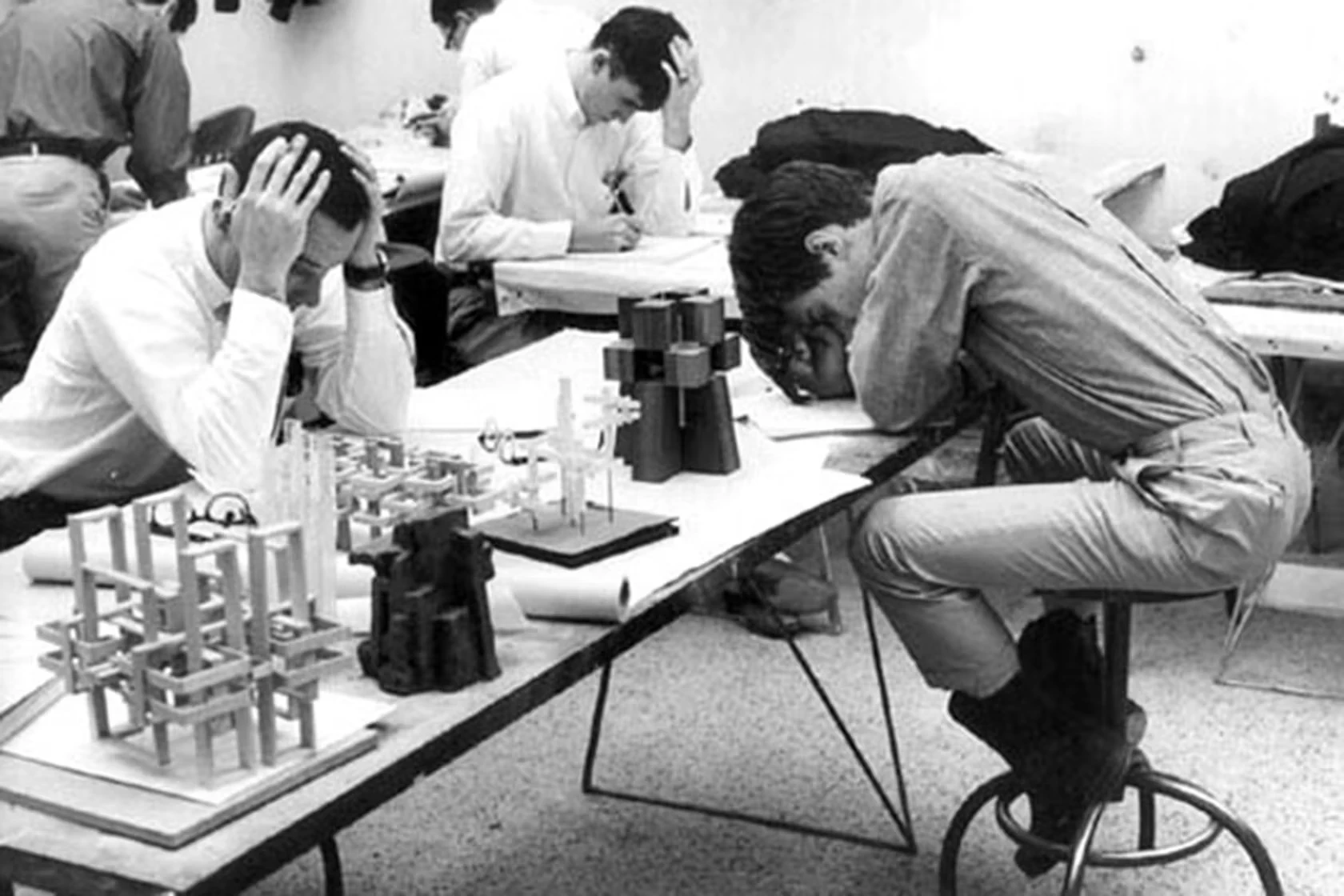



In this opinion piece, Ila Colombo reflects on AI, education, and what we lost when we stopped teaching people to think, arguing that systems designed to optimize execution have, in turn, created a deeper gap now exposed by machines. Grounded in her work at the intersection of design and artificial intelligence, the essay considers how this shift is redefining creativity, learning, and the role of human judgement in an increasingly automated world.
On AI, education, and what we lost when we stopped teaching people to think
We built entire education systems around teaching people to execute. Draft this. Render that. Build to spec. Learn the software, learn the workflow, learn the output. For decades, it worked, or at least it appeared to, because the market rewarded execution. Speed, precision, and technical fluency worked, as these were the currencies that got you hired. And now a machine does all of it. Often better. In seconds. So what, exactly, did we train people to do?
This is not a rhetorical provocation. I run two companies at the intersection of AI, architecture, and creative intelligence, and as I hire, I collaborate with junior and senior talent, studios, and institutions. And I keep encountering the same gap: people coming out of even the best programmes can operate tools with extraordinary proficiency, but many cannot reason through a genuinely unfamiliar problem. They can execute a brief. They struggle to question one.
Something broke in how we prepare people to think, and AI did not break it, but AI simply made it impossible to ignore.
The benchmark that explains everything

In AI research, there is a benchmark called ARC, the Abstraction and Reasoning Corpus. It was created by François Chollet, the engineer behind Keras and one of the more rigorous thinkers on what intelligence actually means. ARC is designed to test one specific thing: can a system reason about something it has never encountered before? It is not designed to retrieve a learned pattern or interpolate from training data but actually reason, from first principles, about a novel problem.
Most frontier AI models still struggle with it. The systems that can draft legal contracts, generate photorealistic images, and write functional code in dozens of languages, all hit a wall when asked to do something they have not, in some form, seen before. The latest version, ARC-AGI-2, remains largely unsolved. The top score on the private evaluation sits around 24%.
This matters because it reveals a structural truth about current AI, as these systems are extraordinary interpolation engines. They are not yet reasoning engines, as they can retrieve, recombine, and pattern-match at a speed and scale no human can approach. But when the problem is genuinely new, when there is no template to retrieve, they falter.
However, here is the uncomfortable part, and if I described that limitation to you without naming the subject, you might think I was talking about a recent graduate. The junior who just finished a five-year architecture program can produce beautiful renders. They can operate Rhino, Grasshopper, Revit, Midjourney, Stable Diffusion, and whatever else shipped last month. Additionally, they can execute a brief with impressive superficial polish. But ask them to sit with a genuinely ambiguous problem, one with no precedent, tutorial, or reference image, and reason their way through it from first principles, and you will often find the same wall that ARC exposes in machines.
This is not their fault, as it is ours, as we optimized education for throughput. We taught execution and tested execution, and in doing so, we produced a generation that is, in the most precise sense of the word, optimized for the same tasks that AI is now better at.
The honest question about originality

There is a deeper provocation buried in this parallel, and it is one I have been thinking about since I wrote about it in my article “The Odds of Feedback Loop Creations”. AI forces us to confront something we have mostly avoided: our own brains are, in many ways, biological retrieval systems.
We absorb, we store, and we recombine. Every idea you have ever had is, at some level, a reconfiguration of inputs you have previously received: things you saw, read, heard, touched, were taught, and experienced. The architect who designs a “novel” building is drawing, whether consciously or not, on every building they have ever walked through, every drawing they have studied, every material they have held or fallen in love with. The musician composing a “new” melody is recombining fragments of every piece of music that ever passed through their ears.
This is not cynicism but is neuroscience. Human cognition is, in the broadest sense, a retrieval-augmented generation system. A spectacularly sophisticated one, operating on orders of magnitude more contextual richness than any current AI, but a retrieval system nonetheless.
So, can we honestly say that anything was ever truly ‘unicum’? That any creation in the history of human making emerged from pure nothing, untouched by prior input? Perhaps we have overestimated human originality all along. Not because humans are not remarkable, we are, but because we located the remarkableness in the wrong place. We attributed it to the output and to the novelty of the thing produced. When, in fact, the real intelligence was always upstream of the output. It was in the quality of the retrieval. The sophistication of the recombination. The taste in knowing which fragments to bring together, which to discard, and which to collide in ways that had not been collided before.
This is what I mean when I say that AI has not diminished human creative value but has made it legible for the first time. If you accept that all creation is, at root, recombination, then the differentiator was never “originality” in the romantic sense, as it was always judgment and discernment. The accumulated, embodied intelligence that tells you this combination matters and that one does not. Technology democratized the tool, but it never democratized the eye.
What the feedback loop reveals

There is a second dimension to this that has direct consequences for education, and it has to do with the feedback loops that AI-generated content creates. When generative AI systems train on data that increasingly includes their own outputs, the creative ecosystem begins to close. The range of variation narrows. Outputs converge toward a statistical mean, toward algorithmic predictability. You see this already in AI-generated imagery: a particular kind of smooth, luminous, vaguely cinematic aesthetic that has become so ubiquitous it has its own informal name. Slop.
This convergence is not a failure of the technology. It is a structural property of any system that learns from its own outputs without sufficient new input from outside. It is an echo chamber operating at the scale of culture. The antidote to this is not less AI. It is better to have human input in the loop. It is people who can recognize when the outputs are converging, who can introduce genuine novelty by drawing on experiences, materials, references, and ways of seeing that the system has not yet absorbed.
It is, in short, curators, not in the gallery sense of the word, but in the deepest sense: people whose primary skill is selection, judgement, and the introduction of productive friction into systems that would otherwise optimize themselves into blandness. This is the expertise that education should be developing. And it is precisely the expertise that execution-focused curricula do not produce.
The apprenticeship correction

If AI handles execution, then the most urgent thing education can do is stop teaching execution as the primary skill and start teaching the things that make AI useful rather than hollow. What are those things? They are older than any curriculum. They are the things that the apprenticeship tradition understood centuries before anyone wrote a learning outcome or designed a module handbook.
Material intuition: The understanding of how things behave that only comes from handling them: the weight of stone, the flex of timber, the way glass responds to light at different thicknesses. This is not knowledge you can acquire from a screen. It is embodied intelligence, the kind that accumulates slowly, through exercise, failure, and the irreplaceable feedback of physical reality.
Critical reasoning: The ability to take a brief, a constraint, a problem, and before reaching for a solution, interrogate the problem itself. Is this the right question? What assumptions does it contain? What has been left out? This is the skill that ARC tests in machines and that education should be testing in people.
Tolerance for ambiguity: Execution-based education rewards convergence: get to the answer, hit the deadline, produce the deliverable. But the most valuable creative work happens in the space before convergence, in the uncomfortable period where the problem is still open, and the direction is still uncertain. Learning to stay in that space, to resist premature resolution, is a skill, as it requires practice and an educational environment that values the quality of the question at least as much as the speed of the answer.
Compressed hands-on experience: The apprenticeship model was not a slower version of classroom education. It was a fundamentally different pedagogy. The apprentice learned by doing, under the guidance of someone whose judgment had been formed by decades of doing. The knowledge transferred was not declarative; it was not a set of facts or procedures, but it was tacit, and it lived in the hands, in the timing, in the ability to read a situation and make a decision that could not be reduced to a rule.
This is exactly the kind of intelligence that AI cannot replicate and that execution-focused education does not develop. And it is the kind of intelligence that will separate the people who use AI well from the people who are used by it.
This shift is already beginning to reshape how design is taught. Across emerging platforms and learning environments, including PAACADEMY, there is a growing emphasis on developing judgement, critical thinking, and hands-on exploration alongside technical fluency, reflecting a broader move away from purely execution-driven education.
Not a nostalgia

I want to be precise about what I am arguing, because it is easy to mistake this for sentimentality. I am not saying we should abandon technology in education, as I use AI every day and build with it. I have founded a studio whose entire premise is that creative design and architecture can be amplified and automated through computational systems. I am not interested in a return to some imagined pre-digital Eden.
What I am saying is that we have a sequencing problem. We gave students the tools before we gave them the judgement to use the tools well. We taught them to produce before we taught them to see. And now that the tools can produce on their own, the gap is exposed.
The correction is not to remove the tools. It is to reintroduce, urgently and deliberately, the experiences that develop the human capacities that tools depend on, and that is material work, physical making, and structured exposure to ambiguity. We need mentorship from practitioners whose knowledge is embodied, not just theoretical, and time in workshops, on sites, in studios where the feedback comes from reality, not from a screen.
This is not nostalgia. It is the counterweight that makes AI useful rather than hollow.
Author: Ila Colombo is co-director of Ross Lovegrove Studio and co-founder of DEOND, a Dubai-based AI, R&D, and 3D printing practice focused on human-centered design, she works at the intersection of design and technology.
Image Credit: Ila Colombo, Deond






-150x150.webp)