


The world is home to many unique cities. Each reflecting its own special culture, architecture, and planning, these cities offer unique experiences to their inhabitants and visitors. However, amidst all this diversity, many cities are built upon certain urban principles. Even in different geographical locations, many cities feature streets designed horizontally, with structures referencing a ground level and rising from it. Chongqing, China, however, is a city entirely defying this familiar design language with its vertical spatial organization.
A City Where Familiar Urban Reflexes Do Not Apply

Chongqing, often referred to as a “mountain city,” is situated in southwestern China and is at the heart of the country’s economic and political power. This city, the largest and most densely populated in the region, is distinguished not only by these parameters but also by its unique urban planning style, which challenges our familiar way of reading urban spaces. For first-time visitors, this results in an experience that is both surprising and intriguing.

Chongqing is a city where the spatial reflexes we typically use when exploring a city for the first time, such as orientation and distance perception, don’t work. In this city of multi-layered topography, the notion of “ground” becomes ambiguous; streets, transportation networks, and buildings are organized as overlapping vertical layers. Someone visiting Chongqing for the first time might find themselves on the 1st, 5th, or even 10th floor, depending on their entrance, and be amazed by the pathways running through the buildings. Chongqing offers visitors an unexpected and discontinuous spatial experience, rather than the continuity to which they are accustomed.

Disorientation and Layered Space
If you’re planning a visit to Chongqing, you should know that getting lost is a structural feature of the city. You may find yourself constantly wandering between different levels and spaces rather than following a specific point of reference. With its overlapping transportation infrastructure and building patterns, Chongqing exhibits a three-dimensional organization; you might suddenly find yourself inside a building while walking on the ground level. Map coordinates are insufficient for navigation in this city; Chongqing is a city that must be experienced firsthand.

Famous for its so-called “eight-dimensional” spatial experience, Chongqing’s layered structure profoundly shapes the way visitors perceive the city. Train lines running through apartment buildings, rooftop shopping malls, and tower-like structures connected by horizontal sky bridges offer a singular urban experience. The city can only truly be understood by moving across and between these different levels.
Is It Really That Complex?
Chongqing, one of the world’s most complex cities, appears chaotic due to its multi-layered structure, but its urban layout is not random or irregular. In fact, the city is in harmony with its steep topography, where conventional horizontal planning principles simply do not apply. Built upon steep hills, cliffs, and river valleys, Chongqing naturally accommodates vertical differences of hundreds of meters as part of everyday urban life. Due to its rugged terrain, the city is structured around a unique “3D urban planning logic,” altering traditional planning approaches.

In this vertically layered city, the height of building entrances is determined by the surrounding roads. Thus, the idea that a building’s entrance must be on the ground floor is invalid; buildings with multiple entrances, depending on the terrain, may have entrances on the first, tenth, or even twentieth floors. In Chongqing, with a population of 32,054,159, daily life practices are in harmony with the city’s multi-layered structure, and the confusion of meaning encountered by someone seeing the city for the first time is a functioning order for the city’s inhabitants.

Chongqing Landmarks
As a living laboratory of multi-layered urbanization, Chongqing is home to numerous iconic landmarks that are deeply integrated into the city’s stratified structure. These structures, which help understand the city’s workings, are must-see landmarks for first-time visitors:
1. Liziba Metro Station

Liziba Metro Station, one of Chongqing’s most impressive structures, is a must-see project. Designed by Ye Tianyi of Chongqing University, the station passes through an apartment block. Known as the first light rail elevated station filled with apartments, Liziba offers a striking and unusual experience. Passing between floors 6 and 8 of a 19-story apartment block, this station is consistent with the spatial logic of the city and helps first-time visitors understand the layered structure.
2. Hongyadong Traditional Culture Preservation and Protection Complex
Offering a hotel complex, multi-story shopping arcade, and restaurants, Hongyadong is a project that will impress visitors with its architecture reflecting the characteristics of the city. A modern landmark of Chongqing, this opulent building comes alive at night with the glow of neon lights on its entire facade, transforming the cliff edge into a surreal, cinematic scene.

The 11-story complex is situated on the riverbank and showcases the city’s vertical organization. With multiple entrances at different levels, the distinction between indoor and outdoor spaces is blurred in Hongyadong. A visitor wandering through the shopping mall via terraces, staircases, and passageways might find themselves on a platform overlooking the river.
3. Raffles City Chongqing

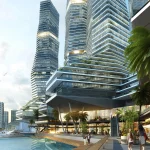
Raffles City Chongqing, a mixed-use structure that interprets the city’s layered architecture in harmony with its topography in a contemporary way, is a must-see for first-time visitors. Designed by Safdie Architects, Raffles City integrates multiple. access points suited to Chingqiang’s rugged topography, an innovative traffic management system, and a new pedestrian walkway that cuts across the five floors of the shopping mall and provides a direct connection between the podium park and Chaotianmen Square.

The most striking element of the structure is the 300-meter-tall horizontal skyscraper (Crystal) that connects the towers and acts as a skybridge. Composed of nine sections, the Crystal goes beyond its iconic form, allowing visitors to view Chongqing from above. Raffles City, which incorporates the layers and elevation differences used to define the city in a controlled and designed manner, is an important structure for understanding Chingqiang.



-150x150.webp)