




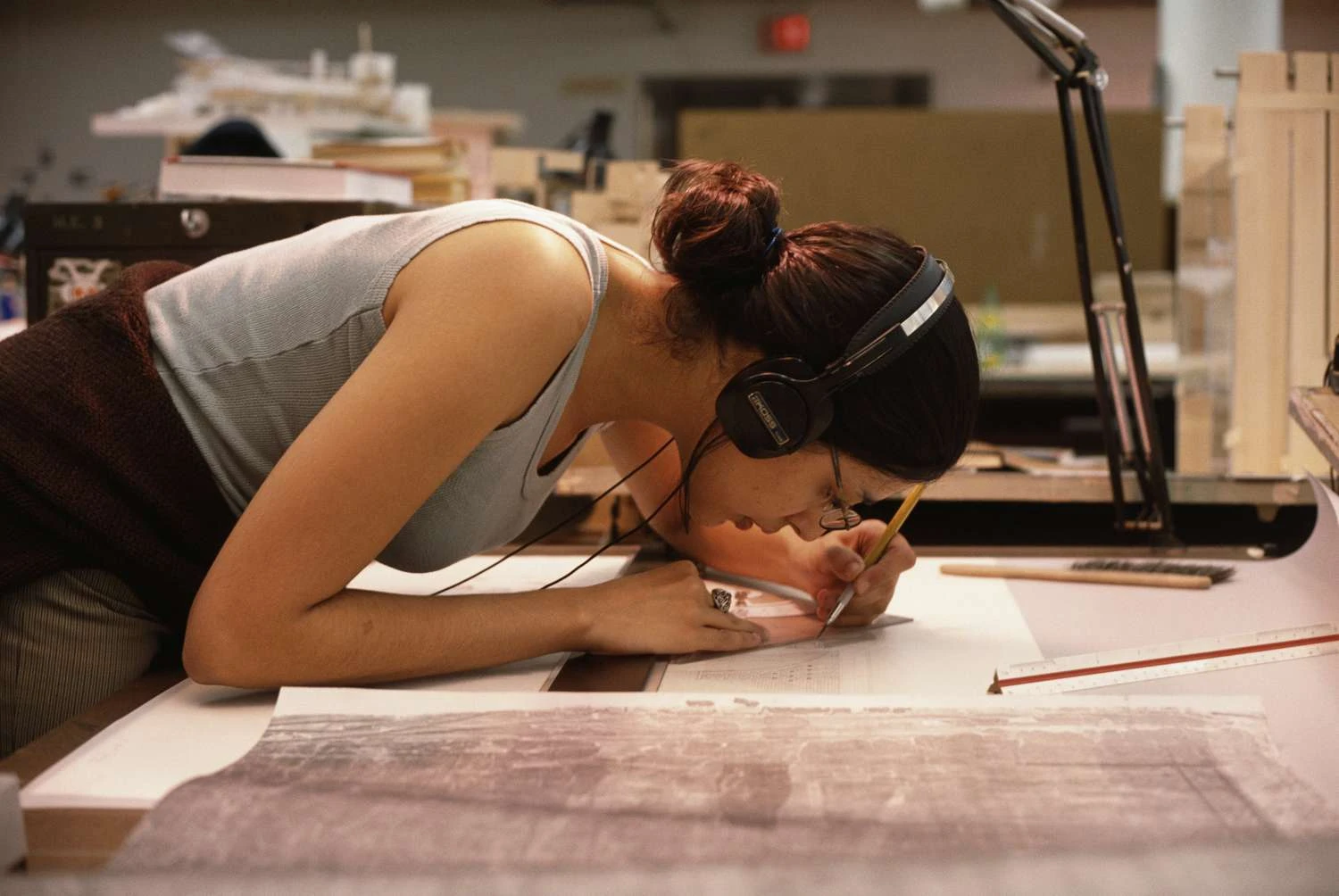








Architecture schools around the world have undergone a remarkable demographic transformation over the past few decades. Walk into the design studios of universities in Europe, North America, Australia, Asia, or the Middle East, and one observation becomes immediately apparent: women often make up half, and in many schools more than half, of the student population. In some countries, female enrollment in architecture programs exceeds 60 percent, suggesting that the profession has successfully attracted talented women and is moving toward gender equality. Yet this impression dissolves shortly after graduation.
- The Educational Success Story
- The Leaky Pipeline
- Long Hours, Low Pay, and High Expectations
- Motherhood Penalty
- Construction Sites Remain Male-Dominated
- Invisible Bias
- The Myth of the Star Architect
- Burnout and Career Change
- Diversity Is More Than Numbers
- Reimagining Professional Practice
- A Profession That Cannot Afford to Lose Talent
Visit major architectural firms, construction sites, executive boardrooms, or professional conferences, and the picture changes dramatically. Women become progressively less visible with each step up the professional ladder. The proportion of licensed female architects declines. Fewer women become project leaders, partners, firm owners, or internationally recognized designers. Those who remain often occupy positions with less authority, lower salaries, or reduced visibility. This contradiction raises an uncomfortable question: If architecture schools are full of women, where do they go after graduation?
The answer is neither simple nor singular. Rather than a shortage of female talent, architecture suffers from a persistent problem of retention. Women are not disappearing because they lack ability or ambition. Instead, many are gradually pushed away by a profession whose structures have changed far more slowly than its classrooms.
The Educational Success Story
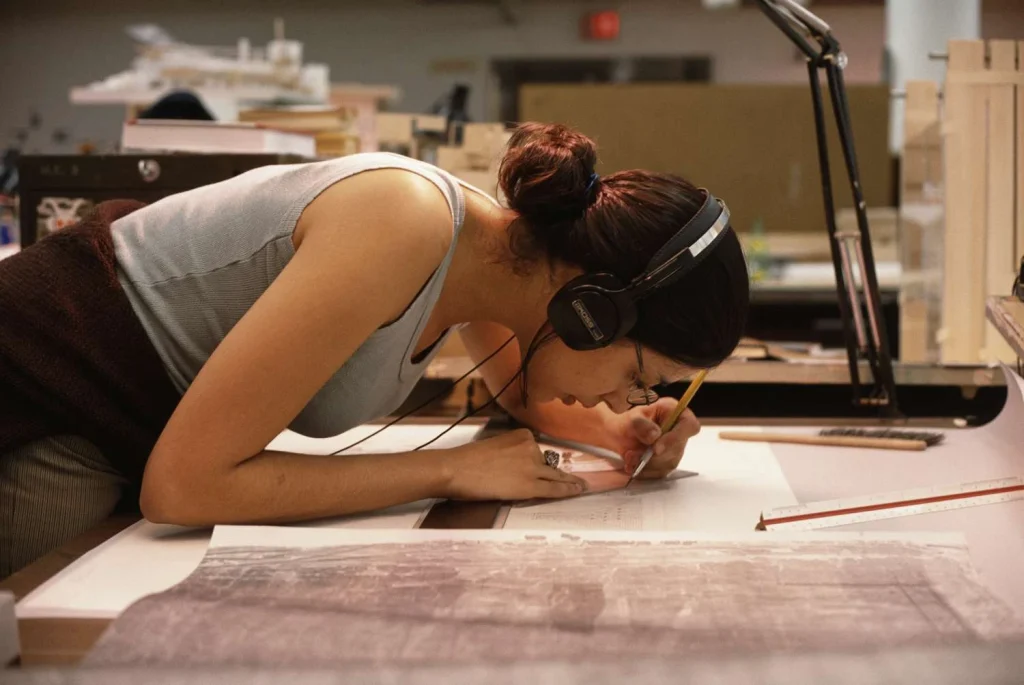
Architecture has become one of the few design professions where women have achieved near parity in higher education. Unlike engineering, where women remain underrepresented in many countries, architecture has become increasingly attractive to female students.
Several factors explain this trend. Architecture combines creativity with technical knowledge, allowing students to engage simultaneously with art, science, environmental responsibility, history, and social issues. It offers opportunities for collaboration, problem-solving, and cultural impact rather than purely technical production. These characteristics appeal to a broad range of students regardless of gender.
Universities have also become more inclusive environments. Female students now receive equal access to architectural education, scholarships, digital tools, and academic opportunities. Studio culture, although still demanding, generally rewards creativity more than physical strength or traditionally masculine stereotypes.
In many architecture schools, female students consistently outperform their male classmates academically. They frequently receive higher grades, demonstrate stronger organizational skills, and produce exceptionally refined design work. Numerous design awards at the university level are won by women. On paper, architecture appears to have solved its gender problem. Reality tells another story.

The Leaky Pipeline
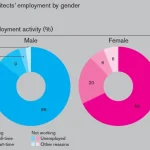
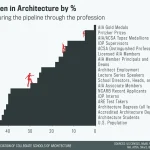
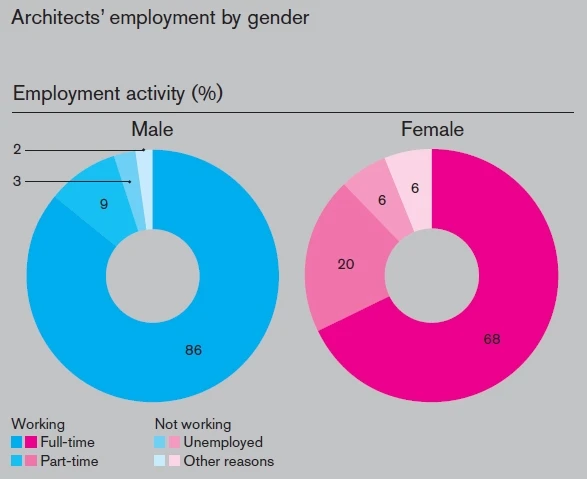
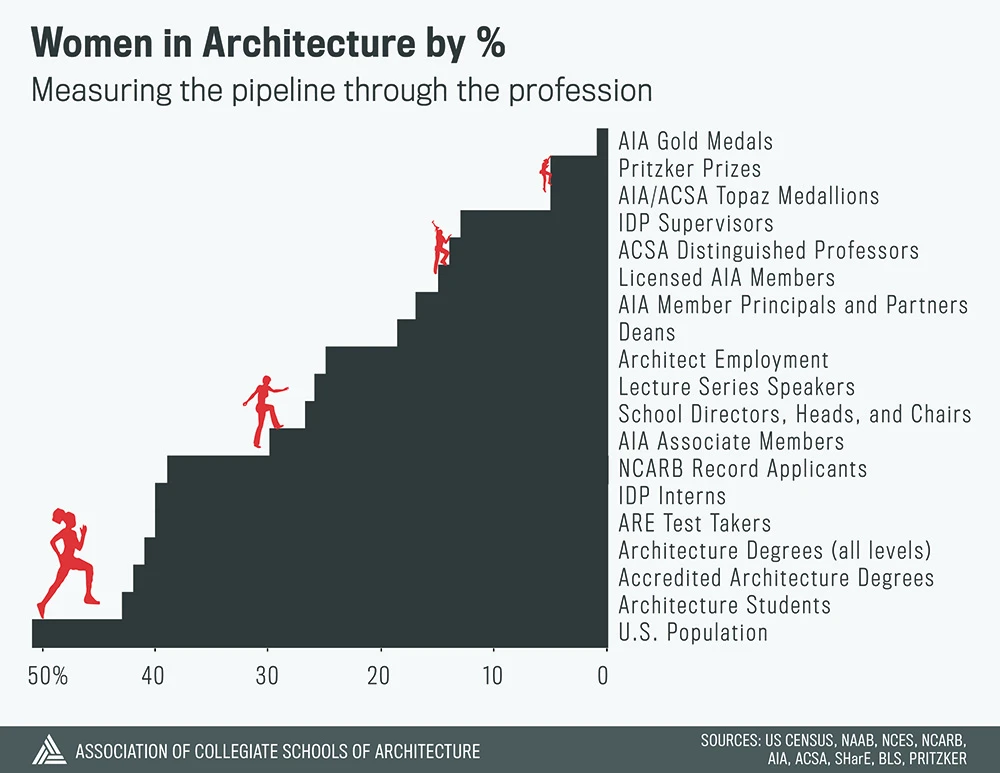
Researchers often describe architecture as having a leaky pipeline. Women enter the educational system in large numbers, but at every career stage, some leave the profession. The pipeline leaks during internships. It leaks during licensure. It leaks during promotion. It leaks after parenthood. It leaks before a partnership. By the time architects reach senior leadership positions, the gender balance bears little resemblance to that of architecture schools.
This phenomenon is visible across much of the world. Although exact figures vary by country, women remain significantly underrepresented among firm principals, directors, partners, and award-winning architects. The issue, therefore, is not recruitment. It is retention.
Long Hours, Low Pay, and High Expectations
Architecture has cultivated a culture that often glorifies excessive work. Long nights in the studio begin during university and continue into professional practice. Working weekends, answering emails late at night, meeting impossible deadlines, and sacrificing personal life have become normalized in many firms. Young architects quickly discover a difficult truth.
Architecture demands years of education, lengthy internships, licensing examinations, and continuous professional development. Yet despite this investment, salaries often remain modest compared with other professions requiring similar qualifications. This affects everyone.
However, when combined with societal expectations that women still perform a disproportionate share of domestic and caregiving responsibilities, the burden becomes much heavier. The profession frequently assumes the existence of an employee who is always available. Real life rarely functions that way.

Motherhood Penalty
One of the most significant reasons women leave architecture is the collision between professional expectations and family responsibilities.
Major architectural projects can last several years. Construction deadlines rarely pause. Client meetings may require extensive travel. Site inspections often begin early in the morning.
Meanwhile, pregnancy, childbirth, and childcare introduce unavoidable interruptions that many firms still struggle to accommodate effectively. This phenomenon is often described as the motherhood penalty.
Women may return from maternity leave only to discover that prestigious projects have been reassigned, promotions delayed, or career momentum lost. Meanwhile, fathers often experience little or no equivalent professional setback. The issue is not motherhood itself. It is a professional culture designed around uninterrupted careers.

Construction Sites Remain Male-Dominated
Although architectural education emphasizes creativity and conceptual thinking, practice requires frequent interaction with contractors, engineers, developers, and construction managers.
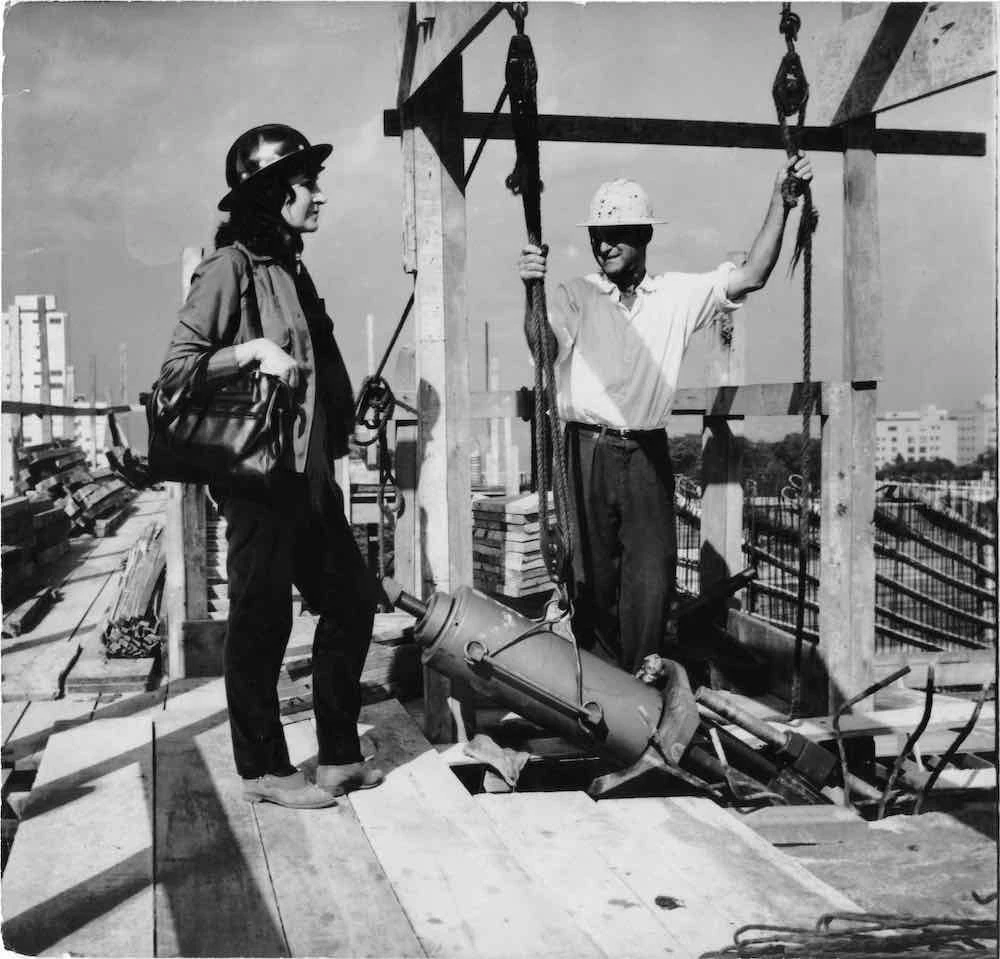
Construction remains one of the world’s most male-dominated industries. Female architects frequently report having their expertise questioned more often than their male colleagues. On construction sites, they may be mistaken for interior designers, clients, or assistants rather than project architects. Their technical decisions sometimes receive greater scrutiny. Their authority may need repeated validation. These experiences rarely appear in university brochures. Yet they accumulate over years, contributing to professional fatigue.
Invisible Bias
Modern discrimination is often subtle rather than explicit. Few firms openly refuse to hire women. Instead, bias appears in small, cumulative decisions. Who receives the prestigious museum project? Who presents to important clients? Who represents the office at conferences? Who becomes the project architect? Who receives mentorship? Who is considered “leadership material”?
Research consistently shows that informal networks significantly influence promotions within architecture. These networks have historically been dominated by men. Consequently, women may possess equal qualifications while receiving fewer opportunities to demonstrate leadership.
The Myth of the Star Architect
Architecture has long celebrated the image of the solitary genius. The profession’s history is filled with iconic figures whose names have become synonymous with buildings.
Although architecture is inherently collaborative, awards, publications, and media coverage often focus on individual personalities. Historically, these celebrated figures have overwhelmingly been men. Women architects have contributed enormously to architecture, yet many worked as collaborators whose achievements were overshadowed by male partners or employers.
Even today, media attention frequently favors charismatic male architects while overlooking equally accomplished women leading complex projects. Representation matters. Young graduates look for role models who resemble them. If leadership appears overwhelmingly male, many talented women begin questioning whether long-term success is truly attainable.

Burnout and Career Change
Architecture has one of the highest rates of career transition among creative professions. Many graduates leave for urban design, project management, real estate development, sustainability consulting, user experience design, academia, policy, or technology. Women are particularly represented among those making these transitions.
Importantly, leaving architecture should not automatically be interpreted as failure. Many discover careers offering greater flexibility, higher salaries, healthier work-life balance, and clearer promotion pathways. The profession often loses some of its brightest minds not because they cannot succeed, but because other industries value their skills more effectively.
Diversity Is More Than Numbers
Architecture frequently celebrates increasing female enrollment as evidence of equality. This is misleading. Equality cannot be measured solely by counting students. Real equality exists when women remain visible throughout every career stage. It exists when they become firm partners. When they lead billion-dollar projects. When they teach as professors. When they chair professional organizations. When they win major architectural prizes. When they influence policy. When their names become as familiar as those of their male colleagues.
Representation at the entry level matters. Representation in leadership matters far more.
Reimagining Professional Practice
Solving architecture’s gender imbalance requires structural change rather than symbolic gestures. Flexible working arrangements should become normal rather than exceptional. Hybrid work models, where appropriate, can reduce unnecessary time pressures without compromising design quality.
Transparent promotion criteria can reduce unconscious bias. Employees should understand how leadership roles are earned rather than relying on informal relationships.
Mentorship programs connecting young female architects with experienced leaders can guide critical career transitions.
Parental leave should be supported for both women and men. When caregiving becomes a shared expectation, the professional penalty associated with motherhood diminishes.
Construction culture also requires transformation. Respect for professional expertise must become independent of gender, ensuring architects are evaluated by competence rather than stereotypes.
Finally, architectural education should prepare students for the realities of practice. Universities often celebrate design excellence while discussing professional challenges only superficially. Honest conversations about workplace culture, leadership, negotiation, entrepreneurship, and career sustainability should become integral parts of architectural education.
A Profession That Cannot Afford to Lose Talent
The disappearance of women from architecture is not inevitable. It is the consequence of systems designed for another era.
Architecture faces enormous contemporary challenges, including climate change, housing shortages, urban resilience, digital transformation, and social inequality. Addressing these issues demands the widest possible range of perspectives and experiences.
Every woman who leaves architecture represents more than an individual career change. The profession loses years of education, creative potential, technical expertise, and leadership capacity. Clients lose diverse viewpoints. Cities lose designers capable of producing more inclusive environments. Future students lose mentors who might have inspired them. Perhaps the most revealing question is not “Why are architecture schools full of women?” The more important question is, “Why does architecture continue to lose so many of them?”
Until the profession measures success not only by how many women enter its classrooms but by how many remain, lead, innovate, and reshape its future, architecture will continue to celebrate a victory that exists largely within university walls.
The studios are already full of talented women. The challenge is ensuring that ten, twenty, and thirty years later, those same women are still designing cities, directing firms, teaching future generations, and redefining what architectural leadership looks like. Only then will the profession’s demographics finally reflect the remarkable promise visible every semester inside architecture schools.






-150x150.webp)