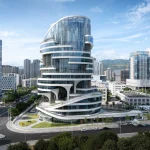
Casual observers of design, even some serious architecture buffs, may not be familiar with the term “parametric design,” yet admire it regularly. This unique style of design involves the use of specialized computer software whose algorithms can generate complex forms much more rapidly than manually adjusting individual elements. This high-tech approach, inspired by old-school designers who first experimented with avant-garde forms, further pushes the boundaries of architectural imagination and often results in alluring curves that evoke a sense of motion.
This article was originally published by Roger Grody for The High End Magazine.

Iconic architect Frank Gehry, famous for Disney Concert Hall in Los Angeles and the Guggenheim Museum in Bilbao, Spain, is a leader in this field, using parametric software to achieve the sculptural forms that have become his signature. The late Zaha Hadid, the pioneering architect once dubbed “Queen of the Curve,” and her eponymous firm are also known for the undulating contours and precisely fitted components typical of parametric design. And, long before Bill Gates or Steve Jobs ever imagined modern computing, Spanish architect Antoni Gaudí was creating architectural forms whose fluid qualities inspire today’s parametric designers.

The use of computer algorithms, which refine designs based on designated parameters, makes the eccentric angles and complex curves of contemporary architecture more easily achievable. Parametric design is a major reason why buildings are becoming increasingly intricate and dramatic, a departure from the more simplified geometric aesthetics that previously constrained designers.
Established in 2016 by architect Hamid Hassanzadeh, Parametric Architecture has emerged as a leading online hub for designers, journalists, and enthusiasts of this rapidly emerging specialty. “Parametric design is a methodology in which algorithms define the relationships between various design parameters,” explains Hassanzadeh, who adds, “This means that instead of designing each component individually, architects set rules and parameters, and the design evolves within those constraints.”
Hassanzadeh insists that these technologies are enabling groundbreaking projects, from intricate façades that respond to sunlight to entire cities planned for climate resilience. Hassanzadeh, whose ParametricArchitecture website and social media platforms have become a phenomenon, further states, “Parametric design not only helps create highly efficient structures, but also ones that are captivating in beauty.” He reports that artificial intelligence (AI) is now being integrated into parametric design programs, further enhancing their capabilities.
Gensler is a global architectural firm whose portfolio includes the 128-story, gently spiraled Shanghai Tower (China’s tallest) and the Silicon Valley headquarters of AI chipmaker NVIDIA. Gensler developed a proprietary algorithm, creating a parametric, pattern-producing system that allows designers to rapidly generate and test different scenarios for façades, which means their responses to sunlight and other environmental factors can be precisely evaluated. For the two 1,050-foot-high towers of Shanghai’s “Gate of Science,” Gensler applied a parametric design approach to create mesmerizing exteriors whose staggered glass panels echo ripples of water.

Dramatic curves were a known signature of Zaha Hadid, whose legacy continues through Zaha Hadid Architects, the London-based firm she founded with parametrically designed projects around the globe. Opus, located in the shadows of Dubai’s Burj Khalifa tower, is essentially a reflective glass cube distinguished by an alluringly abstract, curvilinear hole cut from the heart of the structure. “The precise orthogonal geometries of Opus’ elemental glass cube contrast dramatically with the fluidity of the eight-story void at its center,” explains project director Christos Passas. Opus, which incorporates luxury residences and a five-star hotel, is among many projects representing the parametric possibilities Zaha Hadid Architects has become associated with and defies preconceived notions of high-rise architecture.
The firm’s 42-story Morpheus hotel in Macau — the glitzy gambling destination considered the Las Vegas of Asia — also features quintessentially Hadid-esque curves and cut-outs that provide dramatic visual interest. Its glass façade is entirely wrapped in a free-flowing lattice inspired by ancient Chinese jade carving traditions but executed with state-of-the-art technology. “The expertise of all members of the Morpheus team has created new possibilities for architecture,” says project director Viviana Muscettola. “The comprehensive parametric model combined all of the hotel’s structural and fabrication requirements and will radically change how our built environment is planned and constructed,” adds the architect.

SOMA, the architect studio of Michel Abboud in New York, is committed to the use of advanced software that enables its designers to create structures whose aesthetics would be far more difficult, even impossible, to achieve through traditional methods. Agora Tower in Dubai, a parametrically designed luxury residential building by SOMA, features an undulating façade whose rhythmic, organic patterns were inspired by the growth of trees. Sinuous balconies wrapping around each floor meet the lifestyle requisites of residents, add elegance, and increase energy efficiency by moderating interior temperatures.
Mumbai, India-based Sanjay Puri Architects has embraced parametric design in a portfolio that encompasses projects on practically every continent. For The Forest, a high-density but eco-friendly residential development in the African nation of the Congo, the company employed a series of cascading balconies, among the parametric design-generated elements that contribute to the complex’s compelling aesthetics.

“In our case, we always start with hand-drawn sketches, but parametric design tools are applied after these sketches as a second step towards achieving the desired design,” explains principal Sanjay Puri. Noting that his firm’s first free-flowing, abstract design was conceived in 2000, the architect recounts, “Due to the lack of appropriate software, we had to create 160 sections for a small project.”
“Now, parametric design allows us to generate the required forms and drawings for fluid, abstract spaces, translating to ease of understanding and execution,” says Puri.
[Approximately 20,000-square-foot] building to make the engineers and contractors understand what we wanted.” He explains that advances in parametric software have resulted in greater efficiencies. “Now, parametric design allows us to generate the required forms and drawings for fluid, abstract spaces, translating to ease of understanding and execution,” says Puri. “The possibilities are endless.”
UNStudio, the acclaimed Dutch firm led by Ben van Berkel, has put parametric design methods to effective use in projects such as China’s Raffles City Hangzhou, Wasl Tower in Dubai, and a pair of stunning high-rises in Melbourne, Australia, distinguished by spiraling “green spines” of generously planted terraces. Much of UNStudio’s portfolio, from aesthetically elevated airports and bridges to graceful skyscrapers, reveals the complexities achievable through parametric design, without those projects appearing computer-generated. Furthermore, the application of new technologies does not impede the firm’s abilities to incorporate relevant cultural influences in its designs, whether traditional Arabian accents in a Dubai residential tower or ancient Chinese references in a Shenzhen opera house.

Another Dutch firm, MVRDV, promotes the use of a parametric approach to arrive at flexible systems rather than specific rigid designs, and founding partner Winy Maas has long insisted that architects should embrace technology. At an international design seminar in 2009, Maas stated, “Parametrization is an essential part of the practice at MVRDV,” adding, “Everything, including desires and emotions, can, in fact, be parametrized.” Valley, a mixed-use high-rise complex in Amsterdam by MVRDV, features a myriad of unexpected angles conceived with the assistance of parametric software. The firm’s Binhai Library project in Tianjin, China, where extravagant curves are juxtaposed against more traditional geometry, is also cited as a parametric project. Ensconced into the library’s relatively conventional, rectangular footprint is an interior plaza anchored by a luminous spherical auditorium. “We opened the building by creating a beautiful public space inside; a new urban living room is its center,” explains Maas.

While parametric design is being widely adopted by architects worldwide, it is not without detractors. Although using computer software for renderings and floor plans has been standard practice for decades, critics suggest that parametric software further dehumanizes the creative process. Supporters insist that no algorithm supersedes human imagination, and that parametric design is simply a tool for translating complex concepts into reality. Parametric design expert Hamid Hassanzadeh submits, “Tools do not dictate design — they only amplify the architect’s vision.”



-150x150.webp)