


A bedroom is often treated as the softest room in a home, but from a planning perspective, it is also one of the most disciplined. One object controls most of its usable area: the bed. Its height, mass, edges, headboard, material, and relationship to light decide how the room feels before any artwork, rug, or lamp has a chance to contribute.
For architects and interior designers, the bed can be read less as furniture and more as a low architectural plane. It sets the room’s ground logic. It determines whether circulation feels generous or compressed. It shapes how the eye reads the wall behind it, how daylight moves across the floor, and whether the room supports rest or quietly produces visual tension.
Low, restrained sleeping systems have become relevant to contemporary residential interiors for this reason. Collections of Japandi-inspired platform bed designs are useful to study not as decorative products but as examples of how horizontal proportion, material honesty, and spatial quiet can change the entire experience of a bedroom.
The Bedroom Is a Plan, Not a Product Shot
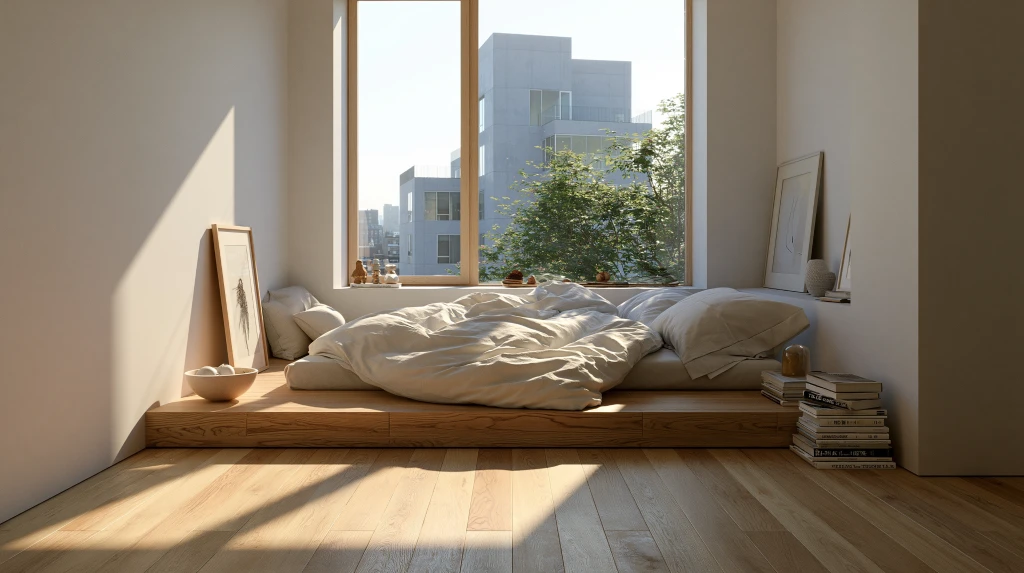
The most common mistake in bedroom design is composing a room as a photograph rather than as a sequence of daily movements. A good bedroom has to work in the morning, at night, half-awake, half-lit, and under all the small frictions of normal life. Where does the body turn? Where does the hand reach? Where does the robe fall? How does the path to the door feel when the room is dark?
Parametric Architecture has often discussed space as an active force rather than a neutral backdrop. In its piece on how spatial design affects mood, the site notes that design decisions can evoke spaciousness and tranquility, or confinement and discomfort. The bedroom is perhaps the most intimate test of that idea because the body experiences it before the mind fully names it.
When the bed is too tall, too bulky, or visually disconnected from the room, it becomes an object that interrupts space. When its height, edge, and material rhythm are resolved, it becomes a datum. It gives the room a calm line to organize around.
Why the Sleeping Plane Controls the Room
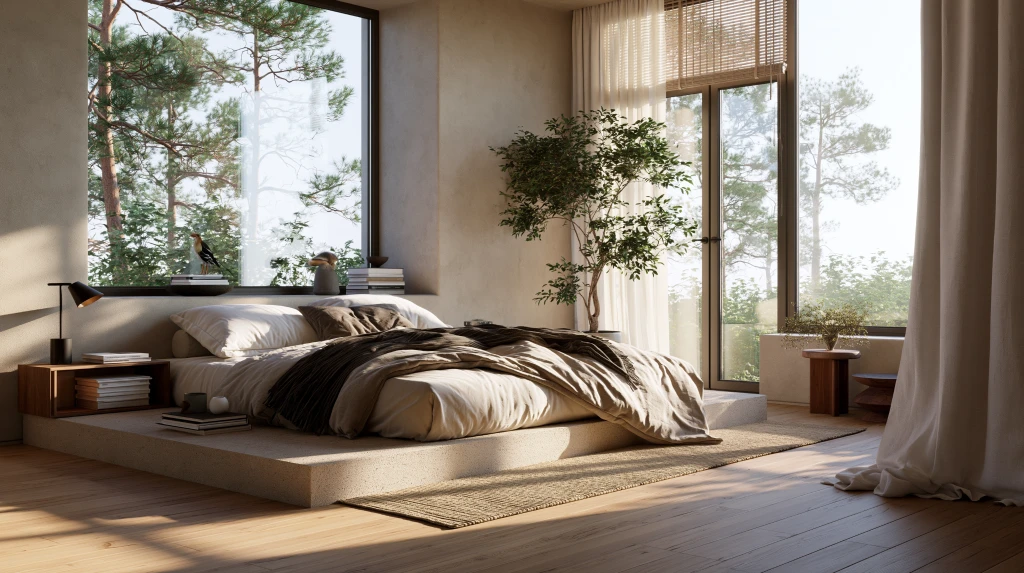
A bed is usually the largest horizontal surface in a bedroom. Because of that, its proportions affect more than comfort. They influence perceived ceiling height, visual balance, and the psychological weight of the room.
A low sleeping plane can make the wall above it feel taller. It can also stretch the visual field by keeping the eye closer to the floor, which is especially useful in compact apartments and narrow rooms. This does not mean every bedroom needs the lowest possible bed. It means the height should be chosen as part of the room’s section, not only as a furniture preference.
Several measurements matter. The finished mattress height should be considered before the frame is selected. A thin frame with a thick mattress may no longer read as low. A deep rail may create visual weight even when the mattress sits near the floor. A tall headboard can either anchor a wall beautifully or shorten it, depending on ceiling height and window placement.
The question is not simply, “Does this bed fit?” A better question is, “What line does this bed create in the room?”
Lessons from Japanese Spatial Restraint
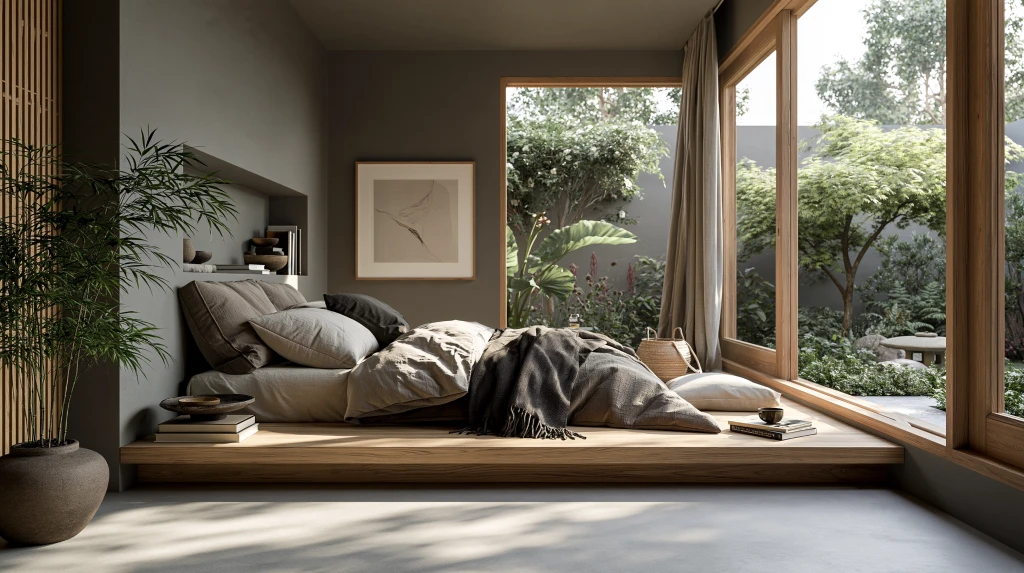
Japanese architecture offers a useful reference point, not because it should be copied as a style, but because it treats space, nature, and proportion with unusual discipline. Parametric Architecture’s overview of Japanese architecture describes a tradition shaped by cultural continuity, innovation, and harmony with nature. In interiors, that often translates into respect for emptiness, shadow, floor proximity, and careful material presence.
A low bed carries some of this spatial logic into the bedroom. It brings the body closer to the floor and lowers the visual center of gravity. The result can feel more grounded, but only if the surrounding room supports it. A low frame placed beside bulky nightstands, glossy finishes, and a crowded wall loses its architectural clarity.
Scandinavian influence adds another layer: functional restraint, tactile wood, and everyday practicality. The strongest contemporary bedrooms borrow from both traditions without turning either into a theme. They use proportion, texture, light, and negative space to create stillness.
From my perspective, the value is not in making a room look Japanese or Scandinavian. The value is learning how restraint works as a spatial method.
Micro-Living and the Return of Furniture as Structure
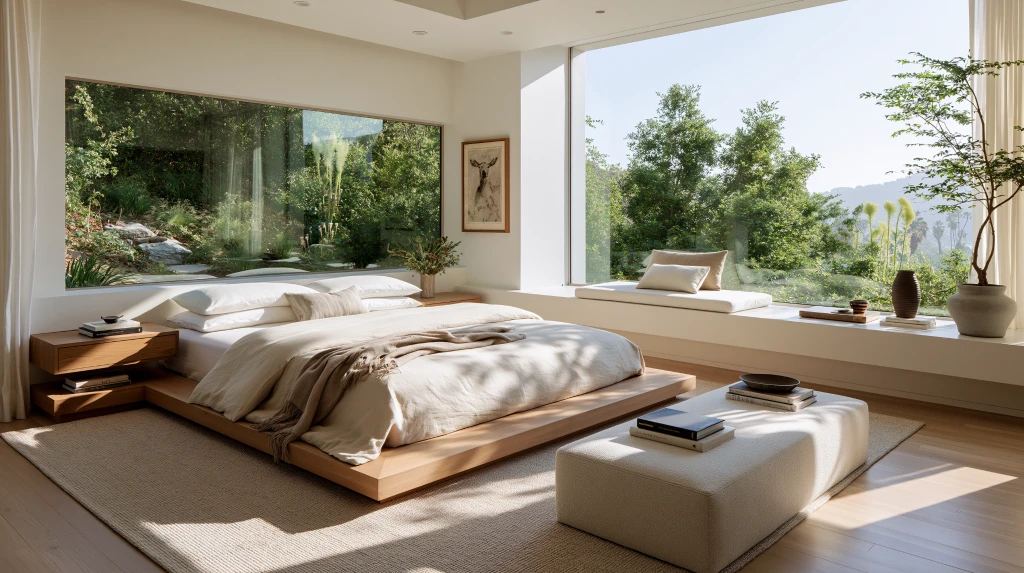
As urban homes become smaller, furniture has to perform more architectural labor. The United Nations projects that 68 percent of the world’s population will live in urban areas by 2050, which makes compact residential planning more than a stylistic issue. It is becoming a daily design condition for millions of households.
Parametric Architecture’s article on the future of micro-living describes how furniture in compact homes increasingly acts as structure rather than filler. Murphy beds, modular sofas, sliding partitions, stacked sleeping systems, and movable storage all show that small homes depend on adaptable objects with architectural intelligence.
A bed in a compact room cannot be treated as a static object. It may need to frame storage, define a sleeping alcove, support seating during the day, or preserve enough perimeter space for movement. Even when it does none of those things mechanically, it still controls the main spatial field.
This is where low platform logic becomes especially useful. By reducing visual bulk, the bed can occupy a large footprint without making the room feel overfilled. The trade-off is that the surrounding details become more visible. When a room has fewer objects, each joint, reveal, fabric texture, and wood tone carries more weight.
Material Honesty, Tactility, and Visual Quiet
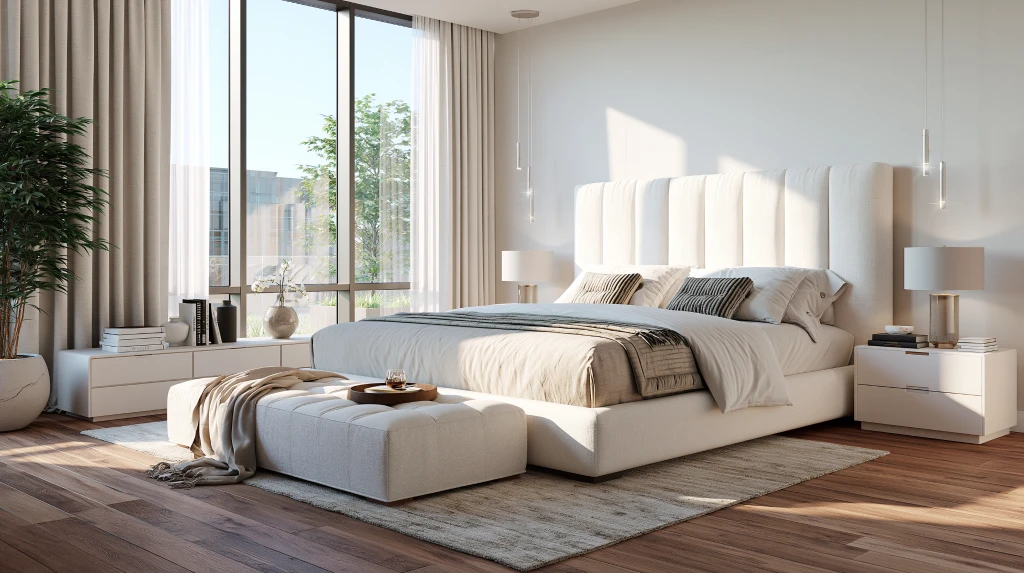
A calm bedroom is not an empty bedroom. Empty rooms can feel cold, temporary, or unresolved. The difference lies in material depth.
Wood grain, matte finishes, woven textiles, paper-like shades, plastered walls, and low-gloss surfaces can give a minimal room enough sensory richness to avoid a sterile feel. Biophilic interiors work through a similar principle. Parametric Architecture’s feature on biophilic interiors describes the use of natural light, greenery, and raw materials to create calming, sensory-rich spaces connected to nature.
This matters because people spend much of their lives indoors. The U.S. Environmental Protection Agency notes that Americans spend approximately 90 percent of their time indoors, where some pollutant concentrations are often 2 to 5 times higher than typical outdoor concentrations. Even when the topic is furniture, the larger design question is indoor quality: air, light, noise, material emissions, comfort, and maintenance.
The World Green Building Council has also noted that buildings account for 39 percent of global energy-related carbon emissions, with 11 percent tied to materials and construction. That statistic belongs mostly to the scale of buildings, but it still reminds designers to think carefully about material durability, replacement cycles, and long-term use.
A bed frame is not a building, yet it participates in the same culture of making. Better choices are not only quieter visually. They last longer, age more honestly, and reduce the need for constant replacement.
Trade-Offs Designers Should Not Ignore
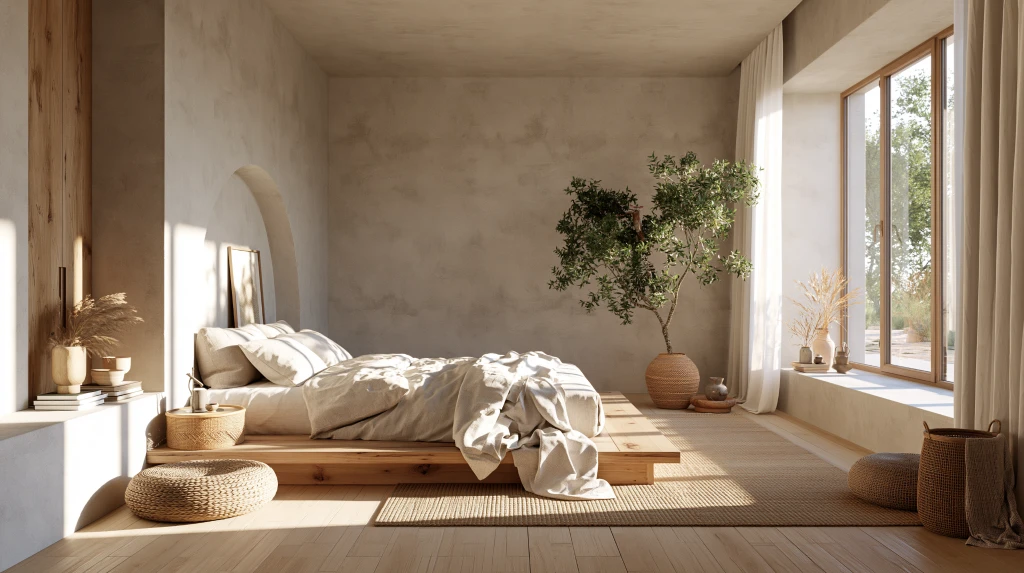
Low-profile bedroom design has limits. A bed that looks elegant in elevation may not work for everybody. Older adults, people with mobility limitations, and anyone with knee or back pain may find very low sleeping surfaces difficult to use. Comfort begins with the body, not the image.
Storage is another compromise. Platform beds with drawers can be practical in apartments, but they often add bulk. If the drawer fronts, gaps, or handles are poorly resolved, the bed starts to feel like a cabinet lying on the floor. Integrated storage works best when the reveal is quiet, and the room has enough clearance for drawers to open fully.
A low bed can also expose weak room proportions. If windows are very high, art is placed too far above the frame, or lamps are oversized, the composition may feel disconnected. The room needs a shared horizontal language.
Color carries a similar risk. A soft palette can be restful, but too many beige surfaces with similar texture can make the room feel flat. Visual quiet still needs contrast: pale wood against linen, shadow against plaster, woven texture against smooth floors, and warm light against matte surfaces.
A Practical Framework for Evaluating the Ground Plane
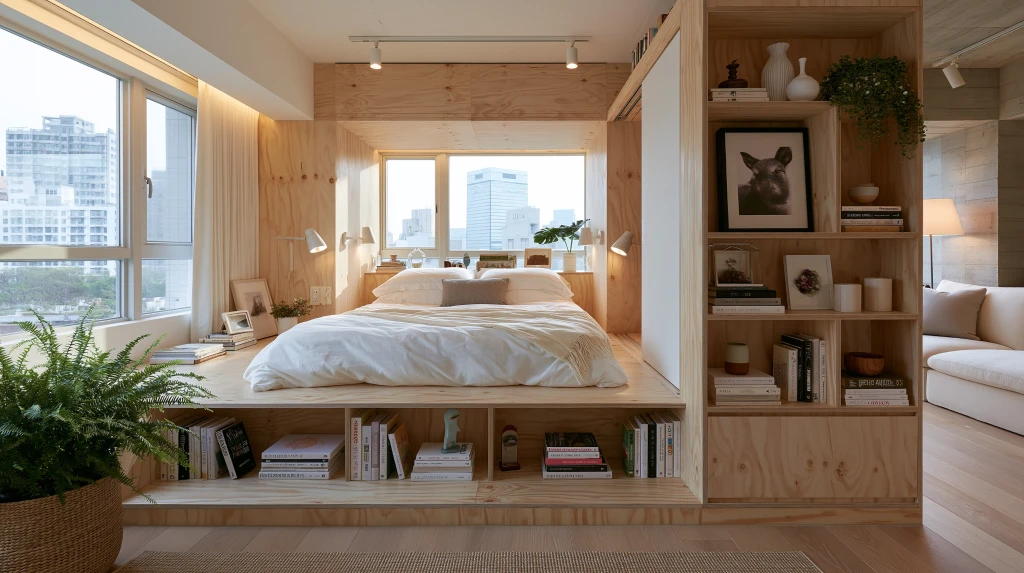
A useful way to evaluate a bedroom is to study the ground plane before choosing decorative layers. I use five checks.
First, height. Measure the combined frame and mattress height, then compare it with the user’s sitting comfort and the room’s ceiling height. A low bed should still be easy to enter and exit.
Second, edge. Look at the corners, rails, and headboard transitions. Bedrooms are used when people are tired. Sharp corners and visually heavy edges create small daily irritations.
Third, void. Study the negative space around the bed. Is there enough clearance to move naturally? Can both sides be accessed? Does the room still breathe when the door swings open?
Fourth, material. The bed should either repeat the room’s existing material logic or calm it. A strong wood grain can be beautiful, but it should not compete with flooring, wall panels, and nearby cabinetry.
Fifth, light. Observe how daylight and artificial light touch the bed. A lower frame often allows light to travel farther across walls and floors, while a tall headboard can create a useful shadow field when handled intentionally. Wall sconces, lamps, and low storage should be checked against the same horizontal language so the room feels measured rather than scattered.
Common Mistakes in Low-Profile Bedroom Planning
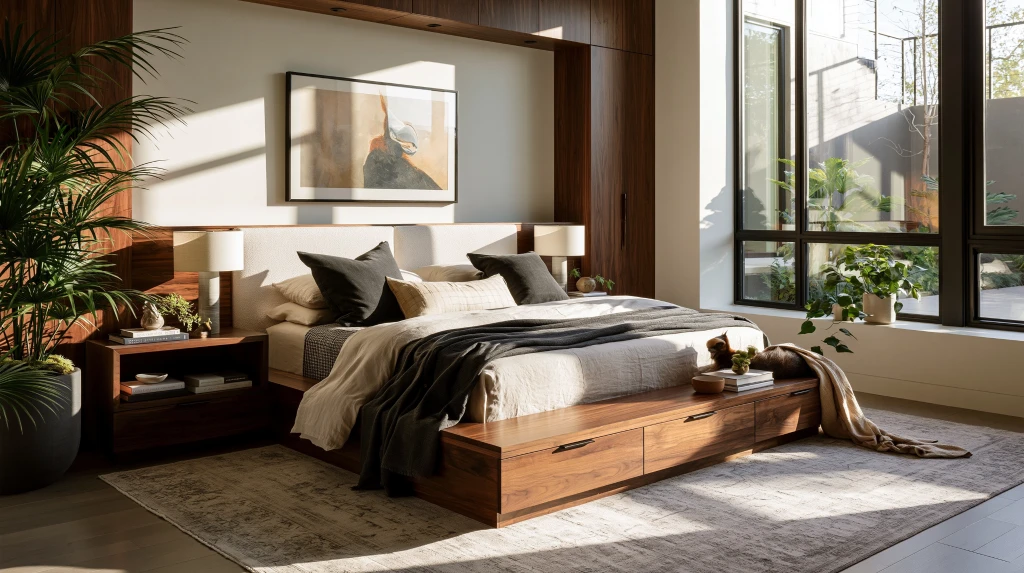
One mistake is choosing the frame before the mattress. The mattress often decides the final height more than the frame does. A second mistake is treating the headboard as a decorative panel rather than a wall-scale element. Its height should respond to the ceiling, windows, artwork, and lighting.
Nightstands are often misjudged, too. If they are much taller than the bed, they interrupt the calm horizontal line. If they are too small, the room becomes impractical. Lamps can create the same problem. A tall lamp beside a low bed may feel theatrical rather than restful unless the shade, wall, and ceiling heights support it.
Another common issue is reducing minimalism to the absence. A quieter bedroom still needs tactile decisions. Without texture, shadow, and material variation, restraint becomes emptiness.
The National Sleep Foundation notes that sleep improves when a bedroom is optimized for temperature, noise, light levels, and comfort. That is a helpful reminder that the bedroom is not primarily a styling exercise. Its success depends on sensory control.
The Resting Datum Test
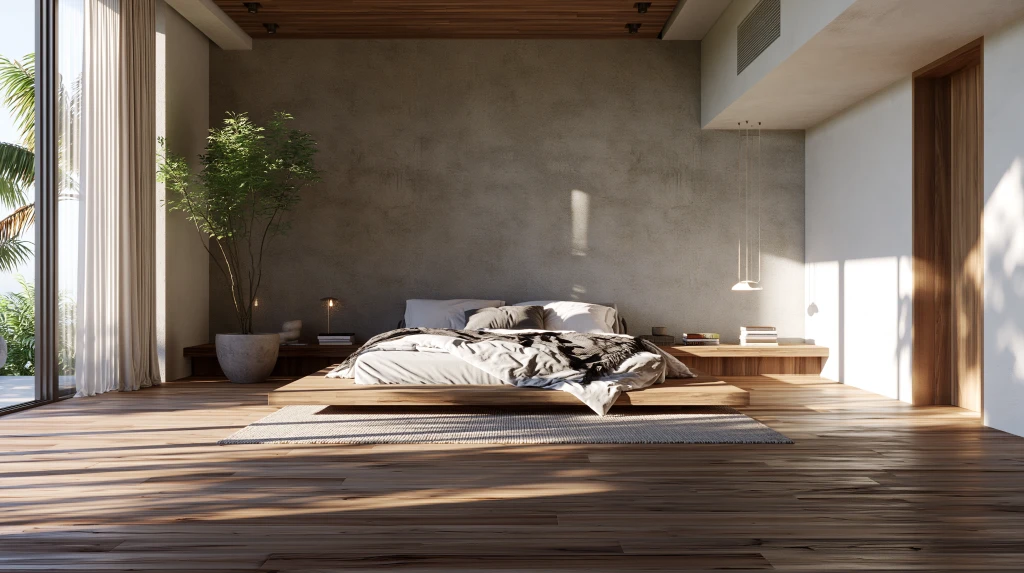
Here is a simple test for designers: draw an imaginary line across the top edge of the bed, nightstands, bench, low storage, and any nearby sill or ledge. Does the eye move calmly across the room, or does every object fight for its own height?
This “resting datum” is not a rigid rule. It is a diagnostic tool. A room can still have a tall lamp, vertical artwork, or a strong plant form. In fact, it often should. But those vertical elements need to feel intentional against a stable low field.
When the datum works, the bed becomes more than a place to sleep. It becomes the organizing horizon of the room. Circulation feels clearer. The wall feels less crowded. Materials become easier to read. The body receives fewer visual signals at the end of the day.
The strongest bedrooms do not lower everything. They give the eye one quiet line to trust.
Designing for Rest, Not Just Style
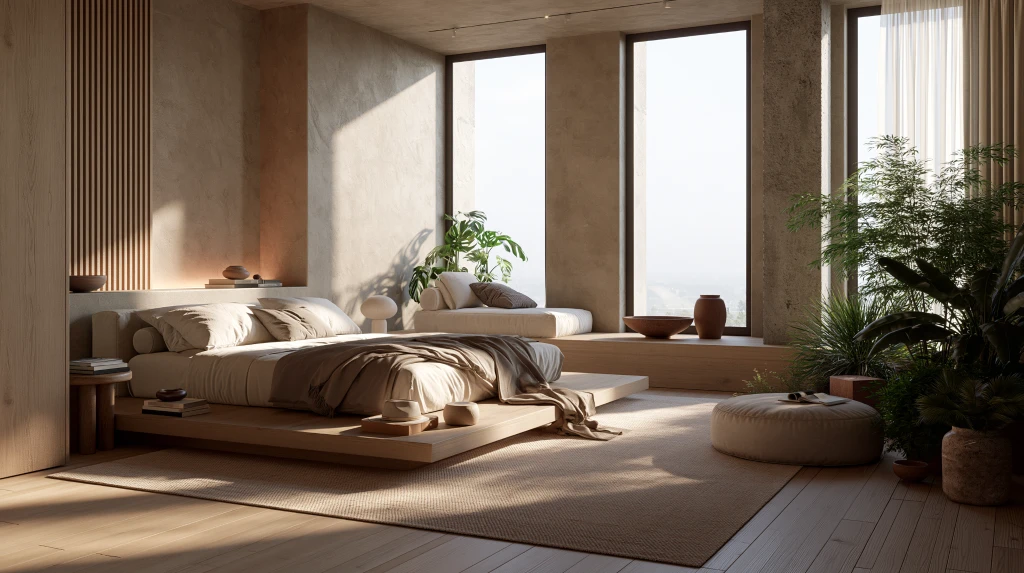
Contemporary residential design is increasingly shaped by compact living, indoor well-being, material responsibility, and the search for calmer environments. The bed sits directly at the intersection of these concerns. It is intimate, practical, spatial, and symbolic.
A strong bedroom does not begin with matching furniture. It begins with a clear understanding of how the room should support rest. The bed sets that logic first. Everything else follows: the wall plane, the path around it, the softness underfoot, the shadow behind the headboard, the distance to the window, and the quiet relationship between material and body.
Handled well, the bed is not simply placed inside the bedroom. It becomes a small architecture of rest.
