



Whether form follows function or less is more to less is bore, the architectural discourse is no stranger to bold statements. Rem Koolhaas, by far, has posed the most daring one, “f*ck context,” in his theory of “Bigness” in Architecture. While intimidating at first glance, seemingly rude, and defying most of architecture’s essence, bigness is a very intriguing approach. When architecture is measured through the lens of aesthetics and contextuality, Koolhaas breaks all the rules.
The concept of Bigness looks at scale from a different angle and pushes the perception of architecture to uncharted waters. When a building reaches a scale bigger than one could fathom, often bigger than its own context – like a huge monster looking down on us – it becomes something entirely new: an urban engine, collaborative system, or political statement. This article will explore the concept of Bigness, as defined by Koolhaas, and look at real-world examples where his theory has come to life.
The Birth of Bigness in Architecture

Koolhaas talks about “Bigness” in his groundbreaking book S,M,L,XL, arguing that buildings of a certain size start operating beyond conventional architectural principles. Here’s a reiteration of the key five theorems he emphasizes to explain bigness:
- When a building reaches a certain size, it becomes a “Big Building” that can no longer be controlled by a single design approach.
- Inventions like the elevator replace traditional architectural connections. Classical ideas of composition, scale, and proportion become irrelevant in Bigness.
- As buildings grow larger, the exterior no longer reflects what happens inside. The façade becomes its own project, offering stability, while the interior deals with constant changes.
- Due to its sheer size, a “Big Building” exists outside the realm of good or bad. Its scale alone places it in an amoral domain.
- Bigness no longer integrates with its surroundings. It stands apart from the city, existing on its own, often merely coexisting with the urban environment. In Koolhaas’s words on bigness, “Its subtext is f*ck context”.
Breaking Traditional Boundaries of Context

From the city of Rome to Paris and classical urban planners, we can feel the emphasis on contextuality. In school, we learned that a building must directly respond to its surroundings and be in harmony with them. Rem Koolhaas sees this in another way: if the city is so fragmented with so many languages, how can it inspire an architectural building? How can architects truly answer the needs of the city and its dwellers if it’s going to surrender to its random preexisting historical and cultural associations? The solution to liberate architectural creativity is to see the context as a clean slate, a blank page where anything can happen with no external factor holding architecture back. On this he writes:
“Bigness, through its very independence of context, is the one architecture that can survive, even exploit, the now-global condition of the tabula rasa”

When Bigness detaches the building from its context, consequently, it detaches its facade from the interior as well. What you see on the outside does not necessarily reflect the inside. The idea that form follows function starts to unravel, and architecture begins to take on an identity of its own.
At this scale, it is not important to focus on revealing the components of a building to the outside, but rather emphasize on what’s the best way for these internal systems to work together. The exterior can be a completely different statement that becomes an engine of urbanism, more than a part of the city, rather it becomes its own city within a city. Koolhaas writes:
“Where architecture reveals, Bigness perplexes; Bigness transforms the city from a summation of certainties into an accumulation of mysteries. What you see is no longer what you get.”
The Role of Technology and Teamwork

Rem Koolhaas is very inspired by technological advancement and emphasizes the role of systems like the elevator to reshape how architecture is built and can transcend traditional constraints. In a sense, Bigness makes architecture both more and less architectural. It heavily relies on external forces like engineers and politicians while its sheer scale shapes the city in unprecedented ways.
Here, he highlights the notion of teamwork, where the “starchitects” have dominated the field. Bigness is not the product of the architect on his own but rather the collective effort of professionals in various disciplines. On this, he writes:
“Bigness is impersonal: the architect is no longer condemned to stardom – Beyond signature, Bigness means surrender to technologies; to engineers, contractors, manufacturers; to politics; to others. It promises architecture a kind of post-heroic status – a realignment with neutrality.”
Bigness = urbanization vs. architecture
This is a statement Koolhaas keeps revolving around, and arguably, it can sum up his entire theory. Bigness in architecture, embodied in large-scale buildings, becomes more about addressing the demands of urban growth, like density and infrastructure, than traditional architectural design principles. Once a building reaches a certain size, it becomes part of the city’s fabric. It operates on an urban scale rather than as an architectural object, therefore the line between architecture and urbanism is blurred?. Only through technology and teamwork can this statement become a reality and Bigness be achieved.
Bigness, Human Experience, and the City

Koolhaas likens Bigness to a revolution without a manifesto, born out of technological advances such as elevators, air conditioning, and steel construction. These innovations allowed architecture to grow taller and more complex, effectively creating a new species of architecture.
Therefore, buildings at this scale entirely change how people interact with and within them. They will move through it as they would through a city, encountering different spaces and functions along the way. Essentially because it’s no longer about aesthetics or human-scale interactions but more about systems, infrastructure, and functionality.
Dissolving boundaries, programming spaces for opportunities, creating unconventional experiences within space, Koolhaas through his dismissiveness of context creates a paradox of a building that becomes context itself. He pushes for architecture beyond its architect, a building beyond its city, an experience that reflects the needs of its occupants and program. Ultimately, Bigness is architecture’s final monumental form, it possesses a hyper-real presence that transcends traditional architecture. Finally, I quote his words:
“Bigness is the last bastion of architecture – a contraction, a hyper-architecture. The containers of Bigness will be landmarks in a post-architectural landscape – a world scraped of architecture in the way Richter’s paintings are scraped of paint: inflexible, immutable, definitive, forever there, generated through superhuman effort. Bigness surrenders the field to after-architecture.”
Rem Koolhaas is indeed a visionary, despite whether or not his approach is the right approach in architecture or not. His concept of bigness challenges architecture and architects to create something beyond themselves, something different.
CCTV Headquarters, Beijing


The CCTV Headquarters is one of the most striking representations of Rem Koolhaas’s Bigness in architecture. Standing at 234 meters tall, this building defies the typical skyscraper form with its looping structure. Instead of being a conventional vertical tower, the building bends into a continuous loop, creating a vast network of interconnected spaces. Koolhaas reimagined how architecture interacts with its environment, shifting from the standard aesthetic to a functional, system-driven approach.
The massive scale of CCTV transforms it into a self-sufficient entity. The building’s complex structure accommodates a wide range of functions, from broadcasting facilities to office spaces, all within its continuous loop. The sheer size and bold shape break traditional architectural conventions, aligning with Koolhaas’s theorem that Bigness erases the need for conventional design elements, and this building shifts the focus from visual identity to technological complexity and infrastructure. Its own program becomes a city within the city of Beijing.
Seattle Central Library
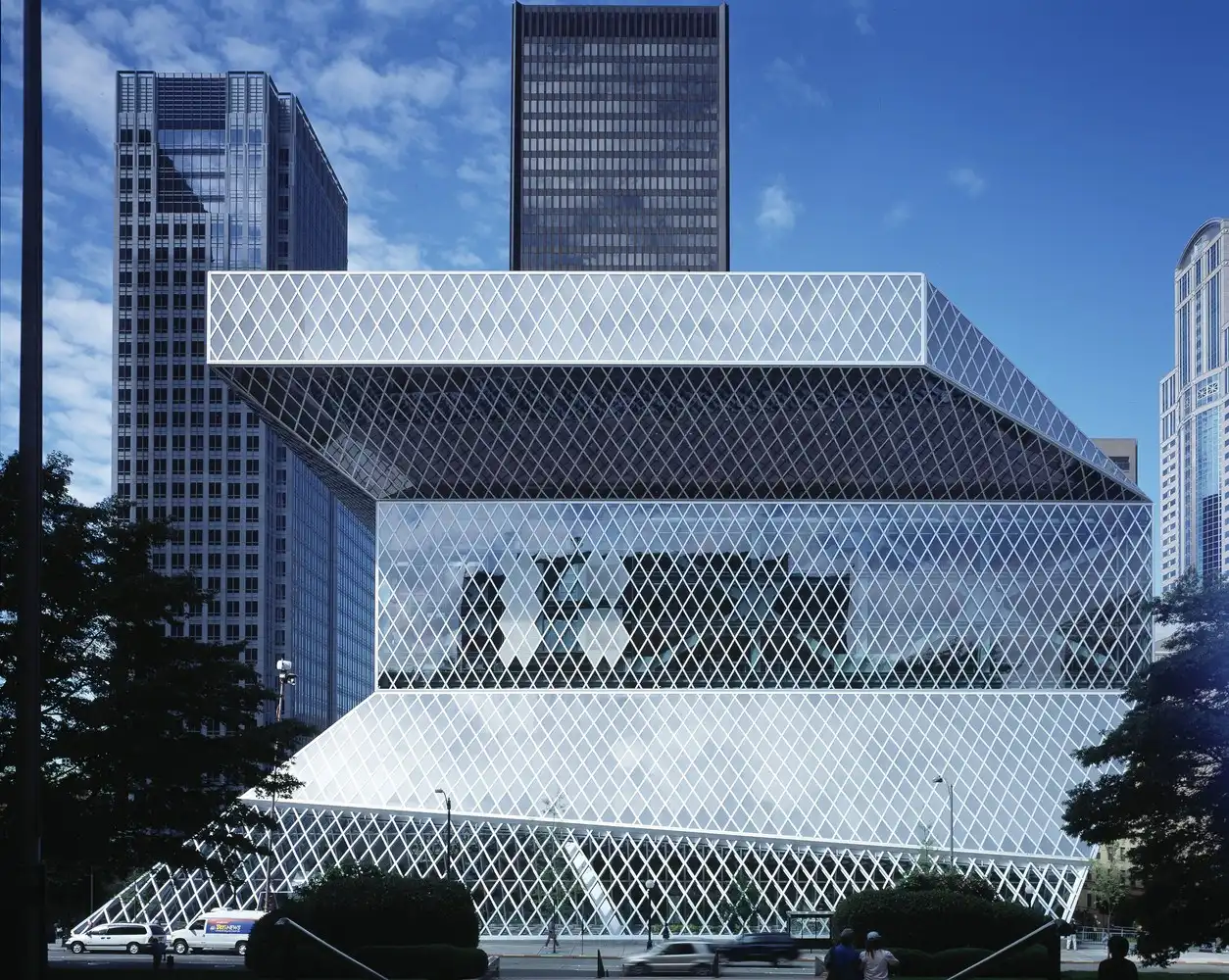

With its layered design, the Seattle Central Library embodies Bigness. Koolhaas designed the library to serve not just as a hub for books but also a dynamic urban space for public interaction. The building’s structure is unconventional, with stacked volumes that each serve different functions, such as reading rooms, computer stations, meeting spaces. This represents a break from the traditional library format with a compartmentalized layout that exemplifies Koolhaas’s assertion that large-scale buildings must organize complex functions into distinct systems.
The external glass and steel façade conceals a series of layers, each functioning independently yet integrated into a single, cohesive system. Inside, users move through a variety of spaces, each tailored to a different use, much like navigating a small city.
The library does not follow traditional architectural expectations but becomes a living, adaptable organism within the urban landscape. At 11 stories high, the library is not massive in height, but it represents Bigness in its concept. This example embodies the essence of Bigness, as it is not necessarily about huge scale but rather as the way you approach architectural design on any level.
