



It’s not just about AI tools or chatGPT in particular, technology is advancing while human nature is inherently the same. We are in a constant battle of keeping up with our own creations. Let me ask you, did smartphones, laptops, and the internet make us lazy? You might feel a little pause, you want to say no but yes lingers.
Even poison taken in daily little dosages becomes protective, so the question is how are we using these AI tools? For example, just because chatGPT can do a summary task much faster, should you let it and at what cost? This article will explore the influence of chatGPT on our life, and conclude whether or not it’s a danger to our productivity and overall sanity.
The Impact of Technology on Our Brains

Before we delve into some of the major issues ChatGPT presses, let’s discuss the general allure of technology, particularly AI. At present, how much tolerance do we have for long-form content, and how has our reading capacity changed? Why is it almost hypnotizing while watching one reel after another, and how could so much time pass when you can swear it was just 10 minutes? What is happening to our cognitive skills, and why have we become so addicted to stimuli?
A very comprehensive study was published on frontiers in 2023 that perfectly highlights the intricate relationship between humans and technology. On the matter of consuming algorithm-tailored content via social media, the review highlighted a decline in the brain’s ability to process information. With time, people become passive consumers of information and this ultimately decreases critical thinking and analytical skills. This dependent obsessive pattern has also been associated with changes in brain structure, particularly a reduction in gray matter volume in areas responsible for emotion, motivation, and cognitive control. Therefore, our random impulsive behaviors and incapability to focus and think deeply are highly related to this decrease. Another major drawback is the decrease of white matter in our brains, which is basically responsible for allowing different parts of the brain to communicate efficiently.
The impact of these changes is not just theoretical; there is evidence that the brain’s reward system becomes increasingly dependent on instant gratification. These structural biological changes can perfectly explain the zombie-like state where individuals mindlessly consume content without meaningful reflection. AI tools like ChatGPT are adding oil to an already burning fire. Our brain is overloaded as it is with AI algorithms and social media, what happens when AI can do all the important thinking for us too?
The Issues with Relying on ChatGPT
Whether it’s students or professional writers, everyone has utilized chatGPT one way or another. The rising concern in education argues that the use of chatGPT can lead to a significant reduction in student effort. This makes sense because most students dislike homework, and using such an AI tool can remove the burden of essay writing or even solving math equations in a few minutes. This leads to intellectual laziness and poses an even bigger question on the role of teachers. What kind of “homework” must be assigned to students in order to further engage them in the learning process without turning to quick fixes like chatGPT?
Furthermore, critics argue that the intuitive dependence on chatGPT to proofread or edit our content, for example, choosing the right synonym or rephrasing a smoother transition, can weaken essential writing skills. Soon enough, even human writing will be flagged as AI-generated because this dependency is toxic for creative thinking. While this habit may not sound too critical, over time writers will lose the ability to craft creative content because they are relying on whatever the AI gives them.
Some researchers positively argue that ChatGPT can significantly boost productivity, especially in the areas of research and journalism. Sure, ChatGPT can summarize complex documents, generate initial drafts, help brainstorm, and manage time efficiently, but at what cost? Throwing these mundane tasks to AI keeps our cognitive, deep thinking, and analytical skills at bay. The brain is like a muscle, and this type of work is the perfect exercise to sharpen such skills. Long story short, we risk losing our intellectual rigor and the ability to think critically when faced with challenges if we keep offloading the autonomous tasks to chatGPT.
The Verdict on ChatGPT Laziness

A study conducted in Pakistan and China explored how artificial intelligence affects decision-making, laziness, and privacy concerns among university students in both countries. The findings revealed that AI contributes to laziness in 68.9% of cases.
One might argue that it is even laziness or the cost of efficiency. The discussion has so many perspectives because while the use of AI tools such as chatGPT can harm us, it can also revolutionize the way we do things. Technology is much like a double-edged sword. Fire, for instance, can save us from freezing in the depths of winter, yet it can also bring destruction to the battlefield. Fire itself isn’t inherently good or bad; its impact depends entirely on how we choose to wield it.
The tech dream, let’s call it, promises that AI will take over all the mundane, repetitive tasks and free up our minds for more creative endeavors. Here lies the challenge: how can we strike a balance in using chatGPT without sacrificing our own productivity? This is another topic on its own, but I’ll give you a quick demonstration. Let’s try to ask chatGPT the title question of this article.
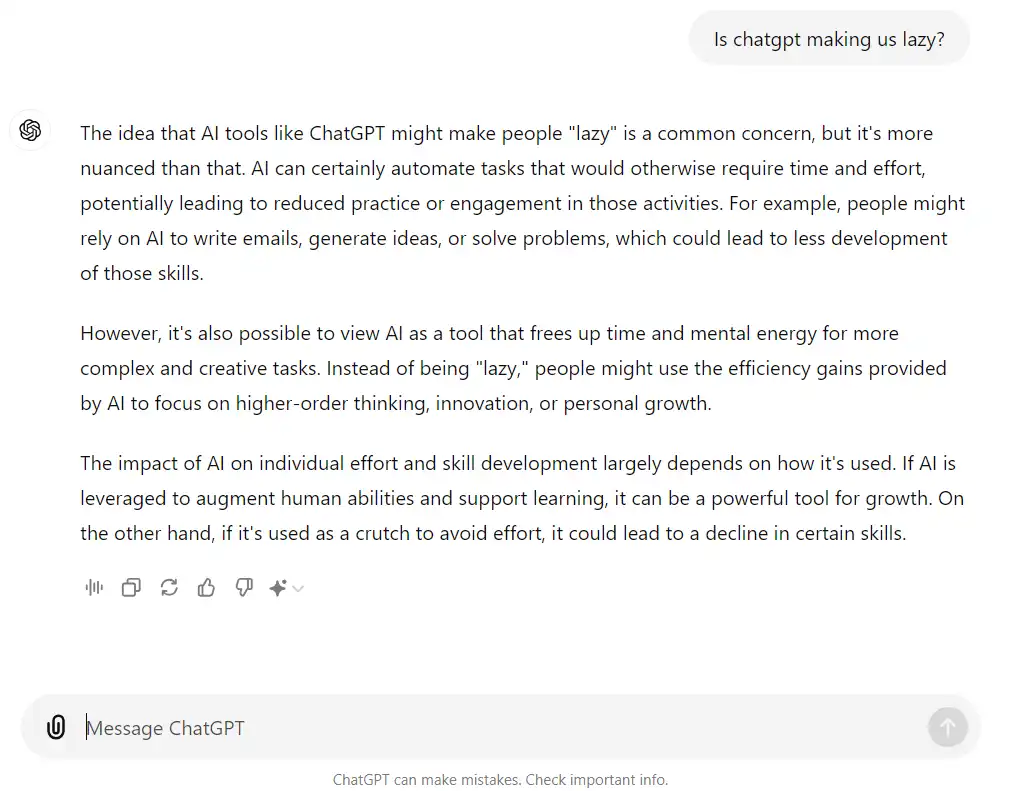
As you can see, the response is the most generic data anyone can use. It does not add any value or depth to the topic, but rather, the answers are very straightforward. The problem is that most people deal with chatGPT as if it’s a source of knowledge. Even though there’s a note screaming down there, ChatGPT can make mistakes. Check important info. A better way to engage your own analytical skills and the AI’s ability to go over vast amounts of data is to write a very detailed prompt. From there, it becomes a collaborative process of give and take, where you treat chatGPT like an editor or an interactive talking notebook. A better prompt for this example can be:
“I need you to compile a list of ideas in brief bullet points to help me write about whether chatGPT is making us lazy or not. Browse the web for the most credible sources. Topics of interest could be human cognition skills, education, and professional writing.“
In an interaction like this, whatever chatGPT gives you becomes the head of a thread that will lead you somewhere else – never the end result. The more effort you put into interacting with chatGPT, the more you train your own thinking skills. That prompt can be pushed even further, for example, you can write up to 100 words describing the different connections you realize on a certain topic and ask chatGPT to find sources that align with your idea. Is chatGPT making us lazy? Yes there’s no doubt. However, is this phenomenon beyond help? Of Course not. We just have to find a way to keep training our instincts and honing our cognitive skills to use chatGPT as an ally instead of a savior.
