


The Great Wall of China is more than just an architectural marvel; it is a cultural icon deeply entwined with myth and legend. Over the centuries, the Wall has transformed from a military defense structure to a symbol of imperial power and, ultimately, into a touristic monument rooted in folklore.

Ancient stories tell of a powerful sorcerer who shaped the Wall to ensure its invincibility with the aid of earth spirits and a white dragon. The Wall’s haunting aura comes from the countless lives lost during its construction; from these tales come statues and temples dedicated to Meng Jiangnü, whose grief for her fallen husband is said to have caused a section of the Wall to collapse. These legends and transformations have woven the Great Wall into the very fabric of Chinese culture, making it not just a feat of engineering but a timeless symbol of the nation’s rich heritage and, eventually, one of the world’s seven wonders.
Introducing the Great Wall of China

The construction of the Great Wall of China began in the 7th century BCE, but the most famous sections were built during the reign of the first Emperor of China, Qin Shi Huang, around 221–206 BCE.
How long is the Great Wall of China?
Spanning over 13,170 miles (21,196 kilometers), the Great Wall is the longest man-made structure in history. Its full length has been accurately measured and announced by China’s State Administration of Cultural Relics in 2012. It roughly consists of:
- 6,259.6-kilometer (3,889.5-mile) artificial wall
- 359.7-kilometer (223.5-mile) trench
- 2,232.5-kilometer (1,387.2-mile) natural barrier
- 5,723 beacon towers
- 7,062 watching towers
- 3,357 wall platforms
- 1,026 other related ruins
This wall has been built over several dynasties, and many of its sections are located in desolate mountains, grasslands, or deserts, making measuring it an almost impossible challenge. Using a combination of advanced remote sensing, GPS technology, and a five-year archaeological survey conducted across 15 provinces, the length is as accurate as it could be today.
The first person to hike the Wall of China was Liu Yutian, who started in 1984 and, after facing life-threatening obstacles, finished in 1986. It took him 2 years to hike 5,000 km, and if you do some math, it would probably take around 9 years to hike the completely discovered 21,196 km today!
What is the Purpose of Building the Great Wall?

Defense: The Wall was primarily built to protect the Chinese states and empires from invasions and raids by various nomadic tribes from the north, including the Xiongnu and later the Mongols.
Protect the Silk Road Trade: The Wall also served in regulating and protecting trade and immigration along the Silk Road (an ancient route linking China with the West), therefore controlling the movement of goods and people across the border.
Construction Evolution of the Great Wall of China
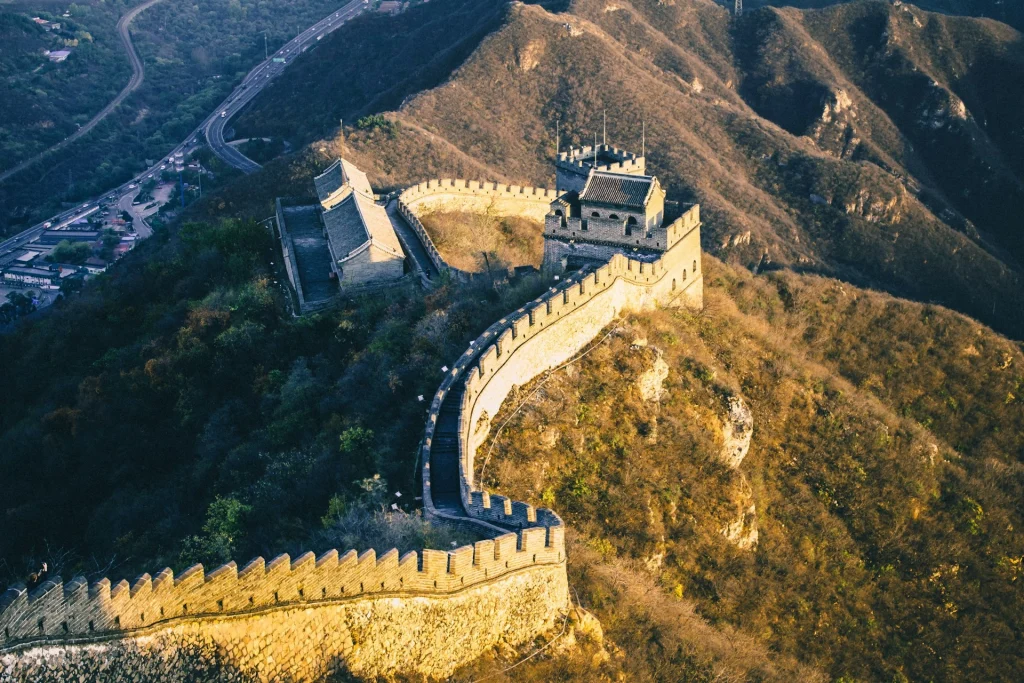
The Great Wall evolved with the changing needs of China’s different dynasties. From a defensive structure into a sophisticated military system and eventually into a historical monument, we can classify the Wall’s construction evolution into three stages:
The Start: Basic Defense Structure

China was deeply fragmented in the seventh century BCE, with ongoing conflicts between its different states. Among the first to construct defensive walls were the states of Qi, Yan, and Zhao, who built these barriers to protect their territories from invasions by neighboring states and nomadic tribes.
These early walls were primarily built with rammed earth and wood, materials that were abundant and easy to work with. The fragmented walls were simple structures meant to slow down or deter invaders rather than completely stop them.
Military Enhancements Throughout Dynasties

Qin Dynasty (221–206 BCE):
- Purpose: Protect the newly unified China from the nomadic Xiongnu tribes to the north.
- Construction Changes: Emperor Qin Shi Huang ordered the connection of the various state walls into a continuous defensive system, creating the first true “Great Wall.”
- Materials Used: Rammed earth reinforced with wooden frames. The construction was strategically significant but less durable compared to later periods.
Han Dynasty (202 BCE–220 CE):
- Purpose: Protect and secure the Silk Road trade routes from nomadic raids to facilitate cultural and commercial exchange.
- Construction Changes: Extended the Wall westward into the Gobi Desert.
- Materials Used: Signal towers were built for improved communication with a continued use of rammed earth. In some areas, stone was utilized to enhance durability.
Tang, Song, and Yuan Dynasties (618–1368 CE):
- The Great Wall of China did not undergo significant construction or expansion during the Tang, Song, and Yuan Dynasties.
- The Tang Dynasty relied more on diplomacy and military expeditions, leading to only minimal repairs on the Wall.
- Due to limited resources, the Song Dynasty focused on fortifying strategic passes rather than major Wall construction.
- Under the Yuan Dynasty, the Wall’s importance declined as the Mongol rulers saw little need to maintain it, leading to its gradual disrepair.
Ming Dynasty (1368–1644 CE):
- Purpose: Renewed threats from northern tribes, particularly the Mongols, revived the defensive need for The Great Wall.
- Construction Changes: There was an extensive rebuilding and expansion program. The Wall was reconstructed as a more strategic defense system, with the addition of beacon towers for signaling, garrisons for troops, and gates for controlled access.
- Materials Used: Bricks and stone, making itl more durable and resilient.
A Historical Touristic Monument

During the Qing Dynasty (1644 CE), the defensive significance of the Great Wall diminished as the empire’s borders expanded northwards into Mongolia and Manchuria. It morphed into a symbol of endurance and protection by China’s previous Emperors.
Tourist interest in the Great Wall of China began in the late 19th and early 20th centuries, but its global recognition didn’t launch until its formal opening in 1957. The construction techniques adopted in the restoration process were a blend of craftsmanship and contemporary methods to preserve the Wall’s enduring legacy as a cultural treasure.
For example, bricks and cut stone blocks were commonly used to restore eroded sections, particularly in areas where the original Wall was built with similar materials. In cases where bricks and stone were not available, rammed earth and uncut stones were employed, following traditional methods. Lime mortar was typically used, replicating the techniques from the Ming Dynasty. In some sections, modern materials like cement were used to reinforce structural stability without compromising the Wall’s historical appearance.
Learn with PAACADEMY: Attend workshops at PAACADEMY to learn from the industry’s best experts how to use advanced parametric design tools, AI in design workflows, and computational design in architecture!
