


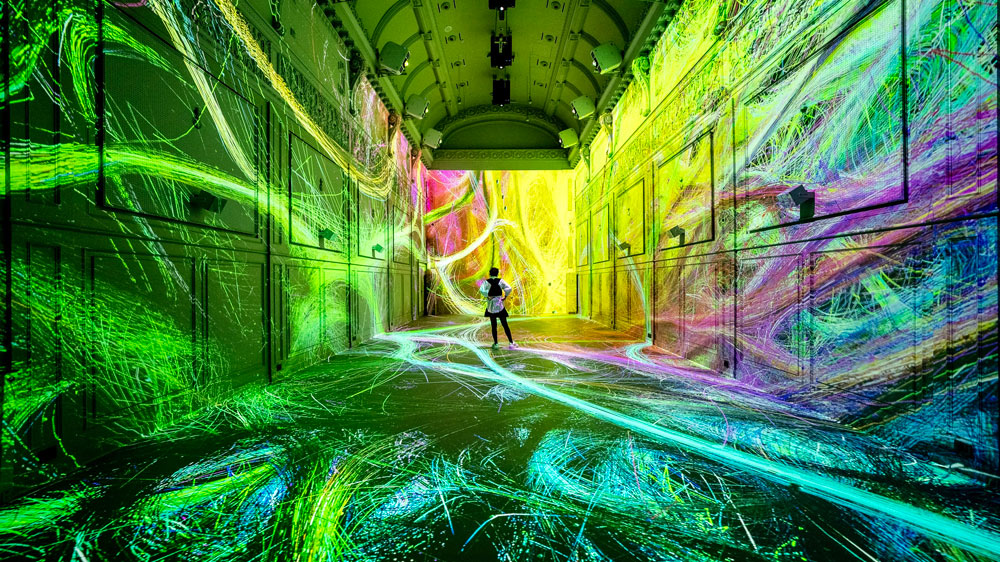
Generative art, an intriguing nexus of art, technology, and mathematics, has evolved significantly through the years. It is ingenious and dynamic work that is set in motion by the use of algorithms and computer processes, often capitalizing on the unpredictable nature of randomness. In this article, we will explore the definition of generative art as well as its typical characteristics, historical evolution, and the interplay between artificial intelligence (AI) and machine learning (ML) within this modern discipline, highlighting some notable works.
Definition

Art produced by machines – such as computers and robots programmed using mathematical formulas, with the intent of creating something beautiful is called generative art. Being created with certain instructions given by the artist, these rule-based systems may lead to unexpected outcomes. Artists use such techniques to create intricate and unusual work that could not have been created by traditional methods.
In general, generative art challenges traditional views on creativity and who makes something by using processes that are not entirely controlled by the artist. Instead, the artist sets initial conditions and lets a system follow its predetermined behavior, resulting in a co-creative dialogue connecting human intention with computational processes. Due to this, artists find themselves producing anything from simple tunes to extremely diffused computer graphics. Indeed, generative art is a form of artistic creativity in which technological innovation blends with creativity and conceptions about conventional practices are defied.
Characteristics

Generative art pertains to an exclusive blend of invention and technology, and it is characterized by several aspects that distinguish it from traditional art branches. Generative art is centered on algorithmic authorship, under which artists apply computer algorithms that specify boundaries and parameters to guide creation. Another distinct characteristic is autonomy: once the basic principles have been determined, a generative system operates independently and often produces new and surprising results without human intervention. This is why an artist can be identified as a proceduralist rather than an author of solitary pieces.
Moreover, generative art requires randomness and chaos to make it more creative because they create an element of uncertainty in the process of creation. Unpredictable and varied outcomes may often result from the introduction of random variables into the generative systems; hence, they are capable of producing diversity from a limited quantity when subjected to particular initial conditions. Repetition and variation are closely linked to unpredictability because many instances of the process are performed. Each repetition introduces minor changes. As a result of this recurrence procedure, the artwork becomes more intricate and reflects similar processes in nature, such as growth and evolution.

For generative art to be aesthetically and conceptually attractive, it must involve complexity and emergence. Moreover, emergence is the way in which a lot of almost impossible patterns to understand rise from very simple rules. The complexity and increased sophistication of findings are illustrated by generative systems, in which complex results are obtained from simple and distinct parts, oftentimes leading to new forms and structures that were not determined before. Generative art is characterized by these dualities: between control and disorder, between order and chaos.
Historical Evolution of Generative Art

The history of generative art is extensive, spanning more than a century. Its early origins are in early 20th-century movements such as Dadaism and Surrealism. When computers were developed in the 1950s through the 1960s, generative art, as it is known today, began to take shape. Frieder Nake and Georg Nees were some of the first artists who played around with machine-generated visuals, whereas Ben Laposky and Herbert W. Franke began creating nonrepresentational electronic art through analog instruments.
Harold Cohen’s AARON was one of the earliest works of art produced by artificial intelligence (AI) programs. As a result, its development was a critical turning point in the field during the 1970s, but by the 1980s and 1990s, personal computer usage and programs like Adobe Illustrator helped open generative art to even more people. Processing, a programming environment democratizing computational creativity, was released in the early 2000s. In recent years, generative art has revolutionized due to the combination of ML and AI. Methods such as generative adversarial networks (GANs) and neural networks have made it possible to create extremely intricate and adaptive works of art.
It is progress embodies the continuous relationship between art and technology, which makes possible a variety of means for artists to express themselves. The internet’s growth and digital distribution channels’ impact and reach have furthered this relationship.
Role of AI and Machine Learning in Generative Art

Artificial intelligence (AI) and machine learning (ML) have taken generative art to new levels of complexity as well as creativity. With fancy algorithms, it is now possible for artists to make unimaginable works. By employing neural networks as well as generative adversarial networks (GANs), AI allows for the creation of artistic pieces using patterns detected in huge databases of earlier artworks. The machines may be trained to understand standards so they can imitate people’s creative ideas, resulting in strikingly aroused feelings that are appealing to the eyes but also make sense at an intellectual level.
AI and ML are crucial components in generative art beyond creation itself since they assist in curating and making art experiences more personal, thereby democratizing art for a larger audience and increasing its accessibility. With the advancements in AI, generative art incorporating it is poised to unlock further possibilities that could lead to innovative forms of expression, while technology will change how humans interact with it in the future.
Notable Generative Artworks and Artists

A lot of popular art pieces and artists have really helped to develop generative art. In this area, Harold Cohen created AARON, one of the initial systems of AI that could individually draw sophisticated drawings. Equally important is Casey Reas, who created Processing, a language that has allowed numerous artists to try out code-based art. It was Reas who made famous generative works such as his “Software Structures series”.
A famous artist, Refik Anadol, is known for his wide and deep installations. He use AI technology to turn empty spaces in buildings into living and dynamic environments. “Melting Memories,” by Anadol, utilizes machine intelligence and analytics to render huge databases into creative visual experiences. Such techniques as real-time data processing and machine learning are always present in his work to create visual experiences full of dynamics.

Mario Klingemann, in contemporary art, is famous for his use of neural networks. Through his art, Klingemann investigates the fine line between human creativity and the capacity of machines for artistic creation. There are an infinite number of portraits generated in real-time by the AI in “Memories of Passersby I” by Klingemann.
To conclude, generative art is characterized by the use of self-generating systems, set processes, scaled-up effects through interaction, and autonomy. These characteristics enable artists to experiment with various things, pushing boundaries within the creative realm. By employing algorithms, AI, and ML, generative artists can create dynamic, unpredictable, but captivating works of art. Creative minds that use high-tech to produce one-of-a-kind pieces have redefined contemporary art through generative artworks that combine imagination with technology.
