


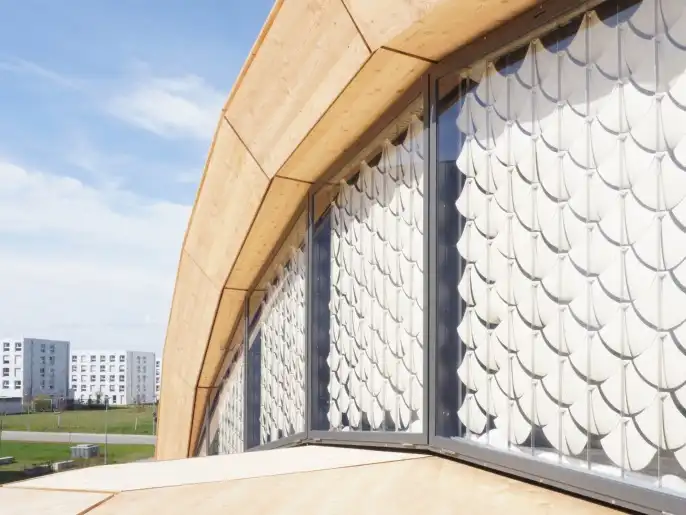
The Solar Gate is a weather-responsive shading system installed on the south-facing skylight of the livMatS Biomimetic Shell. Inspired by the hygromorphic principles observed in pine cones, it achieves adaptive shading without relying on metabolic or electrical energy. Instead, the system utilizes bioinspired mechanisms that emulate the anisotropic structure of cellulose found in plant tissues.
These mechanisms leverage 4D printing, allowing material systems to be fabricated in a flat state and programmed to transform into their desired shapes over time in response to varying humidity and temperature conditions. During winter, the self-shaping elements curl upwards to allow sunlight in, while in summer, they flatten to block direct sunlight. Powered solely by environmental fluctuations, the system represents an energy-autonomous and resource-efficient alternative to conventional shading systems.
Through the integration of bioinspired design, natural materials, and computational fabrication, the Solar Gate illustrates how adaptive facades can improve building functionality while minimizing energy consumption. It highlights the potential of accessible, low-cost technologies for adaptive architectural solutions, paving the way for harmonious interaction between buildings and their environment.
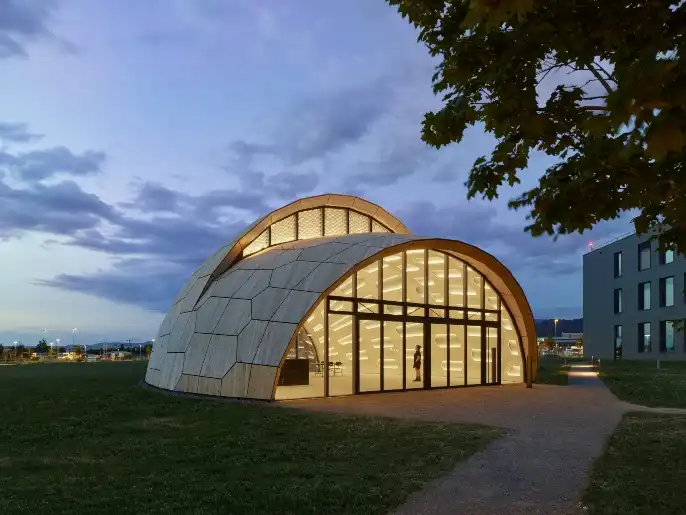
Comfort strategy and solar shading
The livMatS Biomimetic Shell is located in Freiburg, which experiences a temperate climate characterized by hot, dry summers and cold, humid winters, making solar heat management and regulating the building’s indoor temperature a critical consideration.
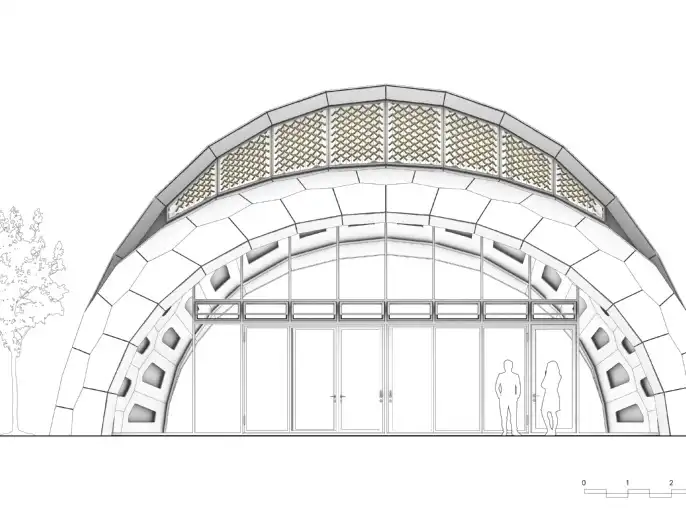
The south-facing Solar Gate optimizes solar heat gain during winter while minimizing excessive radiation in summer by integrating self-shaping elements that adapt dynamically to the sun’s movement throughout the day and across seasons. These elements are programmed to adjust their shapes to open and close based on seasonal solar angles, allowing low-angle sunlight to enter during winter for natural heating while blocking high-angle sunlight in summer to minimize heat gain.
Suspended within a protective double-skin facade, the printed elements are shielded from direct rain and wind, ensuring reliable performance while maintaining responsiveness to climatic changes. The comfort strategy of the Solar Gate contributes to improving occupant comfort and enhancing the energy efficiency of the livMatS Biomimetic Shell’s lightweight timber structure.
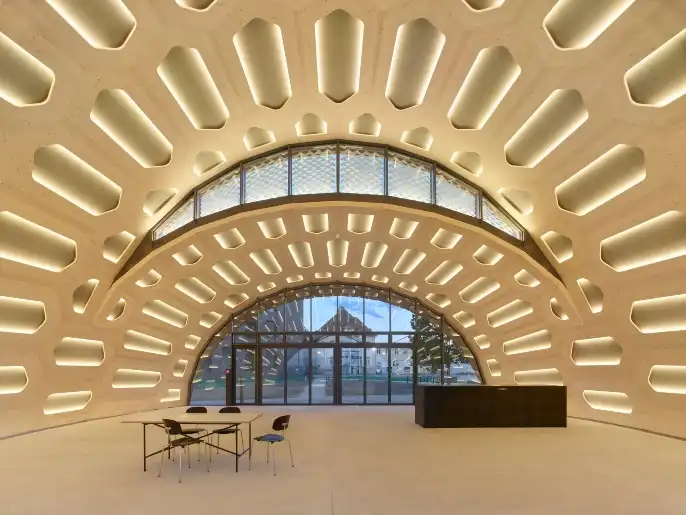
Hygromorphic material system
Cellulose, the most abundant biomass on Earth, is a renewable and highly versatile organic material. The fibers of cellulose exhibit anisotropic swelling and shrinkage behavior, leading to directional shape changes in response to moisture absorption and desorption. This phenomenon, known as hygromorphism, occurs as a result of fluctuations in air humidity. Hygromorphic functions are frequently observed in nature, such as in the dynamic opening and closing of pine cones and flower stands of silver thistles.
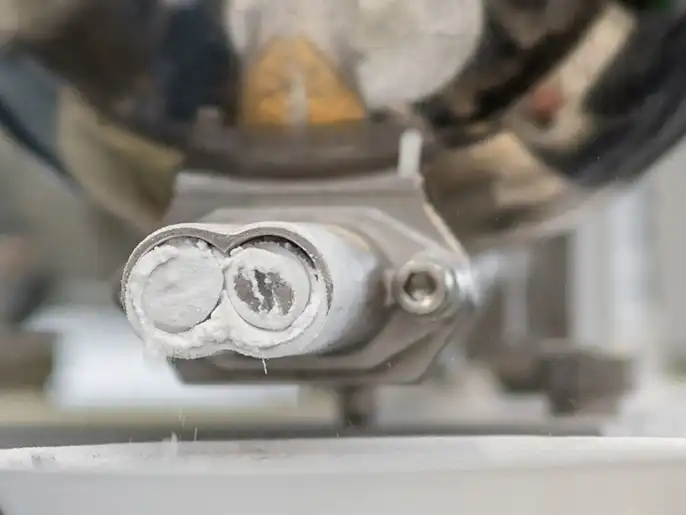
Inspired by the bilayer structures found in the scales of such cones, the Solar Gate leverages hygromorphic shape change through a custom-engineered 3D-printing filament enriched with cellulose fibers. To mimic the orientation of cellulose microfibrils in pine cone scales, the active layer is formed by extruding the swellable cellulosic filament in the direction perpendicular to bending, while the restrictive layer is created by extruding a non-swellable filament in line with the bending direction.
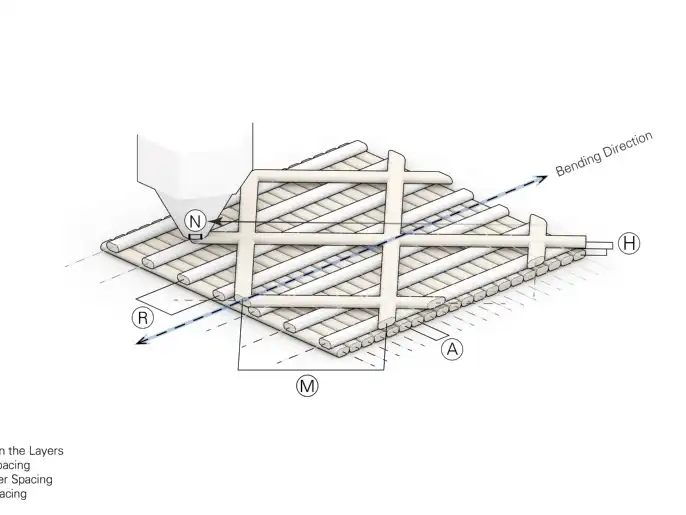
The mesh layer improves adhesion between the active and restrictive layers, helping to prevent delamination. In response to environmental humidity changes, the interaction between the cellulosic and non-swellable layers enables the printed hygromorphic bilayers to bend, creating an autonomous, weather-responsive solar shading system.
Long-term monitoring of the system in real-world conditions has demonstrated the material system’s high responsiveness and robust performance, with no noticeable reduction in actuation or mechanical damage from natural weathering. Further testing in controlled laboratory conditions has shown that the system maintains its reversible and repeatable motion response across numerous cycles and under cyclic actuation and prolonged UV exposure.
Through the codesign approach between biologists, material scientists, and architects, the Solar Gate showcases how the hygroscopic properties of cellulose can be leveraged through bioinspired 4D-printing to develop sustainable and highly responsive architectural solutions.
Upscaling 4D-printing production
The Solar Gate demonstrates a scalable production process for 4D-printed systems. A total of 424 unique self-shaping modules were fabricated for eight geometrically distinct windows, covering an area of 9.37 m². The entire production process was completed in 17 days, with four desktop 3D printers operating for 10 hours daily. Each unique module required 20–25 minutes to print.
The entire shading system was produced using 5.5 kg of cellulosic filament, which is equivalent to 0.65 kg/m2. The raw cellulose powder costs approximately €1.52 per kilogram, contributing to the process’s affordability. Only 7% of modules required reprinting due to minor defects, and 1.4% needed replacement after humidity-cycle testing.
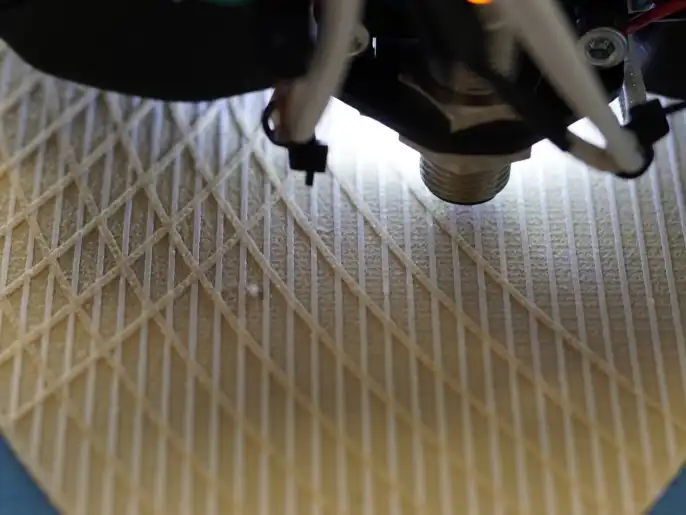
The production of the 424 unique elements was facilitated using a computational design-to-fabrication workflow. The specific geometries and motion responses of each shading element were fed into the 4D printing workflow, which generated the printing paths and machine code based on the curling direction of the double-flap modules. The material paths of the responsive layer are oriented perpendicular to the curling direction, while the restricting layer paths are aligned with the curling direction.
This successful upscaling of the 4D-printing process highlights the feasibility of fabricating self-shaping structures in a time- and cost-efficient manner.
Architectural integration of self-shaping elements
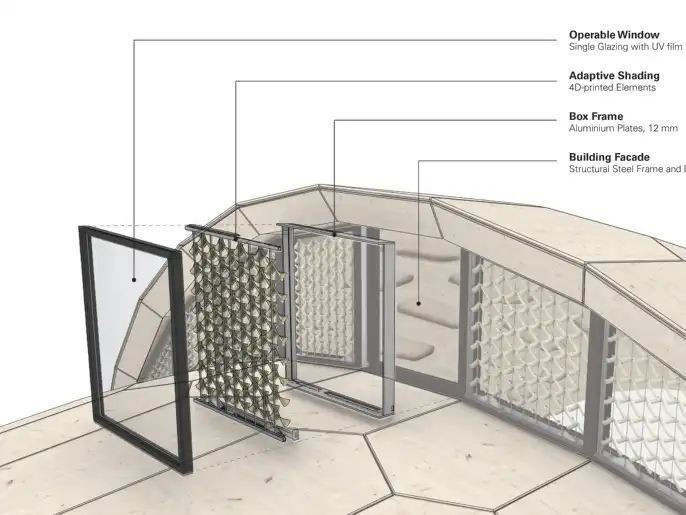
The Solar Gate represents, to our knowledge, the first integration of a 4D-printed self-shaping system into a building at an architectural scale. The printed shading elements are housed within aluminum box frames designed with top and bottom vents to facilitate airflow and ensure continuous exposure to environmental variations without disrupting the building’s ventilation strategy.
The elements are suspended from nearly invisible aluminum support structures embedded in U-profiles and tensioned to the box frames with fasteners. The aluminum box frames are affixed to the building’s structural steel facade, which features double-glazed panels for thermal insulation. Operable windows with single glazing and UV-protective film provide further control over heat intake.
The vents allow adjustment of the climate conditions within the box system of the shading elements, enabling their environment to be either equalized or isolated from external conditions. The combination of passive shading with active climate control reduces reliance on mechanical systems and enhances adaptability.
Each window includes embedded data collection infrastructure for continuous monitoring of shading performance and enables long-term optimization. This ensures that the bioinspired mechanisms function efficiently in response to varying climatic conditions. As a result, the Solar Gate exemplifies how sustainable, adaptable solutions can be integrated into the built environment, paving the way for a more resilient and environmentally conscious future.
Solar Gate 2023
The project description is provided by ICD/IntCDC University of Stuttgart.
Learn with PAACADEMY: Attend workshops at PAACADEMY to learn from the industry’s best experts how to use advanced parametric design tools, AI in design workflows, and computational design in architecture!
