

What if a 3D-printed book could be produced as a complete object in a single manufacturing process, eliminating the need for printing, binding, and assembly?
Manual, developed by Studio Darius Ou in collaboration with Benson Chong under the Hyperpress research initiative, explores that question through an entirely 3D-printed publication. The project treats the book itself as a single manufactured object, including pages, spine, binding, and text.
The result is a 26-page book that contains excerpts of its own G-code, the machine instructions used to fabricate it, transforming the production process into readable and tactile content.
What Makes Manual Different?
Standard books rely on multiple production stages: printing, trimming, folding, binding, and finishing. Manual removes these distinctions.
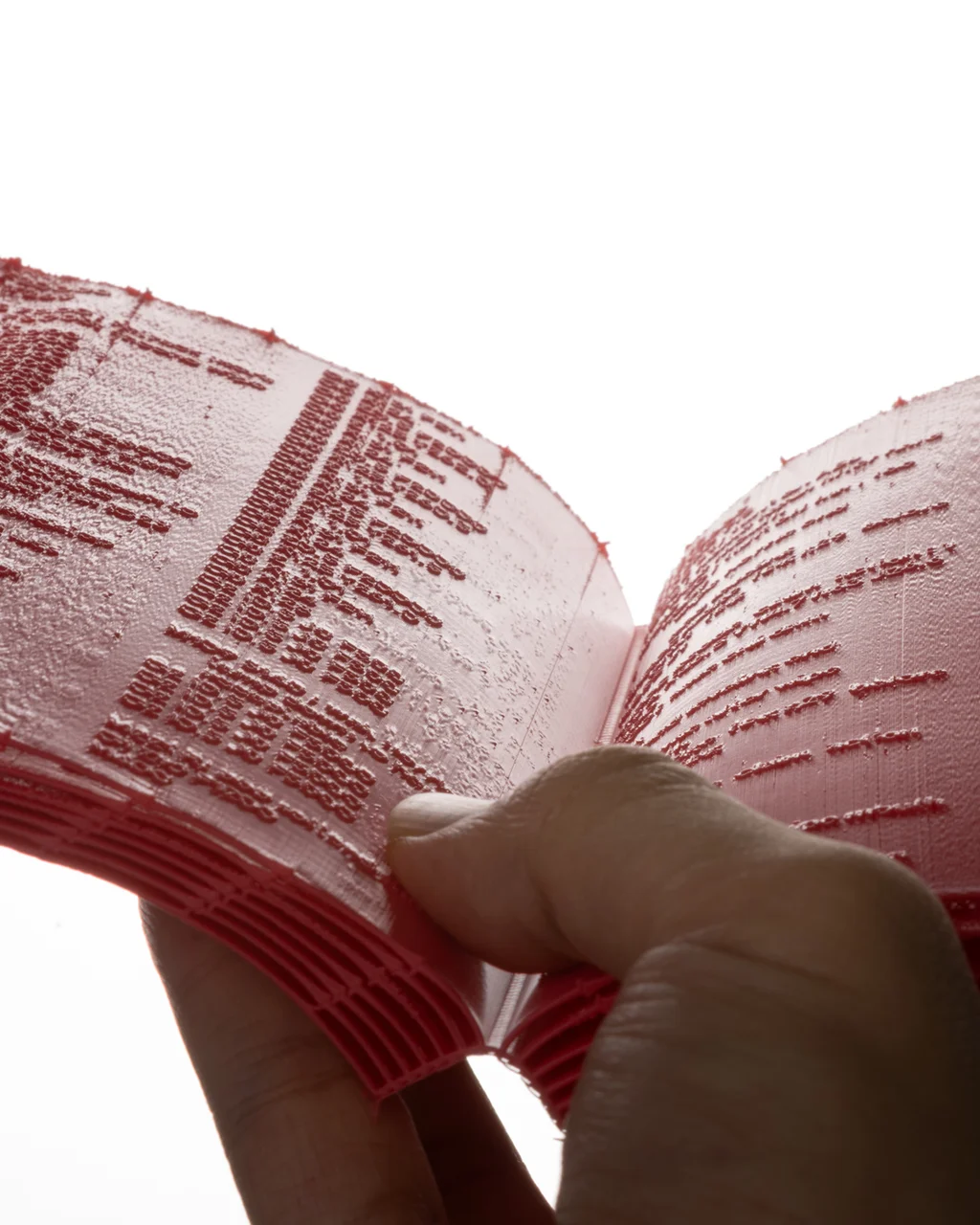
The entire publication is produced in a single uninterrupted printing sequence. Once the print job is complete, the book comes off the printer already assembled and functional, eliminating post-production processes entirely.
Instead of treating text as ink applied onto a surface, Manual integrates text into the structure itself. The embossed lettering found throughout the pages is formed from the same material as the book, making content and construction inseparable.
How the 3D-Printed Book Was Designed
Manual challenges conventional definitions of both books and manufactured objects.
The project approaches the book not as a collection of assembled parts but as a unified system. Every element, from page flexibility to binding mechanics, had to be designed simultaneously within the constraints of additive manufacturing.
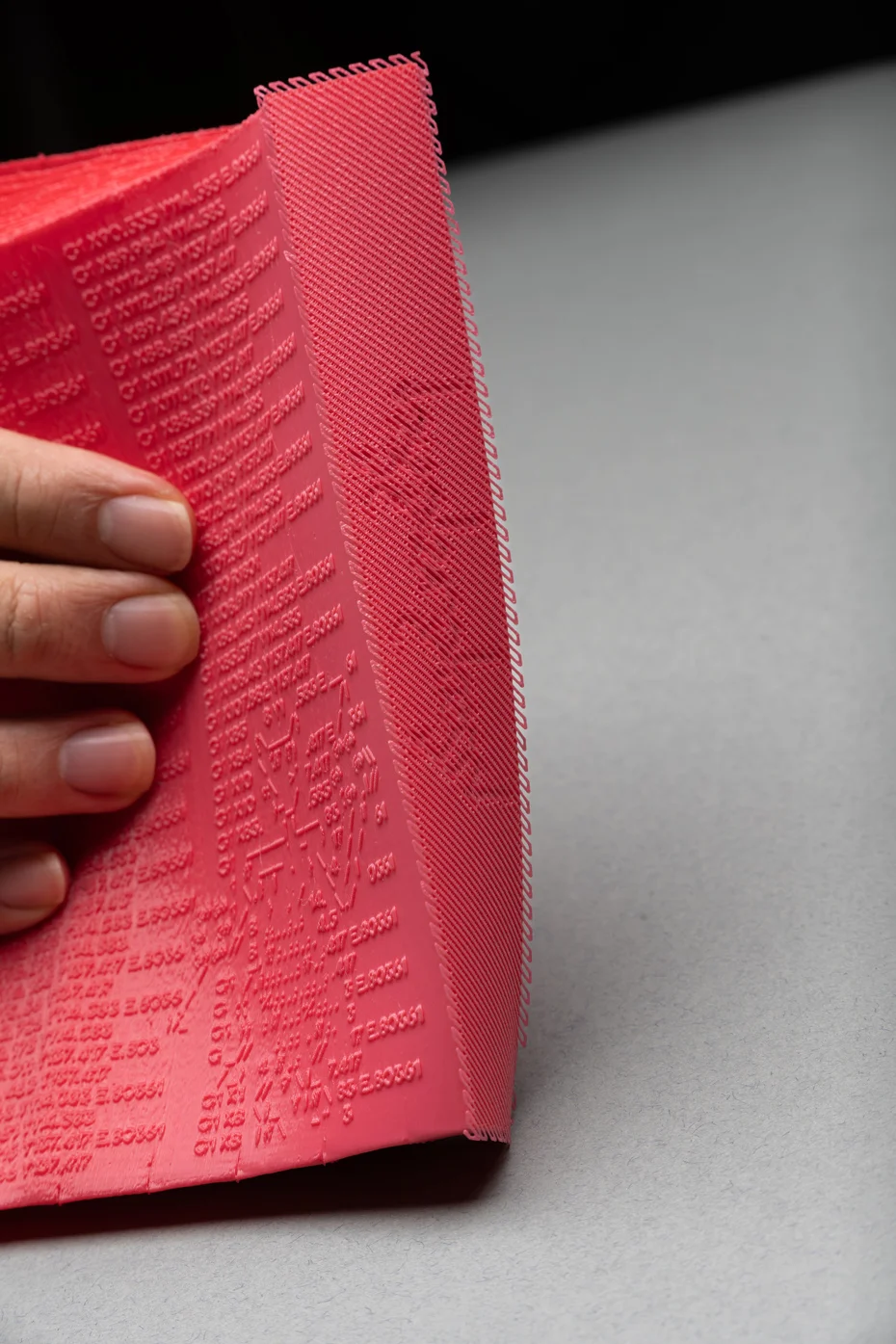
Its most distinctive characteristic is that the object documents its own creation. The raised text visible on the pages consists of portions of the G-code that instructed the printer how to make the book. In effect, the object contains fragments of its manufacturing blueprint.
This creates a unique relationship between content and form; the book is both a publication and a physical record of its production process.
The XY-for-Z Printing Technique
A key innovation behind the project is the use of what the designers call XY-for-Z printing.
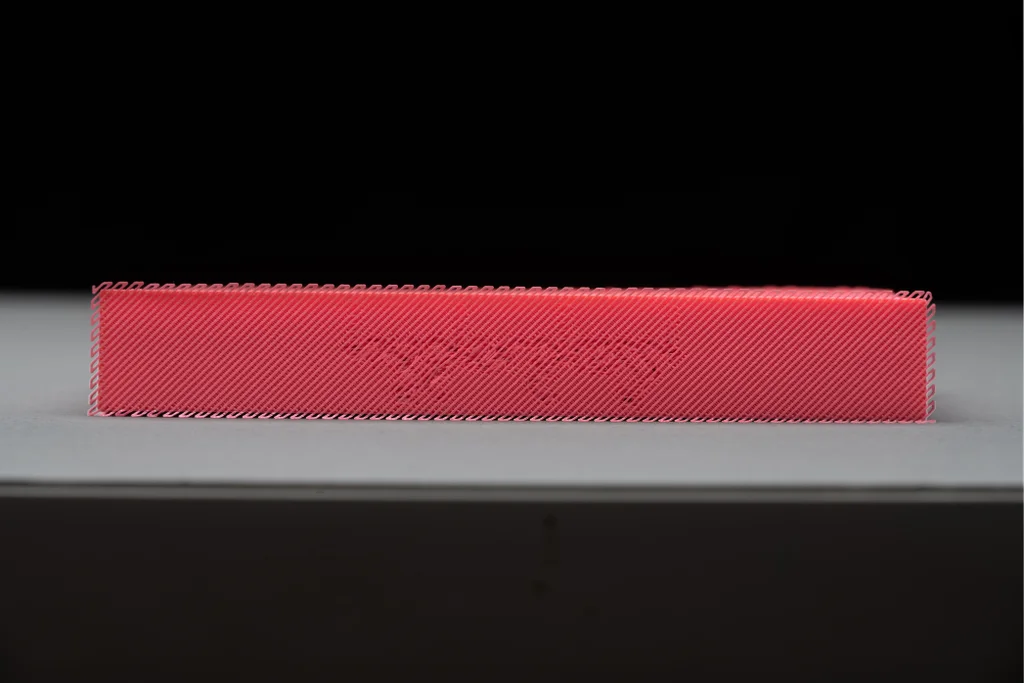
Conventional FDM or FFF 3D printers build objects layer by layer from bottom to top along the Z-axis. For Manual, the printing orientation was reimagined. Pages were printed vertically on their edges rather than horizontally, allowing the complete bound structure to be fabricated as one object.
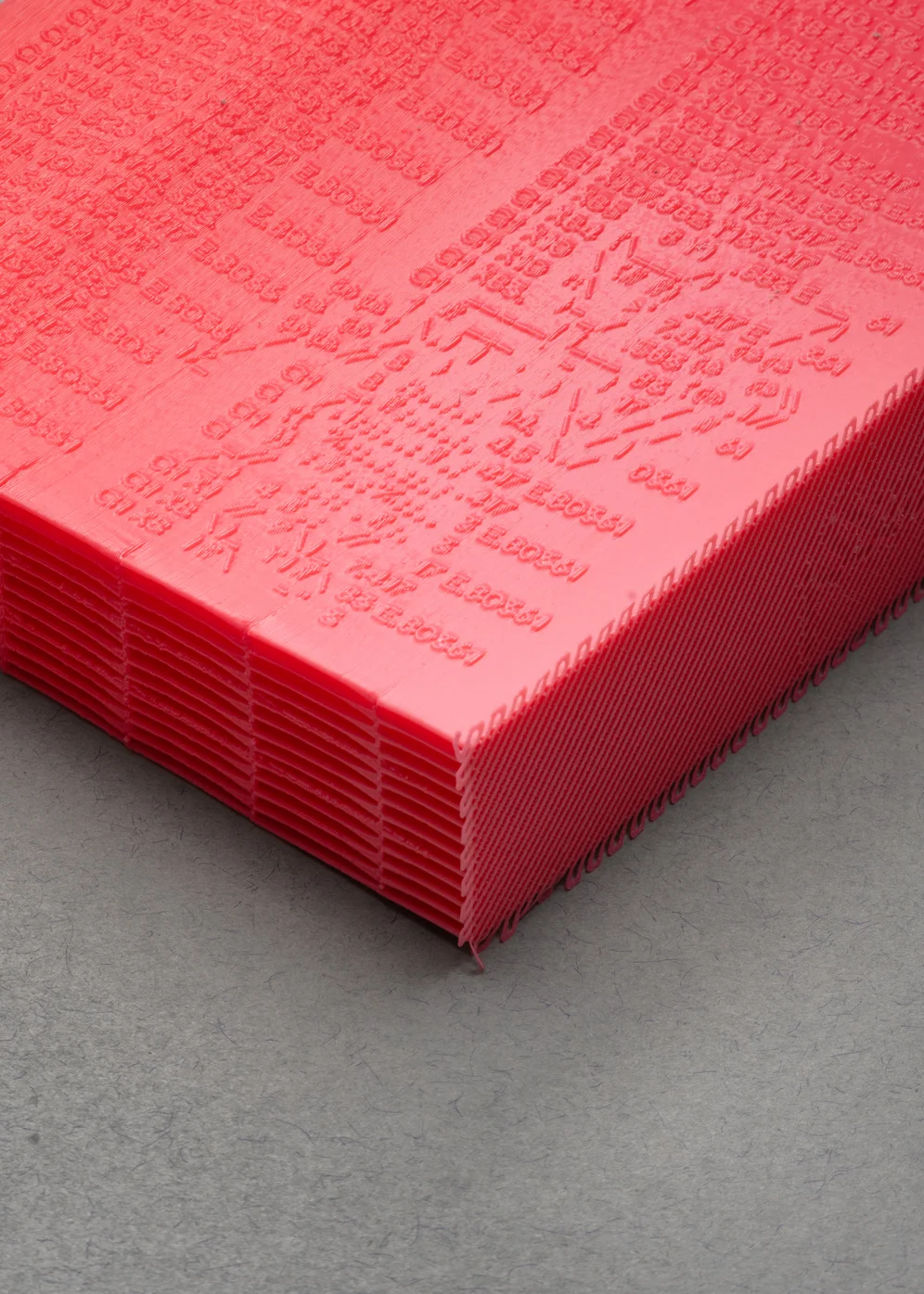
This sideways printing strategy offered several advantages:
- Enabled pages and binding to be produced simultaneously.
- Improved the quality and legibility of small embossed text.
- Allowed text to appear on both sides of the pages.
- Eliminated the need for assembly and post-processing.
The method demonstrates how changing print orientation can fundamentally alter the capabilities of additive manufacturing.
Material Choice: Why TPU Was Essential
The book is manufactured entirely from thermoplastic polyurethane (TPU), a flexible material more commonly associated with protective cases, footwear components, and industrial products than publishing.
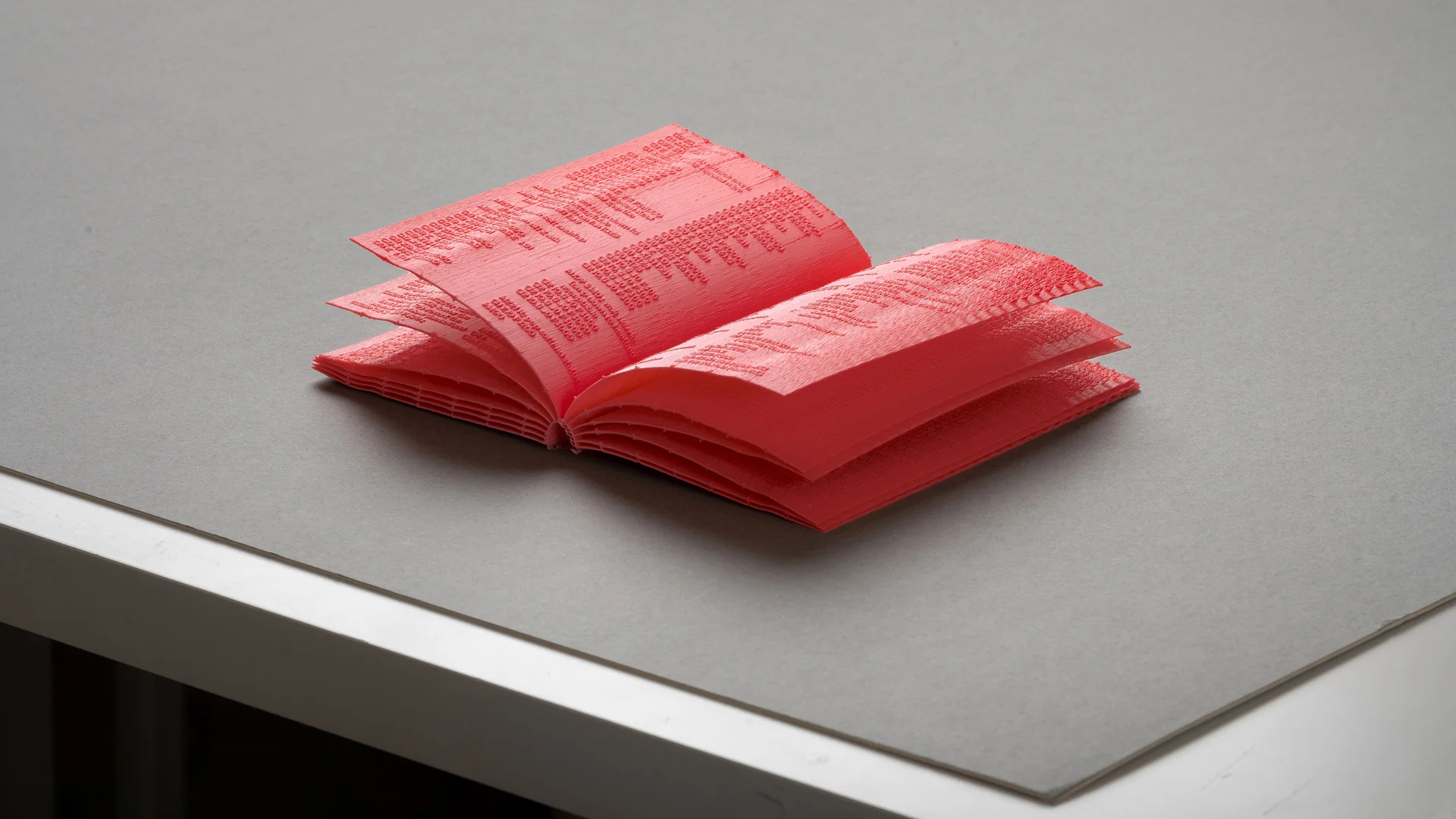
A rigid plastic would have produced pages too brittle to function as a book. TPU’s flexibility allows pages to bend, open, and be handled repeatedly while maintaining structural integrity.
However, flexibility also introduced significant technical challenges. Printing thin vertical structures in TPU required extensive experimentation with hardware calibration and print settings to achieve stable, readable pages without deformation.
The material, therefore, became both a design enabler and a manufacturing challenge.
A Collaboration Between Design, Publishing, and Fabrication
Manual emerged from a collaboration between designer and researcher Darius Ou and collaborator Benson Chong through Hyperpress, an ongoing research initiative investigating the intersection of graphic design, publishing, and additive manufacturing.
Since 2021, Hyperpress has produced several experimental publications exploring alternative methods of book production. Earlier projects incorporated 3D-printed materials but still required additional printing processes for graphics and text. Manual represents a further step, integrating structure and information into a single manufacturing operation.
The project was completed in 2026 and serves as both a technical experiment and a design investigation into what publishing might look like when fabrication becomes part of the content itself.
The Concept of the “Replicable Book”
Beyond manufacturing innovation, Manual introduces the idea of a Replicable Book, or r-book.
The concept extends the logic of digital publishing. An e-book transmits information digitally, but the physical form is absent. An r-book, by contrast, transmits both content and object. The digital file can be sent anywhere and fabricated locally into a physical copy.
During the project’s launch, the file was digitally transmitted and then physically printed in Toronto, demonstrating how a publication could travel as data before reappearing as a material object elsewhere.
In this sense, the book behaves less like a manufactured product and more like a distributed digital file capable of becoming physical on demand.
The Limits of Self-Documentation
One of the most intriguing details of Manual is that it contains only 2.5% of its own G-code.
While the project aspires toward self-description, practical limitations remain. The current FFF printing resolution restricts how much text can be printed at a readable scale. Additionally, a fully self-documenting version would create a paradox: every new line of code added to describe the object would itself require additional code to describe that addition. This limitation becomes part of the project’s conceptual framework, highlighting the gap between information and physical representation.
Manual is less a proposal for the future of mass-market publishing and more an exploration of how digital fabrication can reshape the relationship between information, manufacturing, and physical objects.
By combining structure, content, and production instructions into a single material artifact, the project demonstrates how additive manufacturing can move beyond prototyping and become a medium for publishing itself.
Manual, 3D Printed Book Details
Project: Manual
Designers: Darius Ou and Benson Chong
Research Initiative: Hyperpress
Completion Year: 2026
Material: Thermoplastic Polyurethane (TPU)
Pages: 26
Printing Method: XY-for-Z 3D Printing
Manufacturing: Single-print sequence, no assembly
Unique Feature: Contains excerpts of its own G-code
Concept: Replicable Book (r-book)
Image credit: Jonathan Tan/Hyperpress
