

Shane Burger is working as Principal and Global Leader of technical Innovation at Woods Bagot. He is interested in BIM, digital fabrication, building performance, VR/AR, Smart Buildings, and digital culture and experience.
In a recent interview with Shane Burger from Woods Bagot, we had a discussion on technology and architecture. Shane, who has been involved in projects and design practices, shared his thoughts on digital tools, human-centric design, and sustainability.
The Human Element in Digital Design
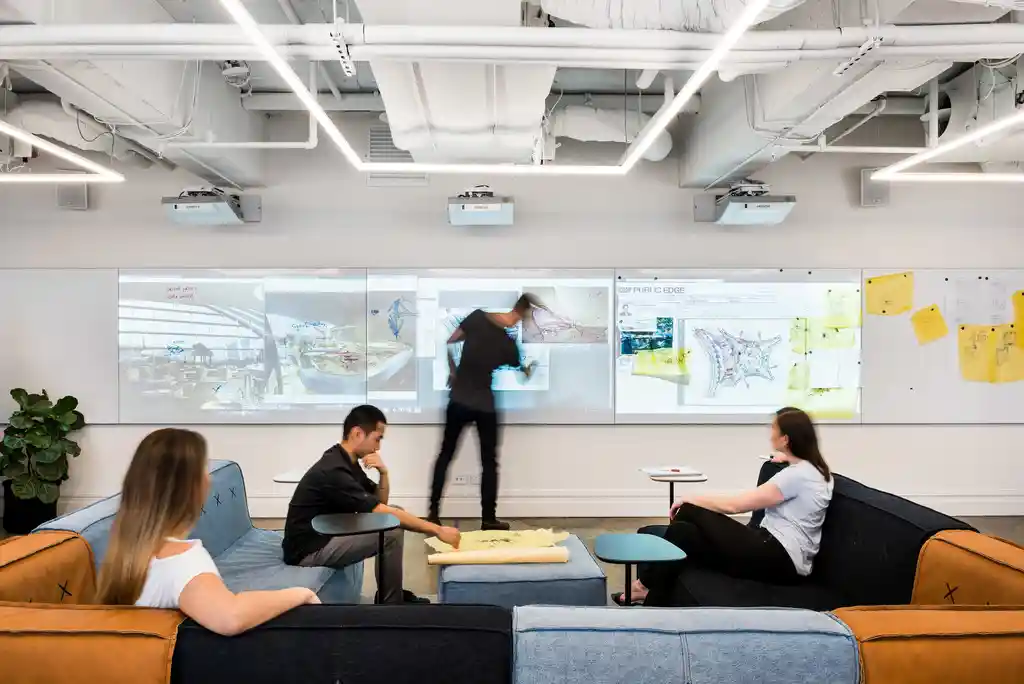
Shane Burger began our discussion by emphasizing the vital balance between advanced digital tools and the human experience in architectural practice. While software like Grasshopper and Rhino has transformed design by enabling complex parametric forms and spatial structures, Burger warns that an over-reliance on these technologies can disconnect architects from the essential human element of their work. He advocates for using technology to enhance, rather than replace, human creativity.
“When I look at some architects using tools like Grasshopper and Rhino, I often feel that we might lose sight of the fact that we are designing spaces for human beings,” Shane said. He repeated instances from academic critique sessions where students presented projects featuring elaborate parametric designs that, while visually striking, overlooked practical considerations for human interaction. “It’s almost as if they created a sculpture out of a parametric approach and then stuck some scale figures in there,” he observed.
Burger highlighted the importance of physically experiencing a space to understand its impact on users fully. He shared a personal experience from designing at Woods Bagot, where VR technology played a role. A virtual walkthrough revealed practical issues based on the practicalities of human form and movement, such as the positioning of hanging shelves and the dimensions of embedded chairs, for which some of these issues were not evident in the initial digital model. However, he also underscored the limitations of virtual experiences compared to physical ones, noting, “You can’t touch materials or get that close to things in VR.”
The Role of Energy and Materials in Sustainable Architecture

Shane Burger highlighted the transformative potential of advancements in energy efficiency and materials as we shifted our conversation to focus on the broader impact of technology on architecture. He spoke about “buildings as material banks,” a forward-thinking approach to sustainability.
“The idea of buildings as material banks is about carbon circularity, where all materials and systems should be continuously reused over time.” Burger explained. This concept challenges traditional views of demolition and waste, promoting instead a mindset of adaptation and extension.
“The building becomes a storage house for materials and systems. If it sits there for 20, 30, 50 years, what do you do with it afterwards if the building needs to change or be demolished? The concept is you reuse its parts. You extend their use; you adapt them to future use cases.”
Burger also touched on the potential of smart buildings and smart cities to further enhance sustainability, as well as AI’s impact on the built environment. He acknowledged the role of AI in improving design practices but cautioned against viewing it as a panacea. “While I love the idea of using an image generation tool to spark new ideas to lead you in new directions, it should be there to open up questions, not give answers. It should never provide you with ‘the design’. It should inspire you to think beyond your current ideas.” Instead of relying solely on AI to deliver answers, Burger advocates using AI as a tool to spark creativity and drive innovation in design.
Challenges in Sharing Knowledge and Data

One of the more pressing issues discussed was the challenge of sharing knowledge and data within the architecture industry. Burger recognized the value of collaboration and open access to information but also noted the practical constraints that often hinder such initiatives. Intellectual property rights and contractual obligations frequently limit the extent to which architectural firms can share their work publicly.
“As architects, we’re not always in control of the intellectual property that we create,” Shane said. He described how, despite efforts to publish research and engage in open-source projects, the proprietary nature of many design processes restricts the ability to share knowledge widely. “Sometimes the work that we produce for a particular client is not something that can be made publicly available for others to learn from,” he explained.
Despite these challenges, Burger remains optimistic about the potential for information and knowledge sharing within the industry. “We need to be thinking about concepts like industry-wide data trusts, where we can contribute anonymized information or share collections of content. Doing so benefits the whole industry because too often firms are inventing the same wheel again and again to solve the same kinds of problems,” he suggested. The industry could overcome some of its traditional barriers to innovation and progress by creating a collaborative environment where knowledge is pooled and leveraged.
Connecting with Communities and Industry Practices
For young architects and designers aspiring to specialize in the intersection of technology and architecture, Burger offered practical advice. He emphasized the importance of exploration and engagement with various tools and communities. “Play with the purpose of imagining new futures,” he urged. He encouraged emerging professionals to experiment with different software and technologies to understand the underlying concepts rather than just mastering specific tools.
Shane also stressed the importance of connecting with industry organizations. “There are a lot of design computation communities, both in professional and academic settings,” he noted. He recommended joining organizations like Acadia and CAADRIA and attending events and conferences such as the Fabricate and Design Modeling Symposium. “Connecting with the various communities in this space will help you stay updated on the latest developments and learn from peers. There are a lot of design computation communities, both in the profession and academia,” he said.
“You need to connect with the broader system of architecture to find your moments to make an impact and push change,” he advised. He emphasized the need to engage with various aspects of the profession, from construction and detailing to client interactions and storytelling. “Know how things are built, go on site, connect with people who are doing delivery and detailing,” he said. This holistic understanding allows architects to integrate their technological expertise with practical, real-world applications.
As our conversation concluded, Shane Burger reflected on the future of architecture and the role of technology in shaping it. He expressed a strong belief in the potential for innovation to drive positive change, both in terms of design practices and environmental impact. “My hope is that technologies around both energy systems and the idea of buildings as material banks will make a very significant impact,” he said.
Burger’s vision for the future of architecture is one where sustainability, efficiency, and collaboration are at the forefront. He envisions a field where digital tools and AI are harnessed not just for automation, but for enhancing the quality and performance of buildings. “We need to leverage AI to enhance our designs by providing valuable simulations and feedback,” he said.
