


Neri Oxman’s Wearable Structures for Interplanetary Voyages
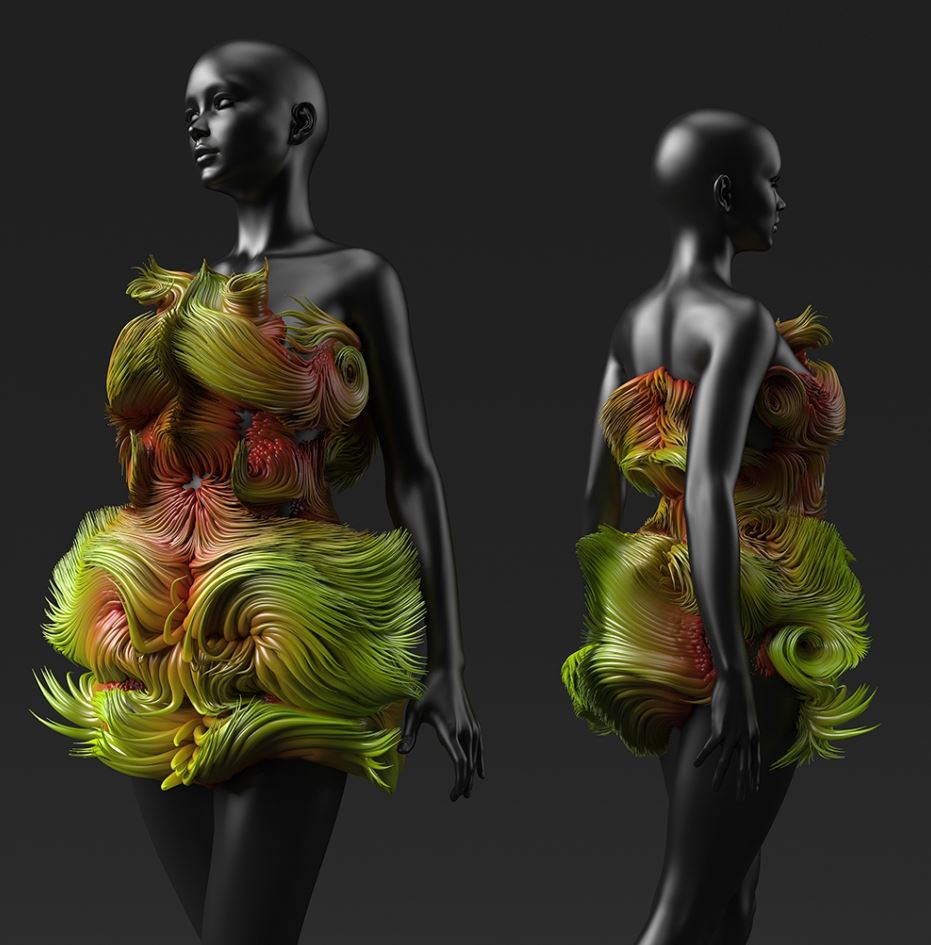
Neri Oxman‘s team at MIT Media Lab Creates Wearable 3D-printed Skins for Interplanetary Voyages.
Wanderers, An Astrobiological Exploration
Traveling to destinations beyond planet Earth involves voyages to hostile landscapes and deadly environments. Crushing gravity, amonious air, prolonged darkness, and temperatures that would boil glass or freeze carbon dioxide, all but eliminate the likelihood of human visitation.
Wanderers explores the possibility of voyaging to the worlds beyond by visiting the worlds within. 3D printed wearable capillaries designed for interplanetary pilgrims are infused with synthetically engineered microorganisms to make the hostile habitable and the deadly alive.
Each design is a codex of the animate and inanimate with an origin and a destination: the origin being engineered organisms, which multiply to create the wearable within a 3D printed skins; and the destination being a unique planet in the solar system.
The setting for this exploration is the solar system where, with the exception of planet Earth, no life can exist. The series represents the classical elements understood by the ancients to sustain life (earth, water, air and fire), and offers their biological counterpart in the form of microorganisms engineered to produce life-sustaining elements.
The wearables are designed to interact with a specific environment characteristic of their destination and generate sufficient quantities of biomass, water, air and light necessary for sustaining life: some photosynthesize converting daylight into energy, others bio-mineralize to strengthen and augment human bone, and some fluoresce to light the way in pitch darkness.
Each wearable is designed for a specific extreme environment where it transforms elements that are found in the atmosphere to one of the classical elements supporting life: oxygen for breathing, photons for seeing, biomass for eating, biofuels for moving, and calcium for building. Design research at the core of this collection lies at the intersection of multi-material 3D printing and Synthetic Biology.
The medieval Arabs are known for their fascination with astronomy. They took a keen interest in the study of celestial bodies; motivated to better comprehend the divine creation, they also appreciated the knowledge of the constellations as guidance in their journeys.
In honor of these early contributions to the science of astronomy the Wonderers in this collection are named in Arabic after their respective destination planets: Mushtari (a wearable for Jupiter), Zuhal (a wearable for Saturn), Otaared (a wearable for Mercury); and Qumar (a wearable for the Moon). The word “planet” comes from the Greek term planets meaning “wanderer”.
Mushtari; Jupiter’s Wanderer
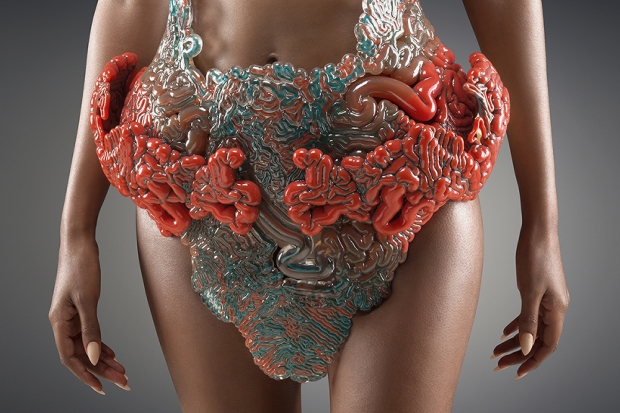
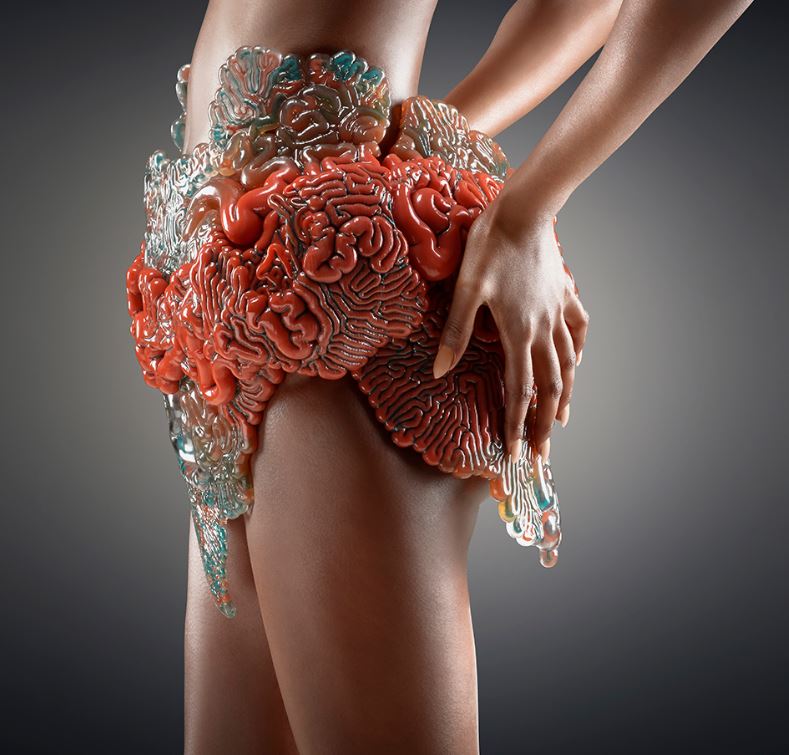
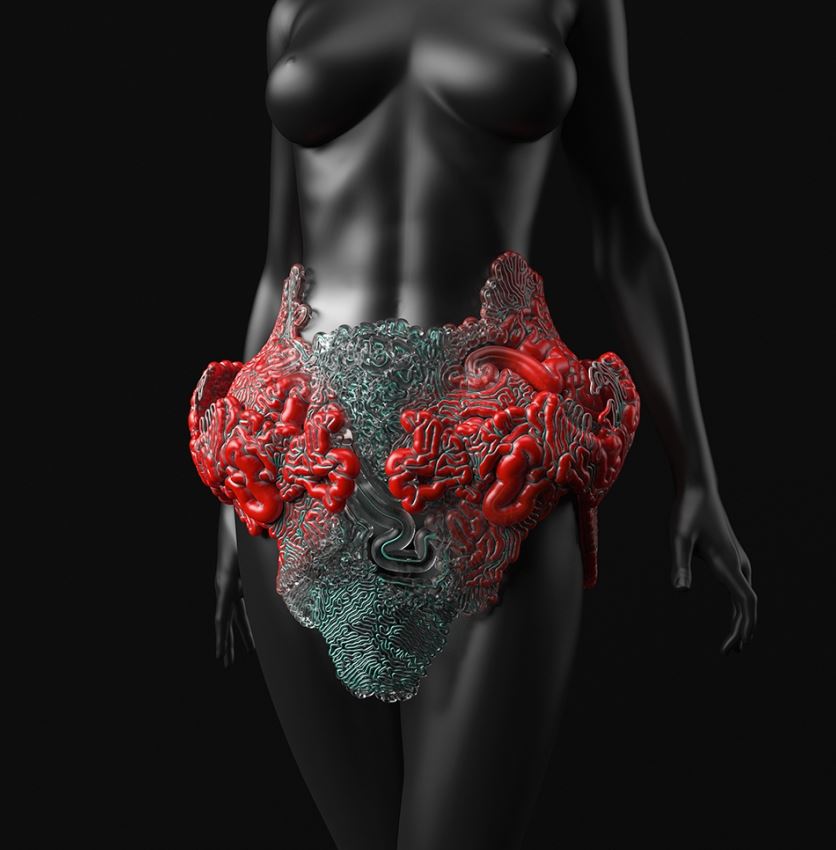
Jupiter is the largest planet in the Solar System with a mass two and a half times greater than the mass of all other planets in the Solar System combined. Named after the king of the gods, its Arabic name reflects is vastness (Mushtari ????? means huge, giant).
Designed as a single strand filled with living matter inspired by the form and function of the human gastrointestinal tract, this wearable is designed as a an organ system for consuming and digesting biomass, absorbing nutrients and expelling waste.
The peristaltic movement of matter within 3D printed translucent tracts is designed to support the flow of cyanobacteria engineered to convert daylight into consumable sucrose.
Qamar; Luna’s Wanderer
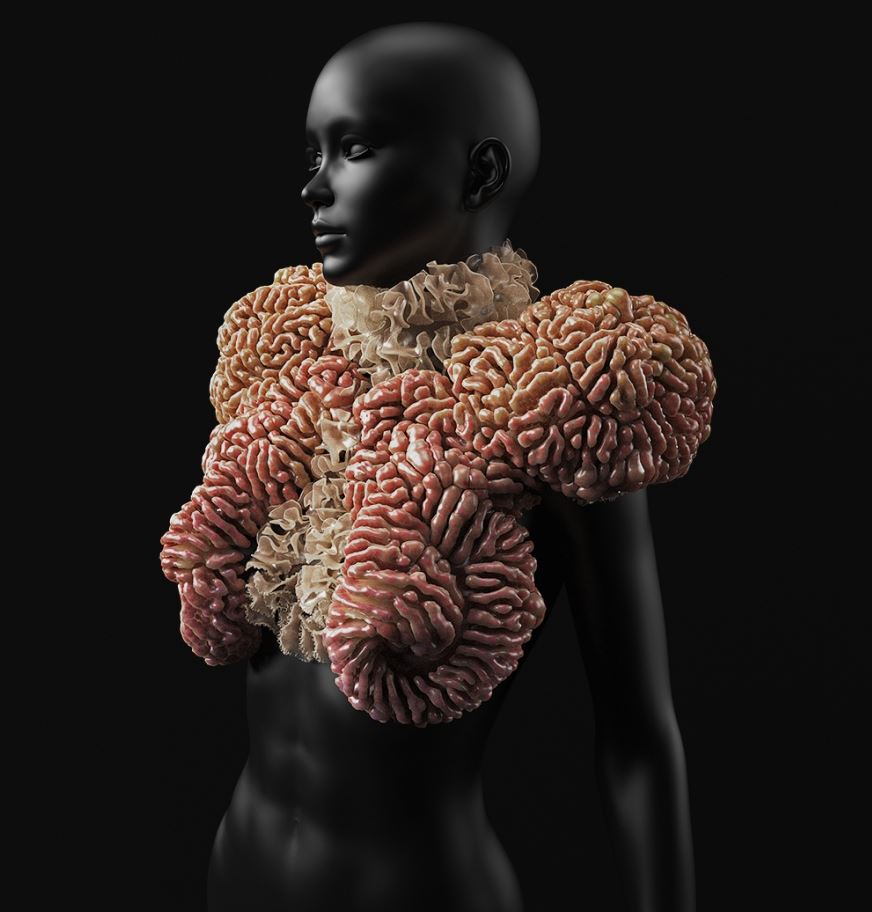
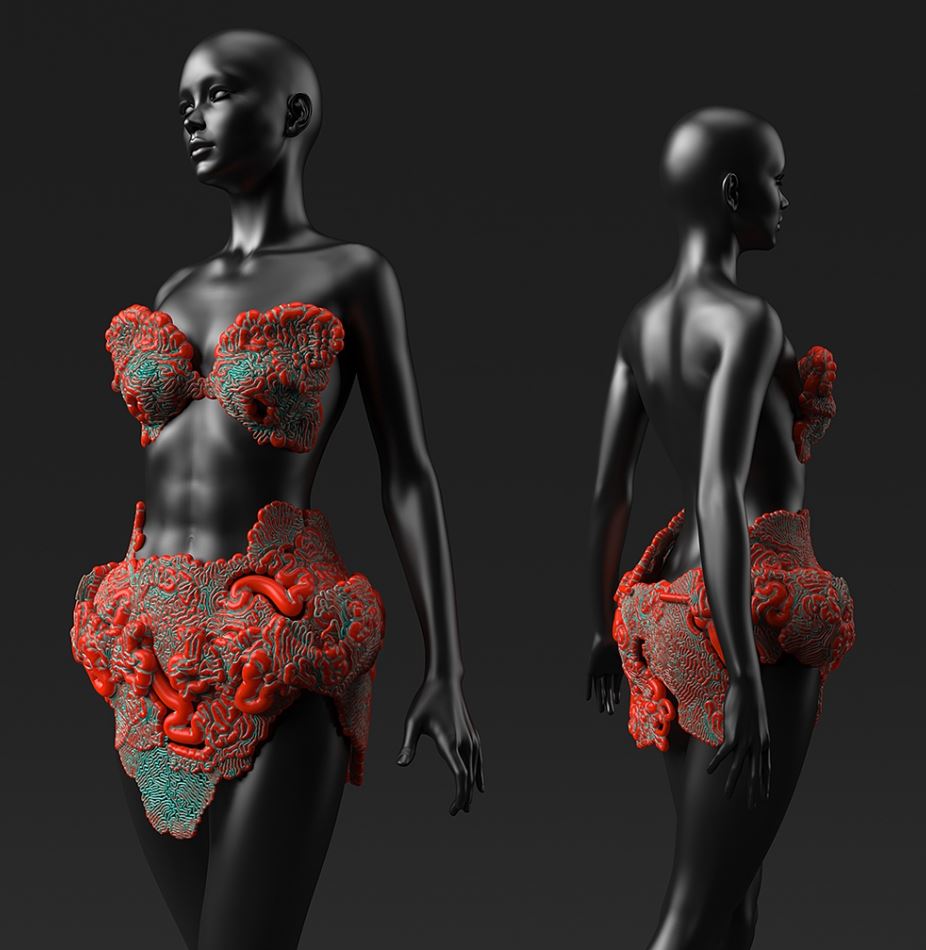
Named after the the goddess Luna (Arabic: Qamar ?????), the divine embodiment of the moon often charachterized by a two-yoke chariot, Luna is the most luminous object in the sky after the sun.
Inspire’d by the Moon’s surface texture this design functions as a wearable pneumatic surface for generating and storing oxygen. Unlike a wearable biodome, this texture contains spatial spherical pockets for algae-based air-purification and biofuel collection.
Zuhal; Saturn’s Wanderer
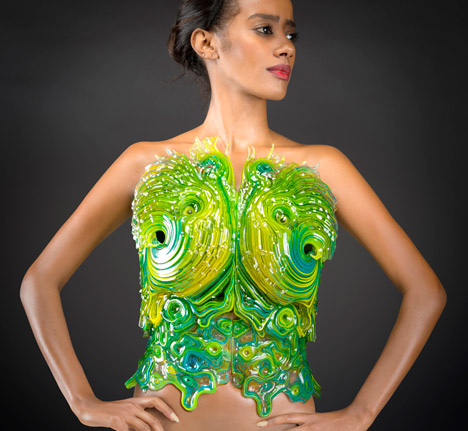
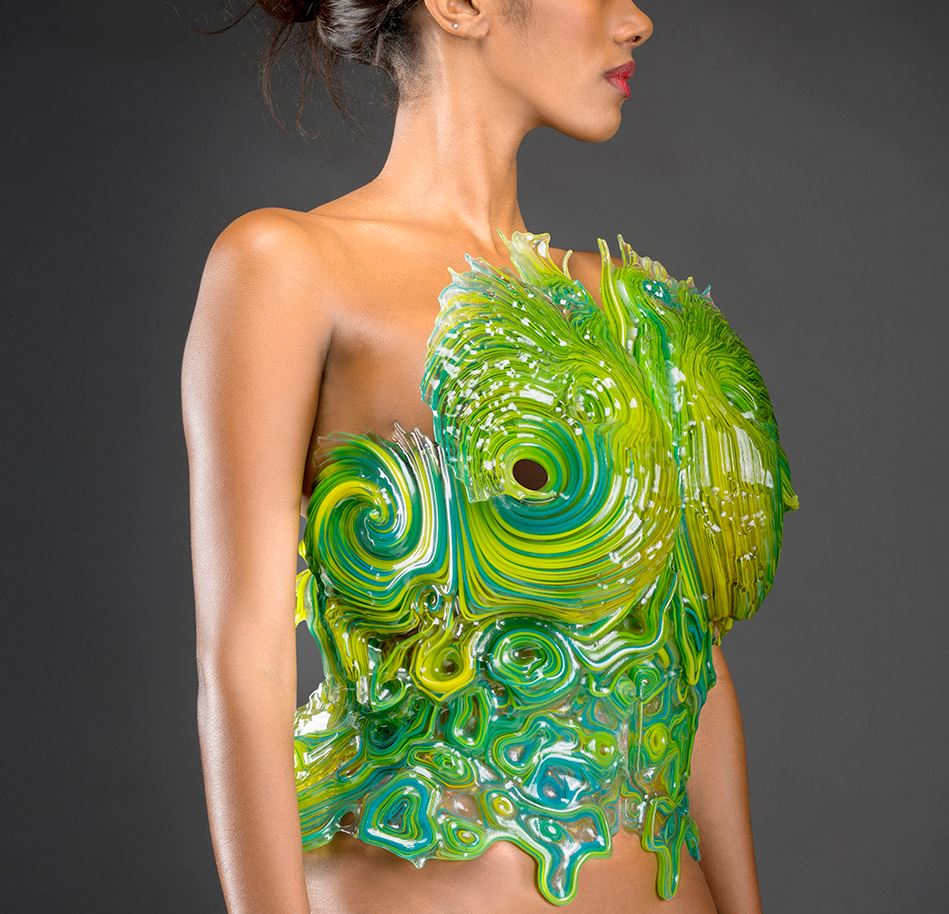
Saturn is known for its vortex storms forming where there is a steep latitudinal gradient in the speed of winds blowing across the planet’s atmosphere. Named after the Roman god of agriculture, its Arabic name – Zuhal (???) – reflects the planet and the mythology, representing fertility and growth.
The wearable is covered with a dense hairy texture responding to Saturn’s vortex winds with intricate structures characterised by high surface area to volume ratio. It is designed as a wearable vortex field, varying in size, density and organization to accommodate for local wind variation. Saturn’s moon Titan has been known to include hydrocarbons in its upper atmosphere as a possible precursor for life.
Its other moon Enceladus with is ocean like composition has been often regarded as a potential base for microbial life. The hairy fiberous surface is designed to contain bacteria that can convert hydrocarbons to edible matter that can be safely consumed by humans.
Otaared; Mercury’s Wanderer
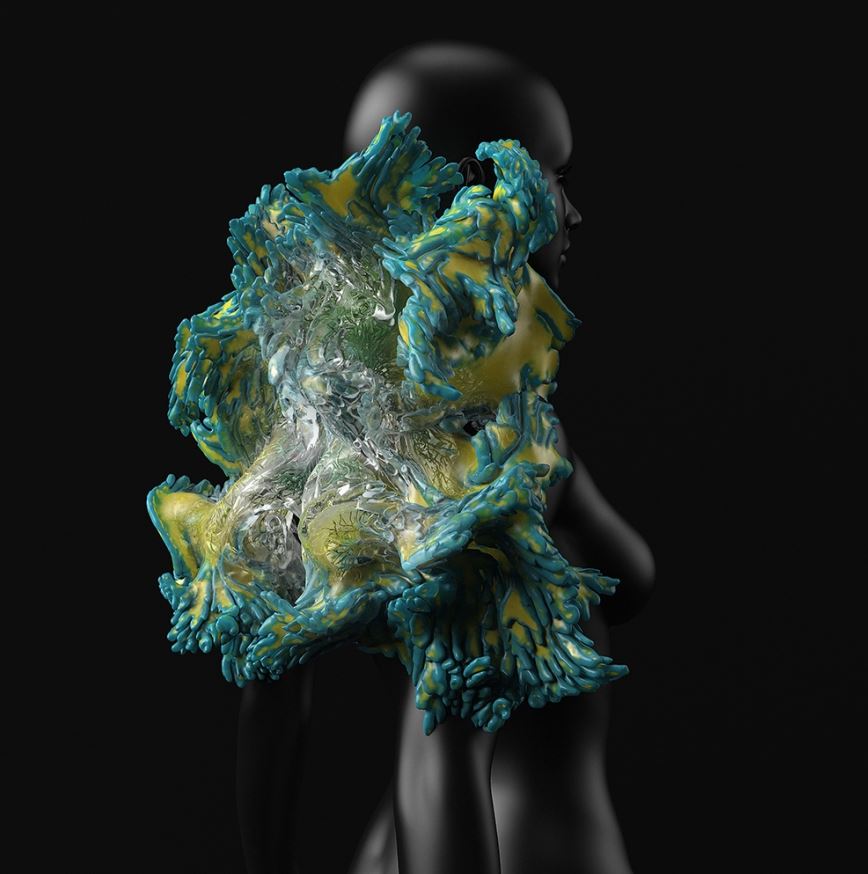
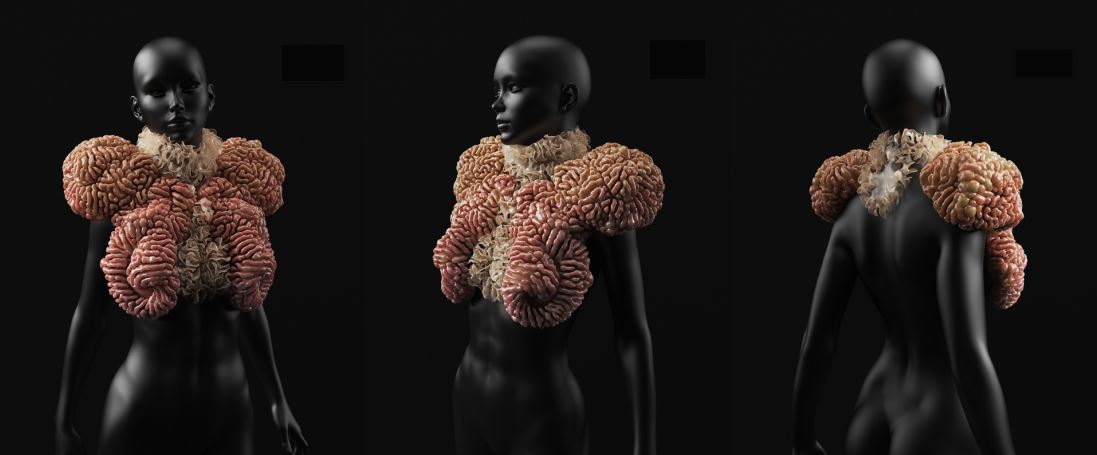
Named after the Roman deity Mercury (Arabic: Otaared ?????), the messenger to the gods, the planet Mercury lacks any atmosphere, making it susceptible to impacts over its entire surface.
The expression mercurial is typically used to refer to something or someone erratic, volatile or unstable, derived from Mercury’s swift flights from place to place.
Otaared is designed as antler-like extensions of the scapulae to protect the head. The 3D printed structure is computationally grown from the scapulae and the sternum outward generating a branched winged exoskeleton.
The printed shell is designed to contain calcifying bacteria grown within a wearable Caduceus. The ultimate goal is to grow true bone structures acting as protective exoskeleton.
Production : Stratasys
Production : 3D printed with Stratasys multi-material 3D printing technology
Collaboration With : Christoph Bader and Dominik Kolb
Photos: Yoram Reshef
Year : 2014
Via : Neri Oxman
