


Imagine standing still for a moment as your jacket quietly comes to life. The fabric begins to move, wraps itself around your arms, slides over your shoulders, and settles into place, all without a single hand pulling on a sleeve.
It sounds like a scene from science fiction, but it has just stepped into the real world.
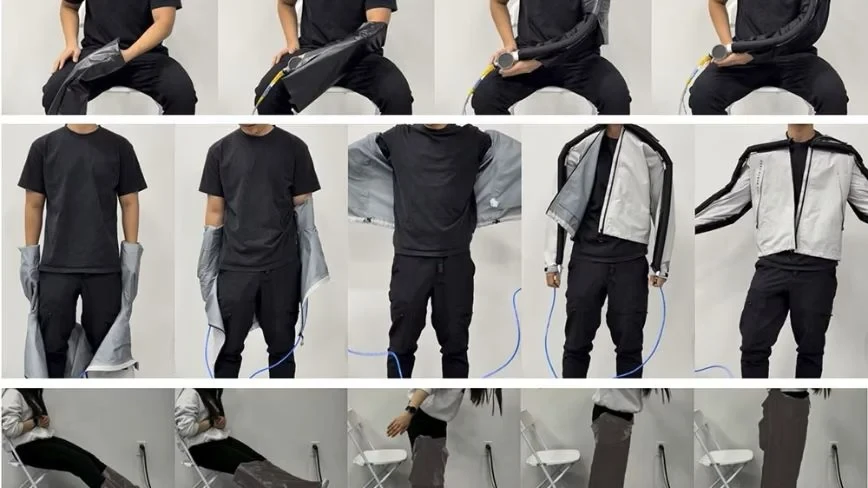
A joint South Korea–U.S. research team has introduced a new form of robotic clothing that can dress a wearer automatically in around 10 seconds. Developed by researchers from KAIST (Korea Advanced Institute of Science and Technology) and Stanford University, the technology transforms garments into active systems by embedding soft, air-powered robotic structures directly inside the fabric.
Unlike wearable gadgets that are on the body, this innovation turns the clothing itself into a robot.
The Moment Clothing Starts Moving
The demonstration begins with what appears to be an ordinary garment lying on the floor. Within seconds, hidden pneumatic structures inflate. The clothing rises, reaches toward the wearer, finds the arms, and gradually wraps itself around the body.
The entire dressing process takes approximately 10 seconds, even while the wearer is moving. The user does not need to stand perfectly still or guide the garment with their hands.
The movement is surprisingly fluid because the system doesn’t drag the entire garment at once. Instead, the clothing advances progressively across the body, allowing it to adapt naturally to changing positions.
Inspired by Ivy, Engineered as Soft Robotics
At the core of the project is a class of soft-growing vine robots.
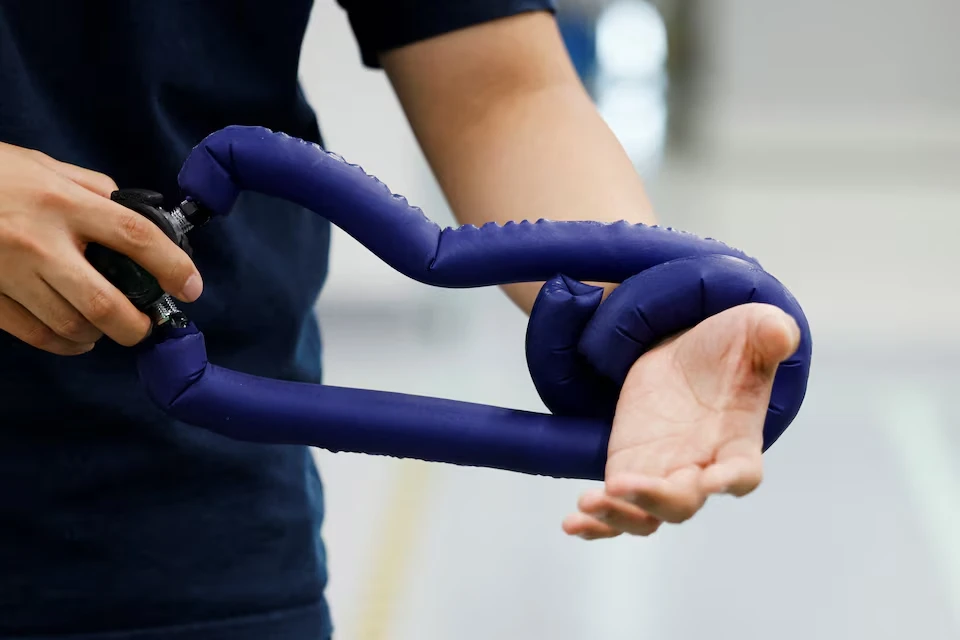
These flexible pneumatic structures expand only at their tips, much like ivy extending across a wall. New material unfolds at the front, allowing continuous growth while the rest of the structure stays stable. This principle has been explored in soft robotics for navigating confined environments, and the research team has now adapted it for wearable fashion.
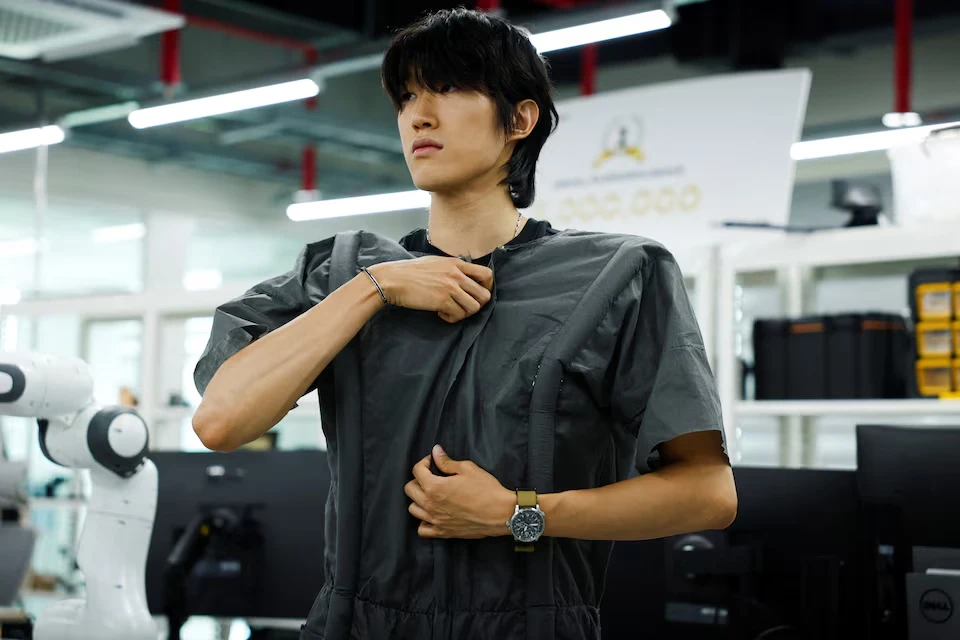
Inside the garment, the inflatable robotic “vines” remain folded until air pressure activates them. As they extend, they gently turn sections of the clothing inside out while climbing along the wearer’s body, effectively pulling the garment into its correct position.
The result is controlled motion without rigid mechanical parts or articulated robotic arms.
Why It Can Dress Someone Who Is Still Moving
One of the most significant engineering achievements is that the system works without complex motion tracking or sophisticated control algorithms.
Human bodies rarely remain perfectly still while dressing. Conventional robotic systems often require extensive sensing and constant position correction.
The vine robot avoids that challenge by remaining in continuous contact with the body throughout the dressing process. As it grows, it naturally conforms to changing body geometry, reducing the need for computationally intensive control.
According to the researchers, this growth-based movement allows the robotic clothing to navigate:
- Curved body surfaces
- Narrow openings such as sleeves
- Sloped or uneven orientations
- Smooth and slippery surfaces
These capabilities emerge from the robot’s mechanical design instead of relying entirely on software.
A Rainy Bicycle Ride Sparked the Idea
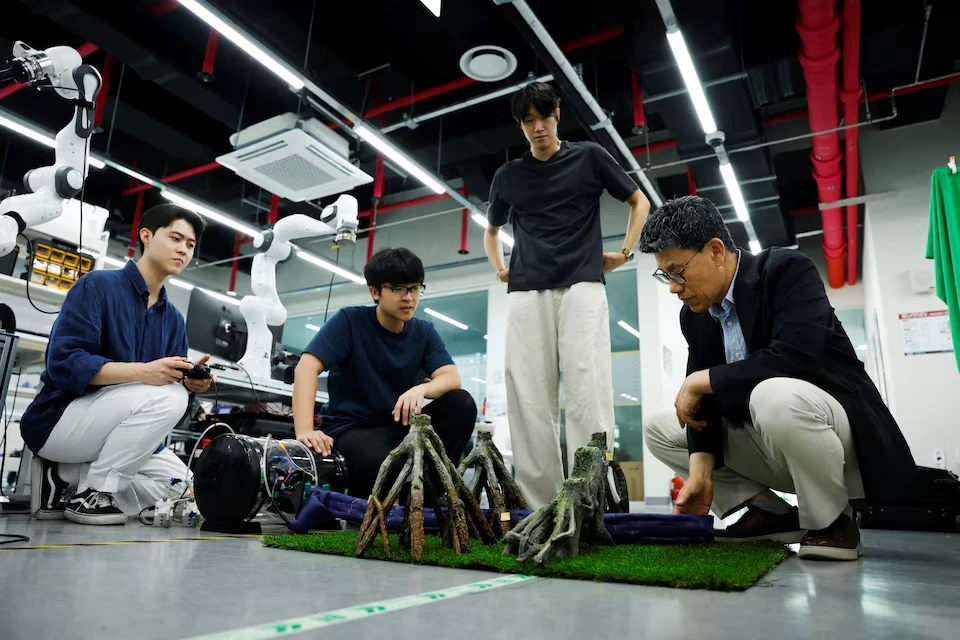
Lead author Kim Nam Gyun, a postdoctoral researcher at KAIST, said the concept began with a simple everyday inconvenience.
While cycling, he was caught in unexpected rain and imagined a raincoat that could put itself on while he continued riding. That practical question eventually evolved into a research project exploring autonomous dressing systems using soft robotics.
The project demonstrates how everyday frustrations can become starting points for entirely new categories of wearable technology.
Fashion Becomes an Active Mechanical System
Although the prototype focuses on functionality, the research signals a broader shift in how garments could be designed.
For decades, fashion innovation has concentrated on new textiles, digital fabrication, responsive materials, and wearable electronics. Robotic clothing introduces another layer: garments capable of performing physical actions themselves.
Instead of passive fabric responding only to the wearer, future clothing could actively assist with dressing, positioning, fastening, or adapting its form through embedded soft robotic structures.
The engineering is intentionally lightweight and flexible, allowing the garment to retain the softness expected from clothing while housing pneumatic robotic components.
Where Robotic Clothing Could Matter Most
The research extends well beyond convenience.
The team identifies several environments where autonomous dressing could improve speed, independence, and safety.
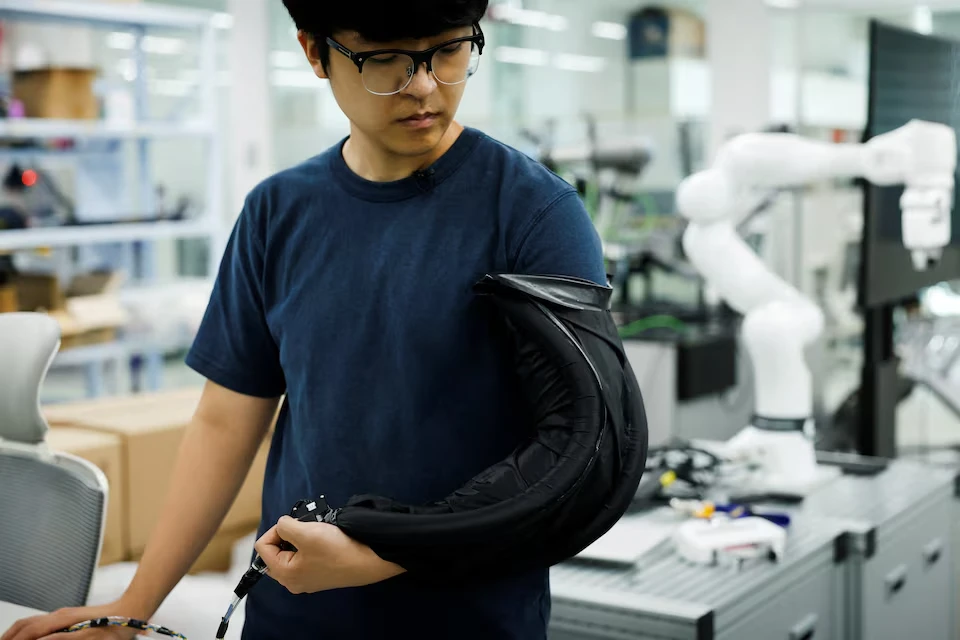
People with limited mobility or reduced arm function could dress with less physical assistance. Semiconductor manufacturing facilities, where workers must quickly enter highly controlled cleanrooms, could reduce preparation time. Emergency responders required to rapidly wear protective suits may also benefit from faster deployment.
These applications position robotic clothing as an assistive technology rather than simply a futuristic consumer product.
Published in a Peer-Reviewed Robotics Journal
The research has been published in IEEE Robotics and Automation Letters, placing the project within the growing field of soft robotics and adaptive wearable systems.
While the current demonstrations remain experimental, they represent one of the clearest examples of robotics moving directly into everyday apparel.
The next chapter for wearable technology may not involve another smartwatch or smart fabric. It may begin the moment a jacket quietly reaches out, finds your sleeve, and dresses you before you’ve even lifted your arm.
