

PA Talks 001 with Han Tumertekin, Parametric Design and Future of Architecture in the Middle East
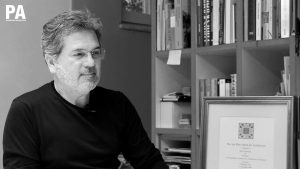
Han Tümertekin is a practicing architect based in Istanbul and principal of Mimarlar ve Han Tümertekin. A firm he established in 1986. He previously worked as an architect in Paris. His work includes residential, commercial and institutional projects primarily in Turkey, as well as in the Netherlands, Japan, United Kingdom, France, China, Mongolia and Kenya.Han was trained in architecture at Istanbul Technical University and completed graduate studies in historic preservation at the University of Istanbul. In addition to his built work, he has been teaching architecture since 1992 at universities including Harvard University’s Graduate School of Design; Istanbul Technical University; Ecole Polytechnique Fédérale de Lausanne; Ecole Speciale d’Architecture, Paris; Y?ld?z Technical University, Istanbul; Uludag University, Bursa; and the Ecole d’Architecture in Strasbourg. He is one of the founders of the graduate programme in architecture at Bilgi University, Istanbul.His works have been widely published in international architectural journals, including Domus, Abitare, AV, Oris, Architectural Review, L’architecture d’Aujourd’hui, the World Atlas of Contemporary Architecture, and the Phaidon Atlas of 21st Century World Architecture. A monograph of his work was published by Harvard University Press in 2006. Mr. Tümertekin has received several architectural prizes, including an Aga Khan Award for Architecture in 2004 for the B2 House in Ayvac?k, Turkey. He served on the 2007 Master Jury of the Aga Khan Award for Architecture, and has been a member of the Award Steering Committee since 2008.
Hamid Hassanzadeh : Dear Mr. Han, thanks for accepting our request. It is been already more than a year we were chasing you to have this interview. Finally, it is happened. It is really important for us what you think about the architecture and the future architecture in the Middle East because when we search among the famous Turkish architects, we see a couple of names and Han Tumertekin is one of them. You have your own style, your own thoughts, your own philosophy for the architecture that is why we are really interested why you choose this profession and what happened you started to study in architecture?
Han Tumertekin : You know, as for as I remember from my early childhood I was interested in putting together things and I was observing the daily life. For example I remember very well when we were with my father to the garage and people repairing our car. This kind of things which was very impressive to me. Now I understand very well that I was attracted by design not specifically designing volumes or spaces but in a way design was something that was really attracting me. I was born in Istanbul in 1958, during early 60s Istanbul was not as populated as it is now. I had the chance to have contacts with so many real stuff, real people, real handwork and of course much more mechanics as well instead of electronics. Then from my early childhood I decided in a way not maybe consciously but unconsciously to become an automotive designer. By the time I am a son of a geographer couple and my father was an urban geographer. Then by the time my observations or relationship with the city such as Istanbul became much more serious and powerful. And then instead of cars or mechanics, spaces became much more interesting to me. Finally, I ended up by becoming and architect.
Hamid Hassanzadeh : So you just followed the design process. You just followed the designing automotive then you jumped into the architecture.
Han Tumertekin : Yes, remember the ships that crossing the Bosphorus, every time I was in that ship with my mother, I was taking her to the machinery room for watching the mechanics doing the grace. It was fascinating to me and then the scale changed more broader, more larger, a city such as Istanbul and then architecture.
Hamid Hassanzadeh : Thank you. You know, every architect has his or her own design process and there are some important factors in this design process. Some architects focusing on like starting from site, some focusing form, function and some other stuff focus on context. What are the main factors for you to start the projects. How do you start to design a project as an architect?
Han Tumertekin : First if possible I start speaking everything mentally and I take my time, I think this is crucial these days. I stop, I bred and I start understanding not just the physical context but the social and cultural one as well. And I start observing collecting data all kind of data. Well, much more maybe trendy name of it can be parametric but the first thing I do is to collect every data that is like as possible put on the table and instead of immediately reacting and starting design. I really everytime resist for not designing but asking questions and questions. Impossible all the questions that I can ask and then finally I take my time to reduce them all of them to just one question which is crucial one. Then you solve everything. It is not magical, but it is really hard time to raise a multitude of questions to create those questions. Answering and answering and finally reducing to just one question once you achieve that level of in a way refinement immediately you solve the problem after spending so much time on a problem, then the design phase starts. For my new clients I know that the feeling that I create is instead of showing them wonderful and impressive renders. I ask questions and they say what how he will do that, he will achieve that level of maturity on the project. Sometimes I can see the discourage that they have in their eyes, but I do not know other way to do then I need time.
Hamid Hassanzadeh : So you start your practice by asking questions and answering them by the design process.
Han Tumertekin : Yes, and collecting data not physical ones, I thing this is another issue that I take in consideration the light, the sounds, social life and tissue the possible construction techniques available this kind of things.
Hamid Hassanzadeh : We had a deep dive into your projects, and we realize that you have some kind of minimalistic tendency, I do not know if I am right or not for example in B2 house which you won Aga Khan Awards. You have designed to a story house with simple geometries made out of concrete and handcrafted stone. What were the reasons to push you to this simplicity in this project?
Han Tumertekin : Not minimalism at all. I am sure on that. Firstly the program was so simple. The brief by my client was just I would like to go there, look at the sea, listen to the music and read some books and that is all he said so extremely simple way of living. That was one issue that I take always in consideration to me the only way of doing architecture is not building. This another issue that we can discuss but there is architecture because there is life. But buildings are not the dynamics of life then life is the dynamic of architecture. So the program is crucial to me. Second thing was about the brief that was the what he was dreaming to do in this house. And the second thing was a building if possible with no maintenance so instead of complicated things we must simplify them.
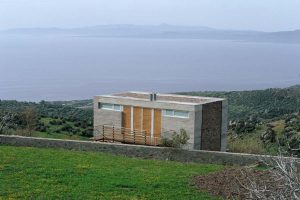 B2 House in Canakkale, Turkey, 2001. Photo by Cemal Emden
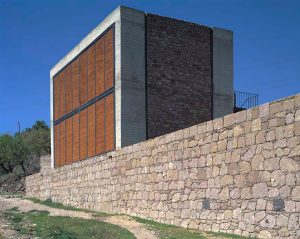 B2 House in Canakkale, Turkey, 2001. Photo by Cemal Emden
Hamid Hassanzadeh : So does it this mean a minimalistic look or tendencies?
Han Tumertekin : Well not you know, when I start a design I forced myself to have the clearest mind possible which is something impossible of course but this is what I am trying to do. Clear everything and concentrate on what I have in front of me in my hands. That is why I need time at the beginning of any design process not just collecting data, etc. But that is why I said first I stop and I take my time to create a neutral if possible state of mind. And then you start working on the real problems specific problems and instead of trying to stay minimalistic with your free mind you can do what you must do instead of or you can do what be done.
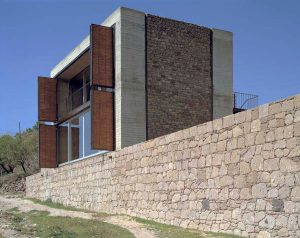 B2 House in Canakkale, Turkey, 2001. Photo by Cemal Emden
Hamid Hassanzadeh : So you say it is not a minimalistic look, and it is just a matter of like you have no option to do it.
Han Tumertekin : And when we stay at B2 house what is achieved there is that the building is anchored to that specific place that you can not move even 20 centimeters that building. If you move it if you move one wall 15 or 20 centimeters you demolish everything. This is another thing that I am always trying to achieve. I frequently say that I am not specific but hyper specific.
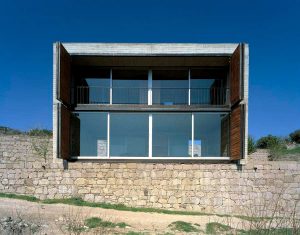 B2 House in Canakkale, Turkey, 2001. Photo by Cemal Emden
Hamid Hassanzadeh : You also had projects in other countries for example in Turkish mission buildings in Strasbourg is one of them. What were the main challenges to design for a foreign country which had a different cultural background, different architecture history? What was the main challenges?
Han Tumertekin : Well, you know to me it is not a big deal to build in foreign country or add the surroundings of my office. The identity is not something preconceived to me. That is for sure. I many times asked myself the question is there any identity when I start the design process in Strasbourg. Shall I use different techniques or approaches or is there anything that I take in consideration instead of taking in consideration another issue? I know that everytime I do not know what will I do but I know how to do it regardless to context or country or culture. This is something that works to me. When I pointed out hyper specificity my tendency on hyper specificity, I was in a way answering your question as well no matter where I am I concentrate on where I am and what I have in my hands. But let’s do a comparison with B2 and Strasbourg, there are similarities and some differences of course. The scale is different, many kinds of differences but at B2 house we knew that the building will be build by local people. That was the logical way to do it. We could do other preferences having a team from Istanbul let’s say or giving up saying to the local builders you do it the way you know. But we choose a third way which was creating kind of a dialogue understanding what are their capacities, possibilities. And forcing them not much just to move one step further and it is worth but one perfectly wonderful. I remember very well when we finished the building, the master builder who became a very good friend of mine and I worked with him for more than 10 years maybe 15 years. He was looking at the building, we were at a distance he said Han you know I have done the same thing that I have done for more than 30 years but the result is totally different. That was the resume of all the process wonderfully expressed. That was the aim not imposing them, something totally new and different knowing them, understanding them, dialoguing. And every building after B2 we collaborated with that team four times or five times in other buildings many proportionally houses but final building that we collaborated was that olive oil factory. Then the scale was changed and was a bit big for them we achieved to collaborate in a again in a perfect way and the result was perfect again. And in Strasbourg, I am talking about similarities, we after observing understanding the context. We decided to use a local stone which is called gray diverge from the Vorges Mountains next to Strasbourg access but that time was that okay we will use it because we have very good French construction company. We know that France has very powerful and innovative construction heritage like Gustave Eiffel and a this kind of people. We said okay we will push a bit contemporary technological technique and we collaborated with the construction companies specialists to use the biggest pieces of that stone of “gres des Vorges” in history in our building. They had to develop new technologies, new equipments to fix to the facades the stones and another step for them as well.
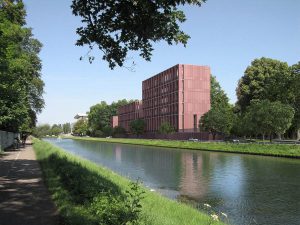 Turkish Mission Buildings in Strasbourg, France, 2011. Photo by Mimarlar ve Han Tumertekin
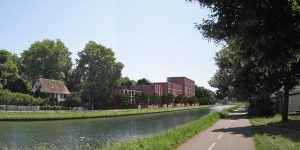 Turkish Mission Buildings in Strasbourg, France, 2011. Photo by Mimarlar ve Han Tumertekin
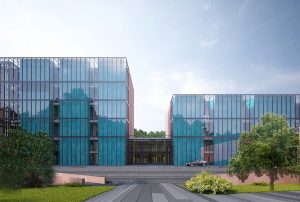 Turkish Mission Buildings in Strasbourg, France, 2011. Photo by Mimarlar ve Han Tumertekin
Hamid Hassanzadeh : So when we look at your architectural career and we see that you are disconnected with the academic activities and universities. You are a lecturer and also you had coordinated many studios in universities in Turkey, United States like Harvard, Austria, Paris and other countries. How makes this connection with the students, and education affect your architecture?
Han Tumertekin : My contact with students and academy is based on responsibility. This is before affecting my architecture this is the bases and this is the atmosphere that I feel in it. First this is another level of responsibility to me besides it helps me to update myself it helps me to ask new questions to myself without sometimes or the majority of cases without being having the capability to answer all of them but I start asking questions at every contact with students. And another thing is by their presence I learned a lot about new technologies or new kind of trends then I stay connected before saying any word to them I think a lot on what I will say. That is why I am at every occasion present at the schools as tutor or as lecturer. This is something that I will do till the end of my career.
Hamid Hassanzadeh : Do you think education is improving or is it getting better or is it getting worsest least in the countries in the Middle East not in the Europe?
Han Tumertekin : I was lucky and honored to be a jury member for The Omrania Awards in Oman 10 years ago and recently I was a jury member for the tenth cycle last summer. I had the change and privilege to compare or to evaluate those 10 years in about architecture education in the Middle East, most the in the Arab countries. And that was really impressive for the jury that we went through the tenth cycle jury reports. We have seen that no matter the composition of jury every year that means every cycle of the awards. The mostly same things were said which is the presentation quality of the projects are always evolving and the tendency about creating interesting and impressive forms. Compared the projects taking in consideration the context, this surrounding, cultural and physical heritage of the country or the city was proportionally the majority. They did the projects trying to do interesting forms this kind of things. They are the proportionally and the most problematic. I think because when we talk specifically about Middle East which has still historical background and heritage. I think it is a pity instead of looking around which is the easiest way. Then there is the sun, the heat. When you get on the street, you see too many data or inputs, parameters about the real life. Instead of looking around they look on the answer of the problems that they do not have what I think it is really a pity.
Hamid Hassanzadeh : So nowadays in the world of architecture Middle East is one of hearts of the gigantic projects with a big amount of budgets like the Louvre in Abu Dhabi which is was recently opened. And most of these projects are designed by the European based architectural firms. How these projects could define the identity of the Middle East architecture and what is your point of view on this?
Han Tumertekin : Everytime I read or I hear a European architect explaining his or her design in the Middle East or any Arabic country. They start talking about the cultural heritage of the country or people or etc. What I find interesting is that when they talk about any of designer in Europe, they never mention this kind of things which I find really interesting. When it comes to an Arabic country, everybody starts talking about the Mashrabiya this kind of things. And one day design a building in Paris, nobody talks about Versailles or something like that you know. I do not like this approach but fortunately the Louvre Abu Dhabi is a very nice building , it is very successful architecture. But when it comes to explain to design, I do not think an architect needs to talk about these kinds of things. The building talks.
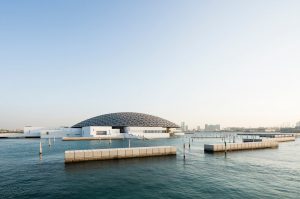 Louvre Abu Dhabi by Ateliers Jean Nouvel, 2017. Photo by Luc Boegly & Sergio Grazia
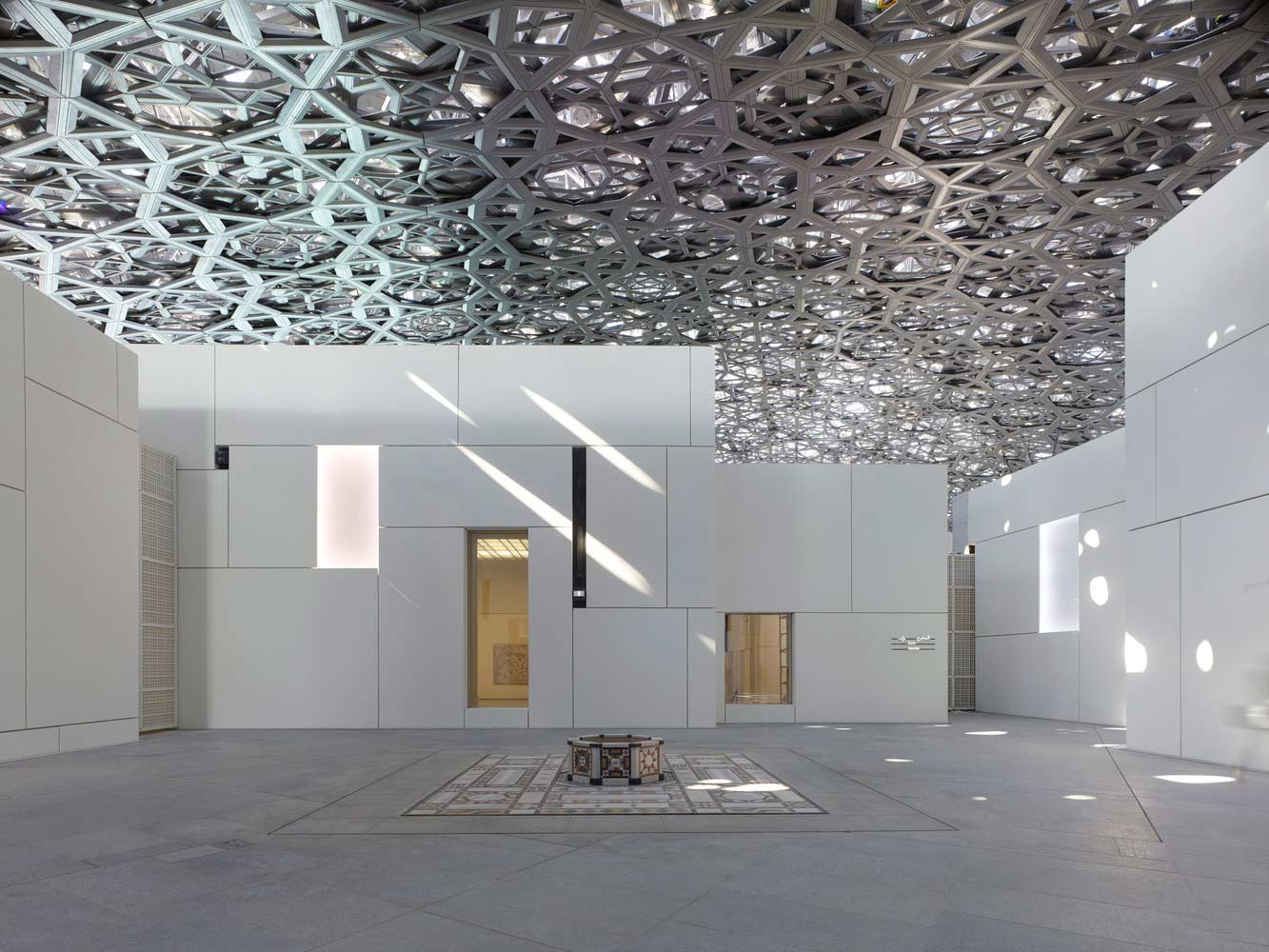 Louvre Abu Dhabi by Ateliers Jean Nouvel, 2017. Photo by Roland Halbe
Hamid Hassanzadeh : You know that we are living in the era codes, algorithms, computer aided design and AI; artificial intelligence. This method of design in approaching is expanding in every aspect of design such as interior, fashion, industrial design, jewelry and mainly in architecture. How do you see this revolution is going? Are you trying to keep your office connected to this world of codes, algorithms and parameters or not?
Han Tumertekin : Technically speaking I am always positive about any developed or new issues. I am open to them but still I am at a phase that I have the tendency to make use of them as tools. As a generation I think this is the most developed way of approaching to the issue is that. And let me confess that to design the dynamic of design to me being always the life and daily life. I do not think that these kinds of novelties can change drastically architectural design. When it comes to defining the question or the problem I do not need that. So to solve the problem sure I make use of them.
Hamid Hassanzadeh : So you say they are just tools and of course they are tools and I really accept it. And you say they are just tools to draw, they are just answer the questions or find a way.
Han Tumertekin : Yes, this is the way I make use of them maybe I am old school but my design approach does not need them.
Hamid Hassanzadeh : How could you define parametric design are you a supporter of these kinds of designs or not?
Han Tumertekin : Yes, I think I am, and I feel that I am a parametric designer. Any designer must be a parametric designer. Let’s define it properly, but I know that there is another so called parametric design which is mostly about forms.
Hamid Hassanzadeh : Yes, the world around us is parametric also because from the first day of the architecture study humans started to build something for themselves. They are using parameters to build them for themselves.
Han Tumertekin : Why define of separately instead of saying design, parametric design because without parameters there is no design.
Hamid Hassanzadeh : But the thing happened in 2008 this word was just coined. It was to put these parameters into the built, into the computer and get the design out of it was like.
Han Tumertekin : I know that is why I always tools.
Hamid Hassanzadeh : What is the importance of the innovations in your office?
Han Tumertekin : I think we call it innovation or not. I always say that we will not have the same answer or we will not repeat the same answer as far as we will not have the same question raised which means and my understanding innovation permanent. Once I was asked to define architecture in one word I was force under pressure, no time and suddenly I said redefining. And everything was clear was to me from then that yes what we are doing permanently during a day as architects we are redefining everything everytime. To me a door is not always a door in our office in our office personally. Let’s define it specifically I never say window or door, I say openings. And opening will be everytime or can be at every occasion defined in a new and innovative way because if you say window then visually you have a window in your mind. This is something to avoid definitely.
Hamid Hassanzadeh : Which should be the role of the architect in the society and your viewpoint?
Han Tumertekin : Let’s assume that we are talking about good architects. Still I can say that they can change the world. That is for sure. In a good way or bad way if we assume that we are talking about good architects. They can positively change the world. That is the motivation that I have every morning I start today saying that move many possibilities. We will have during the day to change the world into a good one.
Hamid Hassanzadeh : Does this mean to connect culture with architecture or something like this?
Han Tumertekin : Well, you know. I am much more interesting on affecting the days of the lifes of ordinary people in their daily life instead of making great gestures influencing at the first sight people. I like to infiltrate in their daily lifes without showing them that thing are now better than before my intervention. Just a dose of ego.
Followers : What is this vision in the future architecture?
Han Tumertekin : I was feeling a bit alone when I was feeling at a distance with the future and once very recently a couple of years ago read an interview Louis Khan I am not feeling alone anymore. To me the future is not something that we can define from today. If define it from today to me it does not mean that its future, to me future is totally unknown or must remain unknown. If I know, if I have any idea about future, it is not anymore a future to me.
Hamid Hassanzadeh : So you say if we think about the future and the design in the future we are not thinking on the future, we are thinking for now. It is not future.
Han Tumertekin : This is the feeling that I had all of the time then I gave up now I say no future.
Followers : How does parametric architecture in corporate the externship aspects of the design the sense of belonging and the feeling one would have when experiencing space?
Han Tumertekin : This is something that I discussed with my students several times that I asked them how can you leave your capacity of creativity the through the capacity of a software. How can you leave it to that in a way or other, to that limited software? Yes it is true that architects and architecture students are making use of a group of softwares and immediately you see the similarities that their projects have then as a tools it is okay but thay do not have any software has not the creative capacity of one person.
Hamid Hassanzadeh : In other words computer just thinks instead of us.
Followers : How do you predict the world well this is the almost the same question but how do you can take the world’s future architecture is the future for ecological ones in an enclosed glass room?
Han Tumertekin : I am always very careful about using this kind of terminology. I believe that a good design has all of them, being conscious about consumption, being conscious about energy safe. We do not need to dividing issues and and name them separately. A good design response to everything.
Hamid Hassanzdeh : Computer is wonderful tool but it happens to you for your students that you offer them to use computer or you offer them to use sketches and set up computers. Which kind of design, which kind of presentations do you prefer for your students?
Han Tumertekin : Not the presentation but insists to force them to make use of their hands drawing by hands and drawing sections. For more than three or four years I say section will save the world, I believe on that. If you draw a section which is not drawing a section to build mentally the space. If you draw a section, you must understand and define everything about that building or about that space. You can not avoid any data on section.
Hamid Hassanzadeh : Good code, section will save the world. I will just enter to my two last questions. According to your acrhitectural experience, what does architecture mean?
Han Tumertekin : To me architecture does not mean just buildings. That is for sure. It is space to me and space is not limited to just build space.
Followers : Which architecture style do you like in Turkey especially about modern architecture?
Han Tumertekin : In modern architecture Mehmet Konuralp. He is my role model. He is from Architectural Association, London.
Hamid Hassanzadeh : Last question, what is your advice for students and young architects?
Han Tumertekin : To look around, to observe, to care and to stop really to stop. I think this is something very difficult to achieve not just stop physically but mentally stop everything and look around. By experience it is approved that no matter what kind of architecture you do if you spend incredible time on your design you do again and again just one skiting. You take your time. You redefine it several times millimeter by millimeter you take control of any component of your building. If you take control of each millimeter no one nor the client or the construction company or the project management guy will refuse them. You will convince everybody.
