

Topic: Pixel Interfaces: AI Workflows in ComfyUI
Date: August 1 – 2, 2026
Time: 14:00 – 17:00 GMT
Format: Online on Zoom
Duration: 2 Sessions (6 Hours)
Registration Deadline: July 31st, 2026
Total Seats: 50 seats
Difficulty: Beginner – Intermediate
Language: English
Certificate: Yes
Course Fee: Free for Digital Members
Organized By: PAACADEMY
Tutor: James McBennett
Recordings: Recordings will be available for all participants afterward indefinitely.
Introduction to Pixel Interfaces: AI Workflows in ComfyUI:
Many currently reach for a hosted service, sending a prompt to a remote server through an interface designed by someone else, and wait for a result, carrying costs that are easy to ignore: energy, latency, dependency, and expense. Local generation inverts that relationship.
It is an opportunity to learn from models running on your own machine, where the relationship between a creative decision and its computational cost becomes immediate and legible. You feel the weight of what you are asking for. The size of the model. The speed of your GPU. The time it takes to think.
This workshop builds hands-on familiarity with local AI image generation using ComfyUI, working across 2D models and workflows to understand the direct relationship between generation speed, image quality, and computational cost.
Participants will construct and modify workflows from the ground up, not by following presets but by understanding what each node does, what each parameter costs, and why one model behaves differently from another.
The workshop covers the current landscape of generation tools, from fast distilled models to slower, more capable models, and asks participants to develop a considered position on when each is appropriate.
The second half shifts from personal instrument to shared medium. A workflow that only you can run is a dead end. Using Gradio, HTML, CSS, JavaScript, and Python, participants will examine and build browser-based interfaces that run locally yet mirror the tools that can be deployed and shared on the web, making their workflows accessible, legible, shareable, and extensible by others.
It asks participants to think carefully about what a tool communicates when it is handed to someone else: what it exposes, what it hides, what it assumes. By the end, participants will have the practical grounding to engage generative AI as a substantive part of contemporary computational design practice, not as a black box to be offloaded to someone else, but as a tool they understand well enough to rebuild, modify, and share.
Methodology:
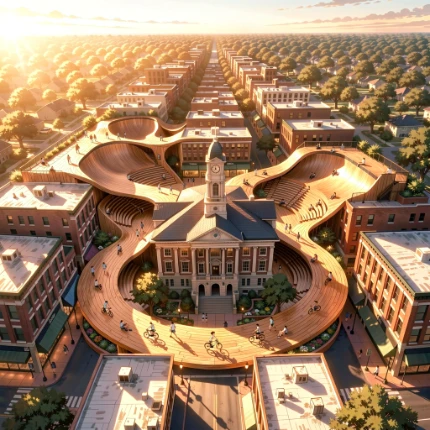
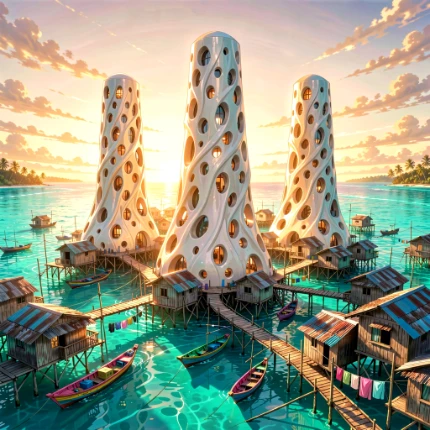
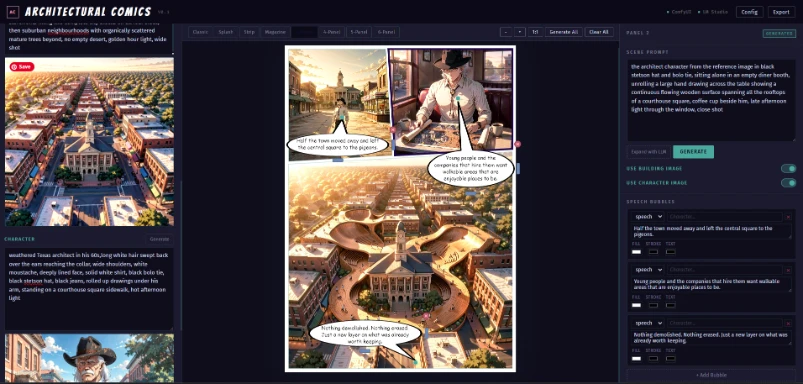
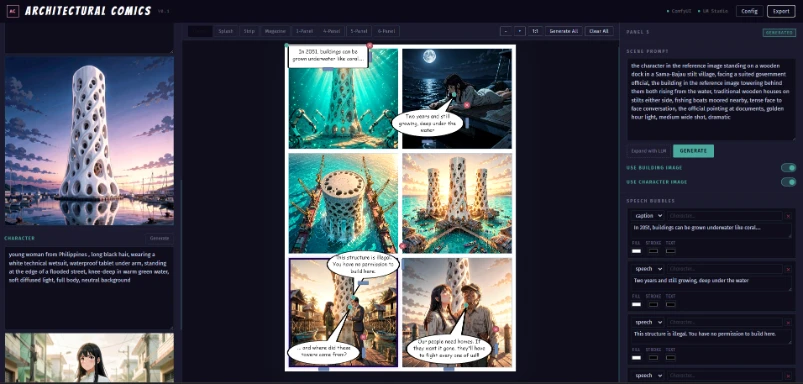
The workshop is organized around the construction of a deployed, interactive interface capable of transforming between text prompts and pixel images.
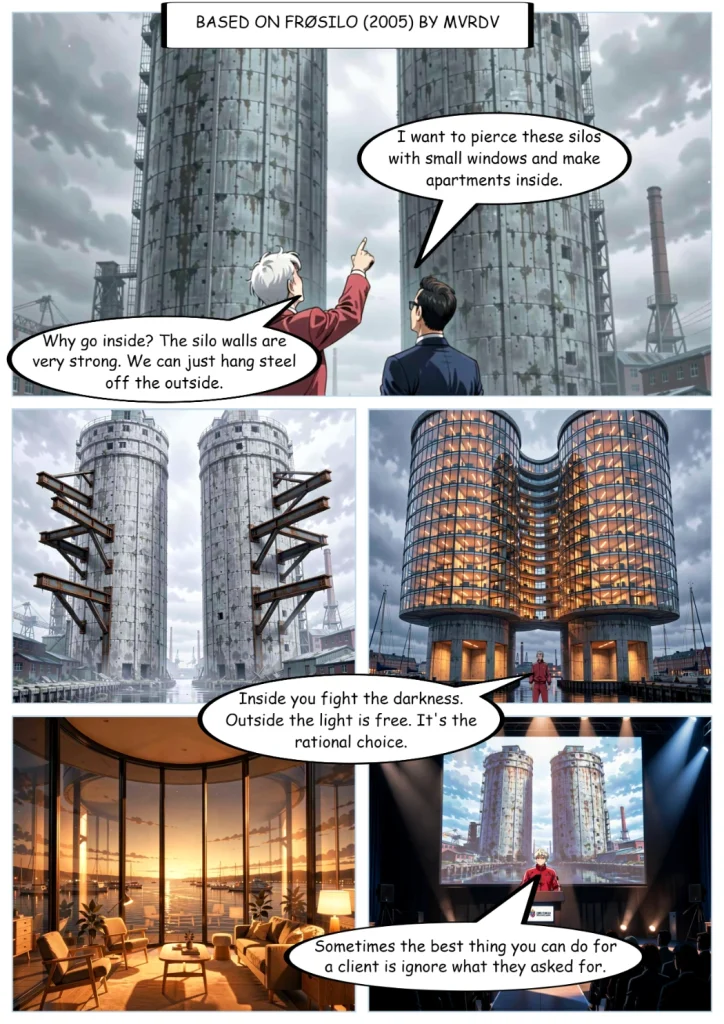
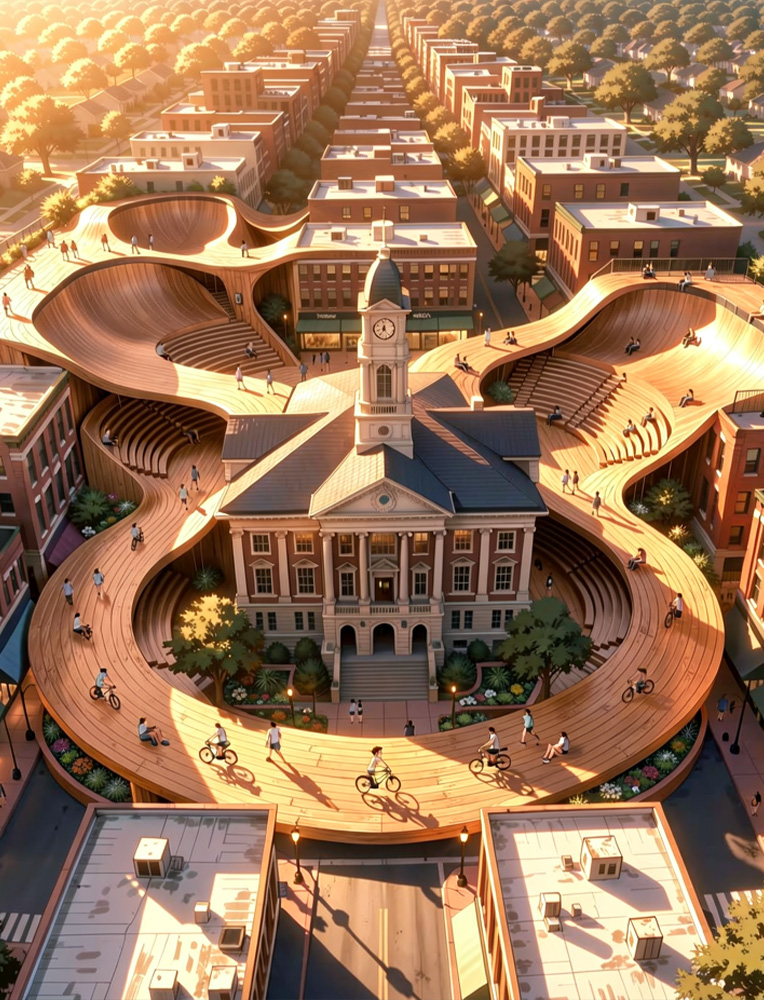
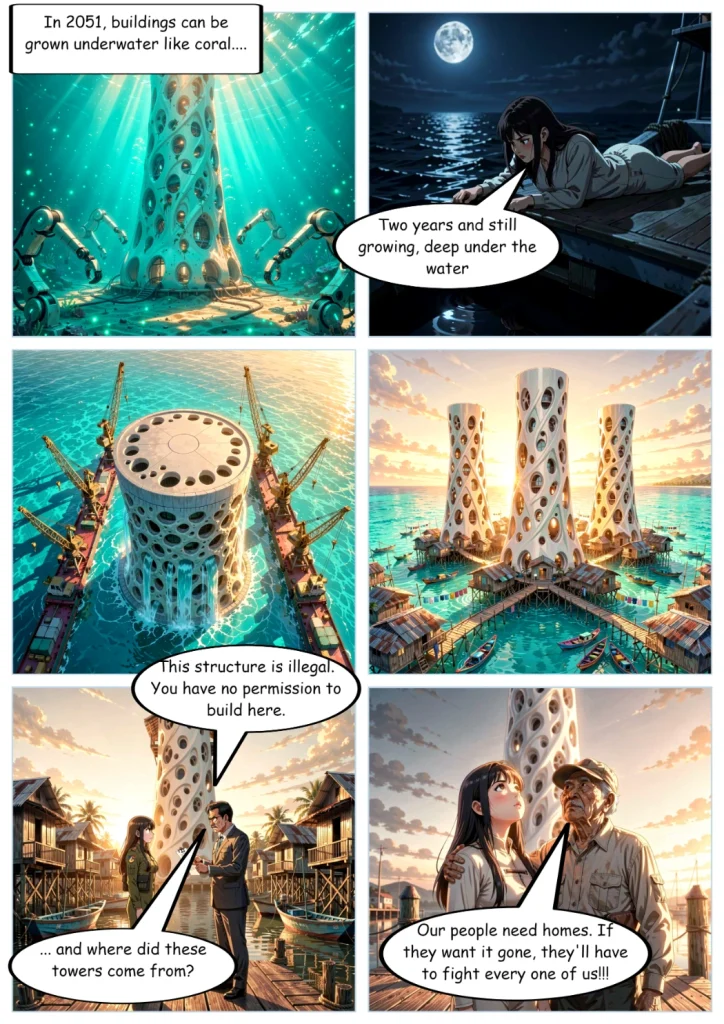
Inspired by a past student project by Christina Christoforou and Renuka Deshpande in 2025, this workshop builds an interface that generates comic book layouts, turning a few text and image inputs into a visual narrative of a project. Archigram pioneered the use of comic layouts in the 1960s to propose radical urban futures such as Plug-In City and Walking City.
OMA used sequential narrative drawing to move a reader through the program and circulation in ways that plans and sections cannot. BIG extended this with “Yes is More” in 2009, using comic-style storyboards to make complex ideas legible, showing not just what a building looks like but also why it exists. This workshop builds on that history.
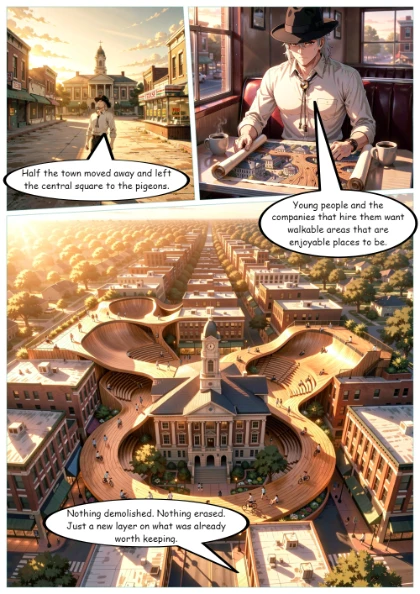
Working in ComfyUI, participants will build and modify node-based pipelines for text-to-image generation and image-to-image transformation that use architectural drawings, reference images, and depth maps as inputs. Its graph-based structure is similar to that of Grasshopper 3D, making the underlying logic of each workflow visible and modifiable, which suits both learning and iterative experimentation. The workshop will move across model types, examining the differences between base models, fine-tuned models, and LoRA adaptations trained on specific architectural styles or practices.
The final deliverable is a working interface that accepts one or more input types and returns meaningful generative output. A pipeline is not complete until someone else can use it and, in using it, reveal what the next iteration might become. As Don Norman observed, the moment you put something in front of users, you discover everything you got wrong.
The brief is open and not limited to comics and stories: any interface that takes architectural inputs and returns generative output is in scope. A material explorer, a facade variation tool, a site atmosphere generator, and a prompt library with live preview. The tool should be legible enough for someone else to use it without explanation.
The workshop progresses through three connected phases: first, participants build foundational skills in ComfyUI by experimenting with structured text-to-image and image-to-image workflows, focusing on how variables like models, samplers, guidance scale, and step count affect outputs. The second phase expands to more advanced workflows using ControlNet and LoRA, in which participants modify and intentionally deconstruct node-based systems to understand how different configurations affect results and their suitability for specific tasks.
In the final phase, participants will design and build their own browser-based interface using HTML, CSS, JavaScript, and Python to make a chosen workflow accessible, resulting in a unique tool accompanied by documentation and a reflection on their design decisions.
Key Learning Topics:
- Understand core principles of diffusion-based generative models and how they produce images
- Navigate and operate ComfyUI for generative workflows
- Build, modify, and extend pipelines for image synthesis and image-to-image translation
- Apply conditioning methods such as ControlNet, depth maps, and style inputs to guide outputs
- Critically evaluate outputs in relation to design intent and project goals
- Package workflows into shareable, interactive interfaces
Program:
The workshop is organized around the construction of a deployed, interactive interface capable of transforming between text prompts and pixel images.
Inspired by a past student project by Christina Christoforou and Renuka Deshpande in 2025, this workshop builds an interface that generates comic book layouts, turning a few text and image inputs into a visual narrative of a project. Archigram pioneered the use of comic layouts in the 1960s to propose radical urban futures such as Plug-In City and Walking City.
OMA used sequential narrative drawing to move a reader through the program and circulation in ways that plans and sections cannot. BIG extended this with “Yes is More” in 2009, using comic-style storyboards to make complex ideas legible, showing not just what a building looks like but also why it exists. This workshop builds on that history.
Working in ComfyUI, participants will build and modify node-based pipelines for text-to-image generation and image-to-image transformation that use architectural drawings, reference images, and depth maps as inputs. Its graph-based structure is similar to that of Grasshopper 3D, making the underlying logic of each workflow visible and modifiable, which suits both learning and iterative experimentation. The workshop will move across model types, examining the differences between base models, fine-tuned models, and LoRA adaptations trained on specific architectural styles or practices.
The final deliverable is a working interface that accepts one or more input types and returns meaningful generative output. A pipeline is not complete until someone else can use it and, in using it, reveal what the next iteration might become. As Don Norman observed, the moment you put something in front of users, you discover everything you got wrong.
The brief is open and not limited to comics and stories: any interface that takes architectural inputs and returns generative output is in scope. A material explorer, a facade variation tool, a site atmosphere generator, and a prompt library with live preview. The tool should be legible enough for someone else to use it without explanation.
The workshop progresses through three connected phases: first, participants build foundational skills in ComfyUI by experimenting with structured text-to-image and image-to-image workflows, focusing on how variables like models, samplers, guidance scale, and step count affect outputs. The second phase expands to more advanced workflows using ControlNet and LoRA, in which participants modify and intentionally deconstruct node-based systems to understand how different configurations affect results and their suitability for specific tasks.
In the final phase, participants will design and build their own browser-based interface using HTML, CSS, JavaScript, and Python to make a chosen workflow accessible, resulting in a unique tool accompanied by documentation and a reflection on their design decisions.
Program:
Day 1: Foundations – Image Generation and Control
- Introduction to diffusion models and their role in generative design
- Set up and first experiments in ComfyUI with text-to-image workflows
- Image-to-image and ControlNet workflows using architectural references
- Exploration of models, LoRAs, and how parameters affect output quality and cost
- Structured comparisons and group review of generated results
Day 2: Extension – Interface Building and Deployment
- Introduction to browser-based generative interfaces and reference examples
- Selection of a Day 1 workflow to develop further
- Building interactive tools using HTML, CSS, JavaScript, Python, and Gradio
- Packaging workflows into shareable, user-facing interfaces
- Final presentations and critique of completed interfaces
Software:
- ComfyUI
- Python
- Gradio
Workshop Notes:
- Software Installation is not a part of the workshop. Participants should have everything installed before the workshop starts.
- An Installation Guide for ComfyUI will be provided.
Instructor:
James McBennett

James is an Irish educator at the Institute for Advanced Architecture of Catalonia (IAAC), where he teaches in the Master’s in Computational Design in Architecture (MaCDA). He has also taught at IAAC’s Global Summer School, Digital Futures, University of Calgary, University of North Texas, University College Dublin, and Oxford Brookes University.
In 2025, he presented a workshop at the annual conference of the International Association for Shell and Spatial Structures (IASS) in Mexico City. His professional background includes operating a CNC workshop, running a successful Kickstarter campaign, and working at KPF, JDS, and OMA. He is currently pursuing a Master’s in Computer Science at Georgia Tech, building on earlier degrees from IAAC and University College Dublin, while also developing PtCrvSrf, an online learning platform for computational design skills.
Important Notes:
- The “Pixel Interfaces: AI Workflows in ComfyUI” workshop by PAACADEMY will start at 14:00 (GMT) on Saturday, August 1st, 2026.
- Total sessions: 2 Sessions (6 Hours).
- The teaching duration per session will be 3 hours.
- Students will have time for a break between teaching hours.
- The workshop will be recorded, and videos will be available for participants just a day after the class for an unlimited time.
- PAACADEMY will provide a certificate of attendance.
- The studio has limited seats. Tickets are non-transferable & non-refundable. Please read carefully before you register.
Topic: Pixel Interfaces: AI Workflows in ComfyUI
Date: August 1 – 2, 2026
Time: 14:00 – 17:00 GMT
Format: Online on Zoom
Duration: 2 Sessions (8 Hours)
Registration Deadline: July 31st, 2026
Total Seats: 50 seats
Difficulty: Beginner – Intermediate
Language: English
Certificate: Yes
Course Fee: Free for Digital Members
Organized By: PAACADEMY
Tutor: James McBennett
Recordings: Recordings will be available for all participants afterward indefinitely.
