


Walk through any skyline shaped by today’s visionaries like Zaha Hadid, Norman Foster, or Bjarke Ingels, and you’ll notice something remarkable. The world’s most breathtaking buildings are not simply drawn; they’re calculated. Behind every flowing roofline, twisted tower, or sculpted facade is a quiet logic of numbers, geometry, and proportion.
What used to exist as abstract equations on paper has become a living design language. Architects today think in parameters, vectors, and algorithms. Their creations react to light, wind, and structure almost like living organisms. Beneath the drama of glass and steel lies a simple truth: mathematics is the hidden framework of modern architecture, shaping how we design, how we build, and even how we imagine the spaces around us.
The Return of the Architect-Mathematician
The connection between architecture and mathematics has deep roots. The Greeks studied symmetry; Palladio built harmony into villas; Gaudí used hanging chains to discover natural curves. What’s changed today is the scale of control. Architects now work with massive datasets and complex models that evolve in real time as each variable changes.
Geometry is no longer a limitation; it has become the starting point of creativity. Instead of fighting against rules, architects use them to unlock endless variations. Whether sketching with a pencil or scripting in Python, they are still searching for that same mathematical beauty that Vitruvius described two millennia ago.
Parametric Design: When Form Follows Formula
Parametric design is built on a simple yet powerful idea: change one number, and the entire design can transform. Every line, curve, and extrusion is connected through relationships, a kind of mathematical DNA. Adjust a single parameter, and the model ripples with new possibilities.
A facade’s perforations might adjust to sunlight. A roof shell could shift its curvature to distribute loads more efficiently. Even the massing of a building can evolve to respect zoning limits or optimize airflow.
This way of thinking turns math into a design partner. Instead of laboring over one version after another, architects define relationships and let the system generate countless iterations. It’s not about replacing intuition with code; it’s about using code to extend what intuition can explore.
Vector Thinking: The Hidden Language of Space
Every digital model starts with vectors, mathematical arrows that describe direction and magnitude. In architecture, they define how forms move, how panels align, and how light travels through space.
When a designer positions facade panels along a twisted surface or simulates air currents inside a hall, they’re working with vectors. These invisible guides decide whether a project feels effortless or chaotic.
Even the smallest computational tasks rely on them, the tilt of a solar panel, the swing of a robotic arm, the path of a bridge cable. For anyone diving into computational design, tools like a vector calculator are a great way to visualize how these magnitudes and directions combine. They’re the same mathematical principles that underpin structure, motion, and even light.
From Geometry to Material Reality
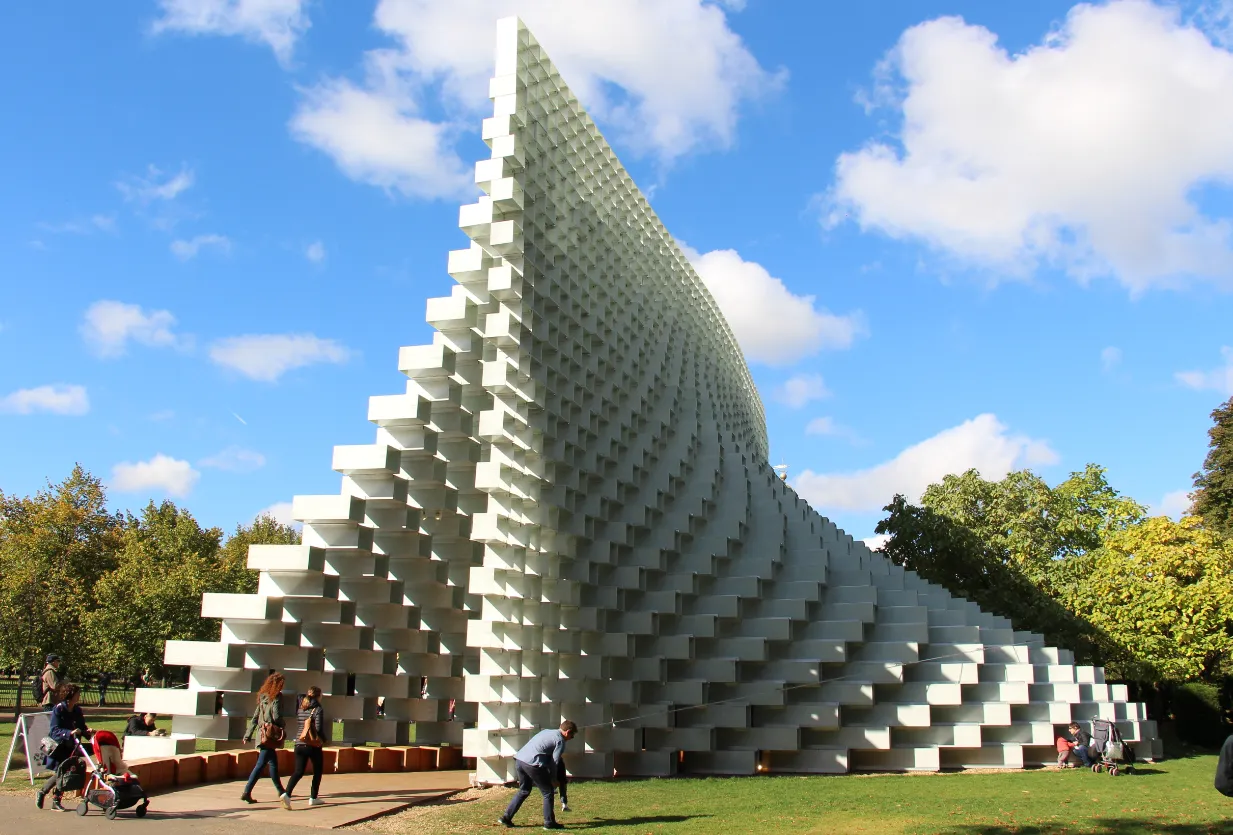
Equations can create beautiful digital forms, but materials bring them to life. That transition from model to reality requires yet another layer of math, one grounded in construction, weight, and tolerance.
Architects calculate surface areas to estimate cladding, optimize tile layouts to reduce waste, and use cubic-yard formulas to determine fill or foundation depth. Even angles and slopes are precisely modeled to ensure prefabricated parts align perfectly on site.
This is where architecture becomes tangible. The challenge is not only to create something visually striking, but also to make it stand, breathe, and age gracefully. Numbers help bridge the gap between digital precision and physical experience.
From Algorithm to Icon
Some of the world’s most recognizable buildings are mathematical expressions in disguise.
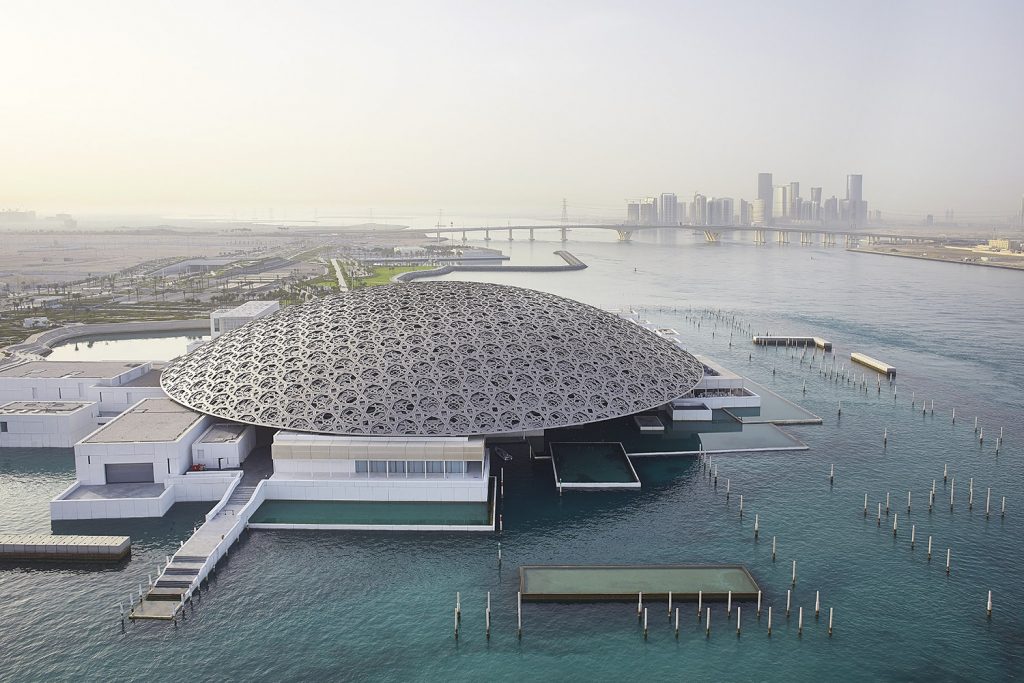
The Heydar Aliyev Center in Baku, designed by Zaha Hadid Architects, uses continuous, curvilinear surfaces and a fluid plaza-to-interior geometry to achieve its seamless flow. The Louvre Abu Dhabi’s dome by Jean Nouvel is a layered lattice derived from a complex parametric algorithm that filters light like a palm canopy. The 180-meter dome is formed by eight layers of ~7,850 star-shaped elements supported on four piers, producing the famed ‘rain of light’ inspired by palm-frond shade. The Vessel in New York, by Heatherwick Studio, a climbable lattice of interlinked stairways, is inspired by Indian stepwells and arranged as stacked hexagonal rings.
Each of these projects began as a dialogue between art and mathematics, not drawing what is seen, but calculating what could exist.
Sustainability Through Numbers
Mathematics also drives one of the most urgent goals in architecture: sustainability. By simulating light, heat, and airflow, designers can minimize energy use long before construction begins.
A parametric facade can adapt to the sun’s movement. Roof slopes can be optimized to collect water or generate energy. Even material choices are modeled to reduce waste.
This shift from intuition to quantifiable performance has changed how architects define “good design.” It is no longer only about aesthetics or structure; it’s about efficiency, resilience, and measurable impact.
When Artificial Intelligence Joins the Equation
Artificial intelligence has introduced a new layer to this mathematical story. Algorithms can now analyze thousands of spatial options and suggest layouts, structures, or material patterns in seconds.
Yet, even AI depends on geometry and logic. Underneath the data are the same equations: vector fields, curves, and transformation matrices. AI might accelerate exploration, but mathematics ensures the results remain buildable and meaningful.
The architect’s role is shifting, from sole creator to guide, shaping how machines interpret design intent without losing the human touch.
Aesthetic Precision and the Future of Design
The beauty of mathematical architecture lies in its precision. It combines logic and imagination in a way that feels both exact and poetic.
Parametricism once seemed cold and mechanical, but it has evolved into a language of rhythm and variation. Each repetition, curve, and offset carries emotion, much like music follows a score.
The next generation of architects will not only draw; they will calculate and iterate. They will design with data, build with algorithms, and think in patterns. Mathematics won’t limit creativity, it will expand it.
Beyond Numbers
Mathematics has always been the invisible architecture behind every great work. The difference today is that we can see it, written in the smooth surfaces of parametric facades and the adaptive structures that respond to their environment.
To understand geometry is to understand architecture itself. And in doing so, we rediscover an old truth made new again: beauty and logic have always been one and the same.
