


The construction of any building on Mars has to be completely different from what builders on Earth are accustomed to. Mars possesses several challenges: a thick atmosphere, extreme distances, and scarce resources. Construction on Earth is also enabled because there are ample building resources and manpower available.

The Martian Challenge of Building
On Mars, only the most basic resources and extreme weather conditions are available. This calls for a shift to innovation in design and resources, where 3D printing — an already disruptive technology for Earth’s construction — has a large scope for enabling off-world construction.
Why 3D Printing?
3D printing, or additive manufacturing, can create the most complex structures by layer-by-layer accumulation of materials available or ready to be locally fabricated. On Mars, where each asset is exploited for its best use, 3D printing has a prospect in using Martian soil and available resources to minimize reliance on earth-sourced supplies. This reduces transportation costs, but it also provides a foundation for a sustainable extraterrestrial colony.
Mars Materials: Regolith and Everything Else
Mars is rich in the solid stuff called regolith-powdery, rocky material that covers the planet’s surface. Research by NASA and other space organizations mentions that regolith would possibly be processed and recycled mainly as a construction material.
As regolith is readily available on Mars, it will be possible to eliminate the necessity for huge transports of building material from Earth. That would be just impractical in many ways, including fiscal calculations.
Scientists could now mix this regolith together with binders that set into the structure of a pretty hard, cementy material well suited for 3D printing robust structures.
NASA’s Goodwill Efforts and Ingenious Solutions
For many decades now, NASA has been putting resources into establishing habitats on Mars. Apparently, the agency pioneered the ‘3D-Printed Habitat Challenge’ which was open to architects, engineers, and even scientists to come up with realistic habitat designs on Mars, leading to very interesting and radical ideas.
The winning works presented some advanced 3D construction technologies, such as ISRU, that exploit local resources—in this case, Martian soil— to fabricate necessary construction elements. In the course of the challenge’s ideas, ways of creating habitats by using inflatable modules laden with 3D printed materials that serve as an insulator against harsh temperatures and deep-space radiation.

Robots and Autonomous Construction on Mars
3D printing on the surface of Mars isn’t limited to the advancement of the building materials, and there is also the aspect of robotic autonomy. Only due to the numerous limitations, in terms of the environment and logistics, paused with human construction on Mars, it is foreseen that most of the construction works would be done by robots.
Autonomous 3D-printing drones could be used to erect the shell of the building before the human inhabitants even enter the area, ready and waiting for them. So that these robots would be working non-stop, erecting module dwelling units, laboratories, and even farming houses.
The Role of AI and Machine Learning
Alongside robotics, AI and Machine Learning have an extraordinarily potent role to play in building on Mars. AI technology, through simulation, has been able to enhance the design of structures within their allowable safety, seismic, and thermal ranges, streamlining other designs to withstand Martian gravity.
AI has taken all research data from Mars rovers and landers and, with this information, could continuously modify construction methods, presenting a streamlined safety and resilience-upgradable platform for any future structures.
Challenges of 3D Printing on Mars
The setting of 3D sanitary construction on Mars remains full of obstacles. Their atmosphere is less than 1% as dense as that of terrestrial ones and filled with highly charged solar and cosmic rays.
The Martian surface remains bare from a magnetic field, whereby these rays embroil exposure of all forms of danger to human life and materials.
Hence, protective designs of double-layered walls or housing structures beneath the ground will be required. The temperatures fluctuate between -60 degrees Celsius and approx. 20 degrees Celsius will demand ready material capable of not cracking while stretching and one that can endure extreme heating and cooling.
The Sustainable and Scalable Approach to Building
One of the great advantages of 3D printing on Mars is scalability. Once the initial habitats are built, inhabitants can start 3D printing additional structures as the population grows on Mars. Where existence along these lines of advancement could lead to the 3D printing of small, fully functional cities one-day comprising labs, living modules, farms, and recreational areas. Such scalability fits perfectly into long-range exploration goals across the field of space exploration: Mars becoming a centrally fit model for sustainability in scientific and commercial applications.
Case Studies: Early Successes and Prototypes
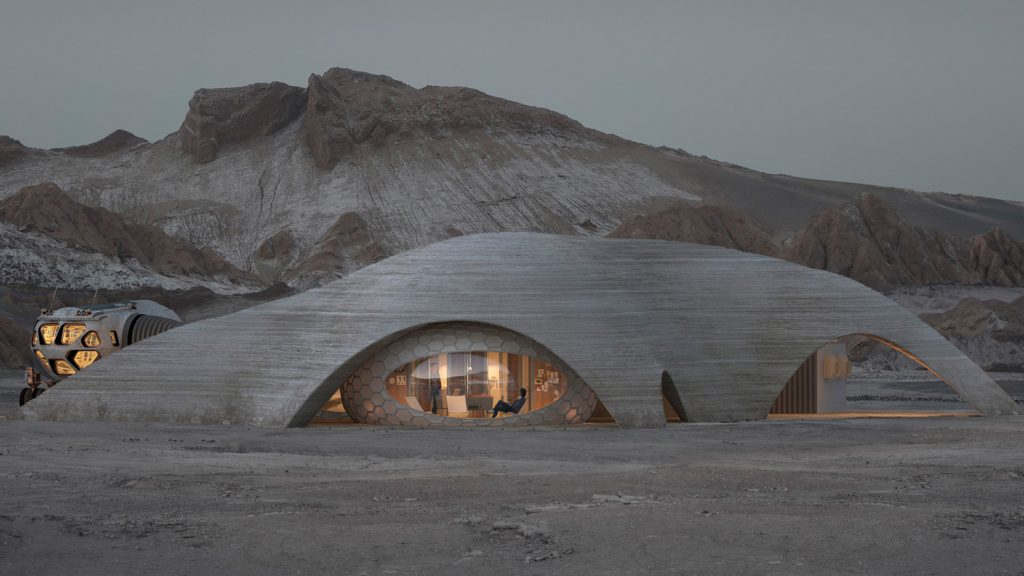
Several companies have come up with designs of Martian habitats that are on Earth. ICON, a construction technology company, together with NASA, has successfully 3D-printed Mars Dune Alpha, a prototype having the same features as the Martian environments.
This Earth version is a model of living on the red planet, and it helps to find out how humans might live there the best ways of renewable resources, and the psychological well-being of the people. Research that is carried out in such settings is essential for the development of 3D printing technologies, and it is crucial to make sure that it fits the needs of the real world.
The Broader Vision: Terraforming and Future Cities
3D printing is not the only thing needed for building spaces, but its potential and promise make the challenges of interplanetary housing look like a much less formidable task.
While future technologies like those that will allow the terraforming of Mars, turning it into an Earth-like place, may eventually help that attention be drawn to our once nearby red planet now capable of supporting life, terraforming is still just a hypothesis and remains a subject of debate.
However, the 3D printing habitats, which anthropocentrism humans’ dreams of occupying Mars, win us time and help us develop the technology necessary, eventually migrate to it properly.
3D Printing as the Cornerstone of Martian Colonization
We are now closer to living on Mars than ever, and 3D technology is at the center of this development. The likelihood that it will be the primary means of construction for the safety, sustainability, and scalability of habitats on Mars as technology continues to grow is high.
Through the combination of Martian natural materials, robotics, and automated systems, a whole new era is about to begin not only on Mars but in the universe. Now Mars is no longer an unreachable, cold world out there, it is precisely where we will find home when technology has progressed further.
