


Asia is home to some of the world’s most impressive and expansive airports. These architectural marvels not only facilitate the travel needs of millions of passengers annually but also stand as testaments to modern engineering, sustainable design innovations, and constant attention to the art and culture of their surroundings.
Let’s delve into the ten largest airports in Asia by size, exploring their architects, construction timelines, and capacities.
1. King Fahd International Airport (DMM)

Architect: Yamasaki & Associates, Boeing Aerosystems International
Location: Dammam, Saudi Arabia
Year of Completion: 1999
King Fahd International Airport (DMM), also referred to as Dammam International Airport or more simply Dammam Airport or King Fahd Airport – is the international airport that serves the city of Damma, the capital of the Eastern Province of Saudi Arabia. DMM is one of the three primary airports in the kingdom of Saudi Arabia.
King Fahd International is the largest airport in the world by area. The area of the airport is approximately 776 square kilometers (300 square miles). The airport building itself is 36.75 km2 (14.2 square miles).
DMM airport was designed by Yamasaki & Associates, (also known as Minoru Yamasaki Associates, Inc.) alongside Boeing Aerosystems International. The construction of the airport began in the early 1980s and officially opened for operations on November 28, 1999. Since opening, DMM has consistently upgraded their terminals to remain modern and comfortable for their passengers, expanded their facilities to increase cargo capacity and in more recent years has implemented various smart technologies such as biometric identification and automated check-ins.
The airport has approximately 12 million passengers annually, operating with 37 different airlines both domestically and internationally. The airport handles approximately 80,000-90,000 aircraft movements annually.
2. Beijing Daxing International Airport (PKX)
Architect: Zaha Hadid Architects, ADP Ingénierie
Location: Beijing, China
Year of Completion: 2019
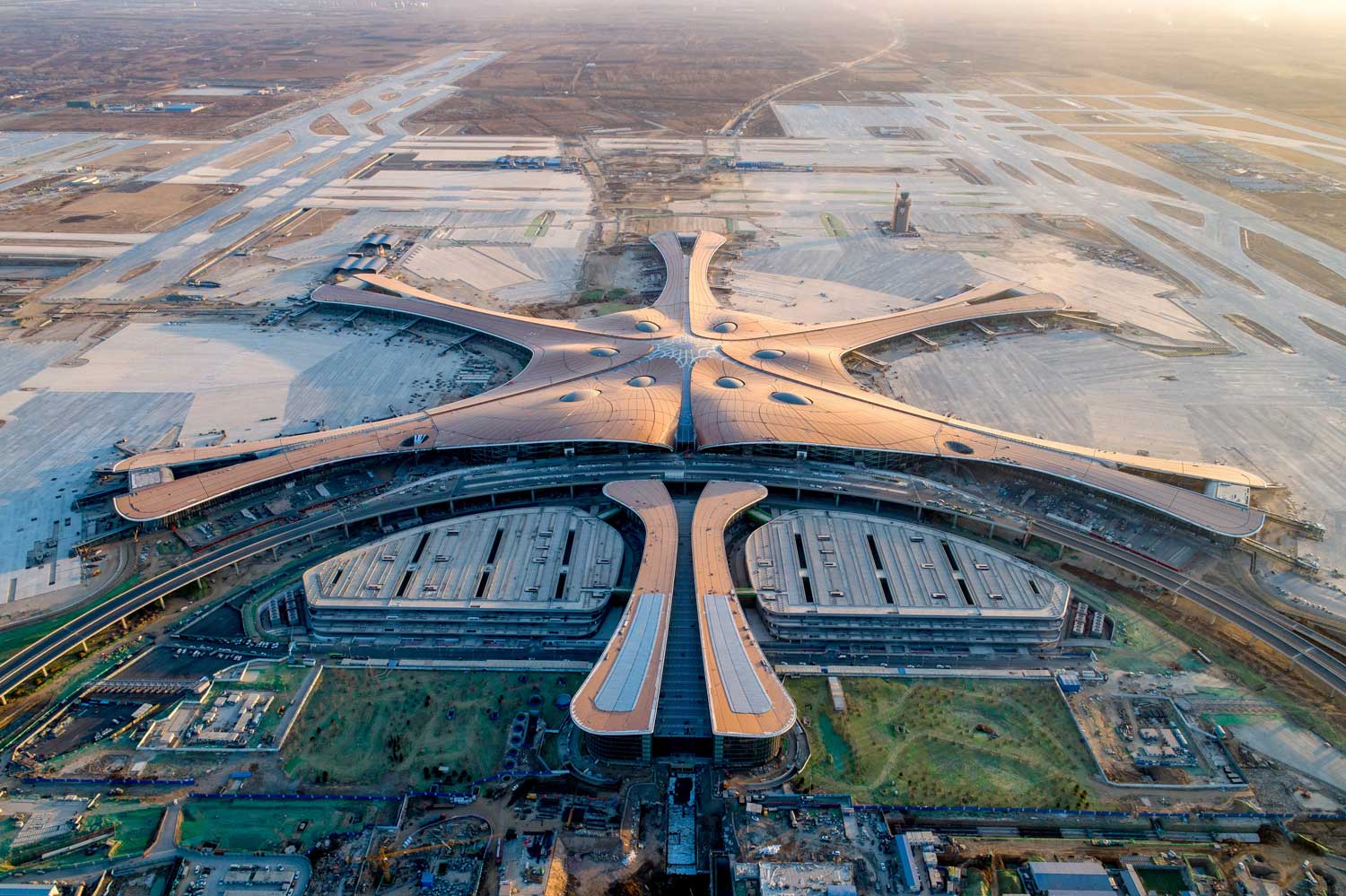
Beijing Daxing International Airport (PXK) is an architectural masterpiece and one of the largest airports in Asia designed by the renowned Iraqi-British architect, Zaha Hadid, in conjunction with the French architecture firm ADP Ingénierie.
Construction of the PXK began in December 2014 and officially opened for operations on September 25, 2019. The airport is well known for its futuristic design. The concourses have five extended arms, resembling starfish. The roof design features large skylights, which create a visually pleasing and warm environment for passengers and crew. The central atrium allows an optimal, quick experience for passengers.
The airport covers approximately 700,000 square meters (7.5 million square feet) and their annual passenger handling capacity is currently 75 million. There are approximately 200,000 passengers who pass through the airport daily. The airport has plans to further expand their annual capacity to 100 million.
Last year in 2023, Beijing Daxing International Airport (PXK) handled 211,238 aircraft movements. The airport’s expansion plan hopes to increase the annual aircraft movements to 620,000.
Beijing Daxing International Airport (PKX) in China is considered the biggest airport by terminal space in the world.
3. Suvarnabhumi Airport (BKK)

Architect: Murphy/Jahn Architects
Location: Bangkok, Thailand
Year of Completion: 2006
Suvarnabhumi Airport (BKK) in Bangkok, Thailand, is situated in the Bang Phli district of Samut Prakan province, approximately 16 miles east of downtown Bangkok. It serves as the primary international gateway for the city.
Designed by Murphy/Jahn Architects, the airport features a striking steel-and-glass structure. It officially opened in September 2006 and underwent significant renovations in 2020 to expand its capacity.
Currently, Suvarnabhumi Airport handles over 60 million passengers annually and accommodates more than 300,000 aircraft movements. Future developments will include a new runway and a satellite terminal to further enhance its operational capabilities.
4. Hong Kong International Airport (HKG)

Architect: Foster + Partners
Location: Hong Kong SAR, China
Year of Completion: 1998
Hong Kong International Airport (HKG) is located on reclaimed land on Chek Lap Kok island and was designed by Foster + Partners. Since its inauguration in July 1998, the airport has undergone numerous expansions to maintain its status as one of the busiest airports globally.
The airport currently handles over 74 million passengers annually and manages more than 420,000 aircraft movements each year.
The airport, built on what was once a mountainous island, underwent an ambitious land reclamation project that reduced its 100-meter peak to 7 meters and expanded the island to four times its original size, comparable to Kowloon Peninsula. The terminal’s design, inspired by Stansted Airport in London, features a lightweight roof canopy, abundant natural lighting, and the integration of technical services beneath the main concourse. The spacious, daylight-filled terminal offers clear orientation with views of land, water, and aircraft. Departing passengers pass through the East Hall, the world’s largest airport retail space, likened to a market square in a microcosm of a city.
5 . Shanghai Pudong International Airport (PVG)

Architect: Paul Andreu, East China Architectural Design & Research Institute
Location: Shanghai, China
Year of Completion: 1999 (with expansions in 2019)
Shanghai Pudong International Airport (PVG) was designed by French architect Paul Andreu and opened to the public in October 1999. The airport has seen multiple expansions, with the latest renovation completed in 2019 significantly boosting its capacity.
Today, Shanghai Pudong International Airport accommodates over 76 million passengers annually and handles more than 500,000 aircraft movements.
Shanghai Pudong Airport features two main passenger terminals and two satellite terminals, designed with distinct architectural elements. Terminal 1, designed by Paul Andreu in 1999, resembles a seagull with a central hall connected by glass footbridges to a long embarkation gallery, featuring elevated roadways that arch over the water. Terminal 2, designed by the East China Architectural Design & Research Institute, showcases a curved ceiling and wavy roof inspired by a flock of seagulls, symbolizing Shanghai’s growth.
Completed in 2019, the H-shaped satellite terminals (S1 and S2), connected to the main terminals via an underground subway, were inspired by magnolia flowers, with petal-like roof modules supported by V-shaped steel columns that shade the interior while allowing natural light to flood in. The modular roof design facilitates rapid construction and cost-efficiency, while the use of APM stations centralizes arrivals and departures, enhancing passenger flow with minimal walking distances.
6 . Indira Gandhi International Airport (DEL)

Architect: HOK, Mott MacDonald
Location: New Delhi, India
Year of Completion: 1986 (with renovations in 2010)
Indira Gandhi International Airport (DEL) in New Delhi is one of India’s busiest airports. Designed by HOK and Mott MacDonald, it initially opened to the public in 1986 and has undergone several renovations since then, with the most recent completed in 2010.
The airport currently serves over 70 million passengers annually and manages more than 450,000 aircraft movements each year.
Indira Gandhi International Airport is designed with a long central core flanked by piers on either side, allowing flexibility for domestic and international flights to use the piers at different peak hours.
The building features a full-height “canyon” that brings daylight into the center, naturally illuminating the departure lounge. The façade provides shading to reduce solar heat gain, minimizing the cooling load. Cooling is managed by small, localized air handling units, with variable speed fans that adjust to demand, saving energy.
The airport also integrates sustainability features like 300 rainwater harvesting stations, storm drains to control erosion, and electric vehicles for ground operations. The landscape deck offers seating with large planters, and water features, including a cascade at the arrival lounge which enhances the terminal’s aesthetic appeal.
7 . Kuala Lumpur International Airport (KUL)

Architect: Kisho Kurokawa
Location: Sepang, Malaysia
Year of Completion: 1998
Kuala Lumpur International Airport (KUL) was designed by Japanese architect Kisho Kurokawa and opened to the public in June 1998. The airport has undergone multiple expansions and renovations, with the most recent completed in 2018.
Today, Kuala Lumpur International Airport handles over 59 million passengers annually and accommodates more than 350,000 aircraft movements.
The airport’s architectural design is a harmonious blend of modern innovation and traditional influences. The main terminal features a striking roof made up of hyperbolic paraboloid shells, evoking elements of traditional Malay architecture, with skylights that seem to float above supported by trusses and a delicate ceiling membrane. Complementing this, tree-shaped canopy roof forms with skylights provide soft, filtered daylight.
Glazing on all sides of the terminal offers panoramic views of the surrounding landscape, which includes a transplanted section of rainforest within the satellite building. The use of natural wood ceilings, supported by trunk-like columns, enhances the organic aesthetic, while the inclusion of prayer rooms reflects a thoughtful integration of Islamic geometry. These elements create a space that fuses cutting-edge technology with the beauty and richness of the tropical rainforest.
8 . Guangzhou Baiyun International Airport (CAN)

Architect: Parsons Corporation, China Airport Construction Group (CAPDI)
Location: Guangzhou, China
Year of Completion: 2004 (renovation in 2020)
As one of the largest Airports in Asia and China, Guangzhou Baiyun International Airport (CAN) was rebuilt at a new location with design input from Parsons Corporation and CAPDI before being inaugurated in August 2004. The airport has continued to grow with its latest renovation completed in 2020.
Currently, Guangzhou Baiyun International Airport serves over 73 million passengers annually and manages more than 480,000 aircraft movements each year.
The airport’s architectural design integrates several sustainable and innovative features. The roof glazing is designed to allow ample daylight without causing overheating in summer or heat loss in winter. Funnels, referred to as the “lungs” of the building, draw fresh air from high-quality sources, channel it through gardens, and into technical plant rooms, while also allowing daylight to penetrate deeper into the floors and collect rainwater. Integrated photovoltaic panels on the roof generate power, while green areas with local vegetation improve air quality, reduce noise, and enhance the microclimate.
9 . Seoul Incheon International Airport (ICN)

Architect: Fentress Bradburn Architects, Heerim Architects & Planners Co.
Location: Incheon, South Korea
Year of Completion: 2001 (renovation in 2020)
Seoul Incheon International Airport (ICN) is one of Northeast Asia’s major aviation hubs. Designed by Fentress Bradburn Architects and Heerim Architects & Planners Co., Ltd., it opened to the public back in March 2001. The airport has undergone several expansions with the most recent renovation completed last year (2020).
The airport currently accommodates over 71 million passengers annually and handles more than 400,000 aircraft movements each year.
The architecture of Terminal 1 and Terminal 2 designed by Fentress Architects, seamlessly integrates modernity with traditional Korean aesthetics. Terminal 1 features an arc-shaped design inspired by the forms of airplanes and waves, while its roof is a contemporary interpretation of a Korean temple. Terminal 2 echoes this cultural heritage with its curved, aerodynamic form, reminiscent of traditional Korean rooflines.
Skylights throughout the terminal project artistic patterns of light, enhancing the traveler experience. The central Great Hall serves as the hub for transportation and amenities, while the airport’s materials palette—comprising indigenous woods and granite—grounds the design in the local landscape. Gardens modeled after Korean courtyard plantings offer peaceful respites for visitors.
A distinctive ribbon roof, with its rippling spans, twists open and closed to allow natural daylight, while funnels descending from the roof reflect sunlight into areas otherwise in shadow. This architectural approach celebrates both innovation and cultural heritage, creating a visually appealing and functional space for passengers.
10. Tokyo Narita International Airport (NRT)

Architect: Nikken Sekkei Ltd, Obayashi Corporation
Location: Narita, Japan
Year of Completion: 1978 (expansions between 2006 and 2015)
The Tokyo Narita International Airport is located east of Tokyo, one of the important international airports for entering Japan. The design of this airport is undertaken by Nikken Sekkei Ltd and Obayashi Corporation.
The first incarnation of NRT was finalized in 1978. Between 2006 and 2015, expansion and refurbishment projects were undertaken to increase its capacity.
As of today, Tokyo Narita International Airport is handling 44 million annual passengers and sustaining more than 250,000 aircraft operations annually.
The airport’s architecture seamlessly integrates lighting and design to enhance both functionality and ambiance. In the Arrival Concourse, LED lights embedded in partition walls guide passengers by illuminating the floor without causing glare or reflections, ensuring a smooth and comfortable transition. The Departure Concourse features dynamic lighting with LED lights set in the middle of the walls to highlight intricate reliefs on the sidewalls, creating a uniformly bright and visually engaging space. A unique year-round control system in the Connecting Corridor adjusts lighting to mirror seasonal changes, blending skylights and ceiling lighting for a harmonious experience.
The Art Promenade is lined with various works of art, thoughtfully placed in areas where visitors naturally pass through, adding a cultural dimension to the environment.
The immense scale of the Asian continent is mirrored in its sprawling aviation hubs, which function as essential transportation centers and exhibit stunning architectural designs by globally acclaimed firms. From the sheer size of King Fahd International Airport to the futuristic allure of Beijing Daxing International Airport, each facility narrates a tale of innovation, practicality, cultural history, and aesthetic style. These airports not only accommodate millions of passengers and manage hundreds of thousands of flights each year but also significantly influence the realms of aviation and infrastructure.
